Decades after being swallowed by the waters of a Thai reservoir, a key depot on World War II’s notorious “Death Railway” has reemerged, giving historians and descendants of those forced to build the line a once-in-a-generation chance to document and understand this brutal chapter of wartime history.
The 415-kilometer Thailand-Burma Railway, better known by its grim nickname the Death Railway, was constructed between 1942 and 1943 as a supply route for occupying Japanese forces across mainland Southeast Asia. Built at the cost of staggering human life, the project forced approximately 60,000 Allied prisoners of war—mostly captured from Australia, the United Kingdom, the United States, and the former Dutch East Indies—to work alongside more than 200,000 Asian laborers, who the Japanese called römusha. Official records confirm more than 12,500 POWs and 75,000 laborers died from starvation, disease, abuse, and dangerous working conditions during construction, cementing the railway’s place in global wartime memory. The site has been featured in popular culture ranging from the 1957 classic film *The Bridge on the River Kwai* to the 2025 miniseries adaptation of the award-winning novel *The Narrow Road to the Deep North*.
The newly exposed site, Nithe Station, was once a major hub along the railway, and has remained completely submerged under the reservoir backed by Vajiralongkorn Dam for decades. The unexpected reappearance came after Thailand’s Electricity Generating Authority drained the reservoir for scheduled maintenance work. With the dam’s maintenance set to wrap up in August and the Southeast Asian monsoon season approaching fast, the reservoir will quickly refill, leaving researchers with a narrow window of time to survey the site before it disappears under water once again.
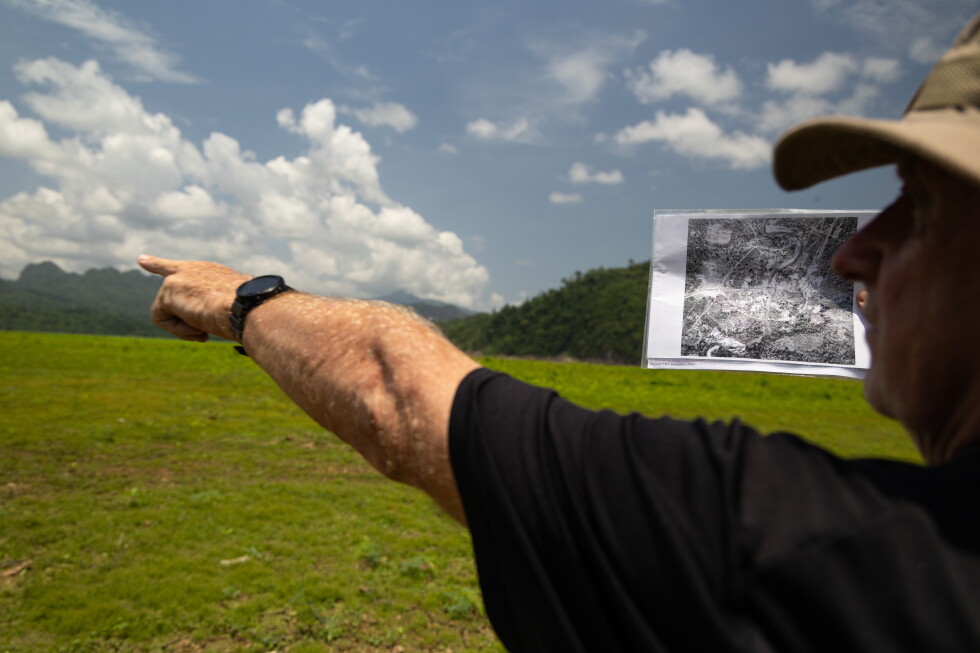
For many researchers working at the site, the project is deeply personal. Martyn Fryer, an independent Australian researcher from Perth, traveled thousands of kilometers to examine the exposed station after his grandfather, a POW captured in Singapore in 1942, died while working on the railway. Traversing muddy bogs in 38-degree Celsius heat, Fryer called the trip a chance to connect to the experience of the men who built the line. “I’ve been to Nithe Station three times in the past, but the water level has always been too high to actually really appreciate the fantastic offerings that it has with the remaining infrastructure and the layout of the railway itself,” Fryer explained. While scanning historic embankments with a metal detector, he has already recovered small but meaningful artifacts including iron railway spikes and bridge staples. Working alongside Andrew Snow, a researcher from the Thailand-Burma Railway Centre whose own father was captured in Singapore and forced to work on the railway, the pair cross-reference 1940s wartime aerial photographs from the UK National Archives with hand-drawn historical maps to pinpoint the location of former POW camps surrounding the station.
Snow noted that this year’s drawdown is uniquely suited for research: while dry seasons occasionally expose small portions of the station, the unusually low water levels and rapid draining left little time for vegetation to regrow, leaving the full layout of the depot exposed for the first time in generations. “It is a good opportunity for us to do some surveying,” he said. “When you’re dealing with relatives of people that worked on the railway, it’s always nice to be able to show them the areas that maybe their relative worked on.”
The unexpected reappearance has also drawn hundreds of domestic tourists to the remote western Kanchanaburi province site. Local resident Kitti Laokham’s social media posts of the exposed station have accumulated more than 32 million views, and visitors like Channarong Noimala have traveled hundreds of kilometers to see the rare sight. “At least for those who died here, no matter whether they are laborers or prisoners of war, we can remember them,” Noimala said.
The rediscovery of Nithe Station comes as public interest in preserving the Death Railway’s legacy continues to grow. Around 100 kilometers southwest of the newly exposed site sits Hellfire Pass, one of the most brutal and well-documented sections of the railway, where hundreds of POWs died carving a path through solid rock. The Hellfire Pass Interpretive Centre, funded by the Australian government, welcomed a record 169,000 visitors in 2025—the 80th anniversary of the end of World War II. Mick Clarke, an Australian Army veteran who manages the center, explained that as time passes, these physical sites grow only more important. “They keep personal stories alive and help future generations understand the cost of war,” he said. For Australia alone, the statistics underscore the deep national connection to the site: around 13,000 Australian POWs were forced to work on the railway, and 2,800 died during construction. “For many Australians, Hellfire Pass is deeply personal,” Clarke said. “It connects families and the nation to a difficult but important chapter of wartime history.”