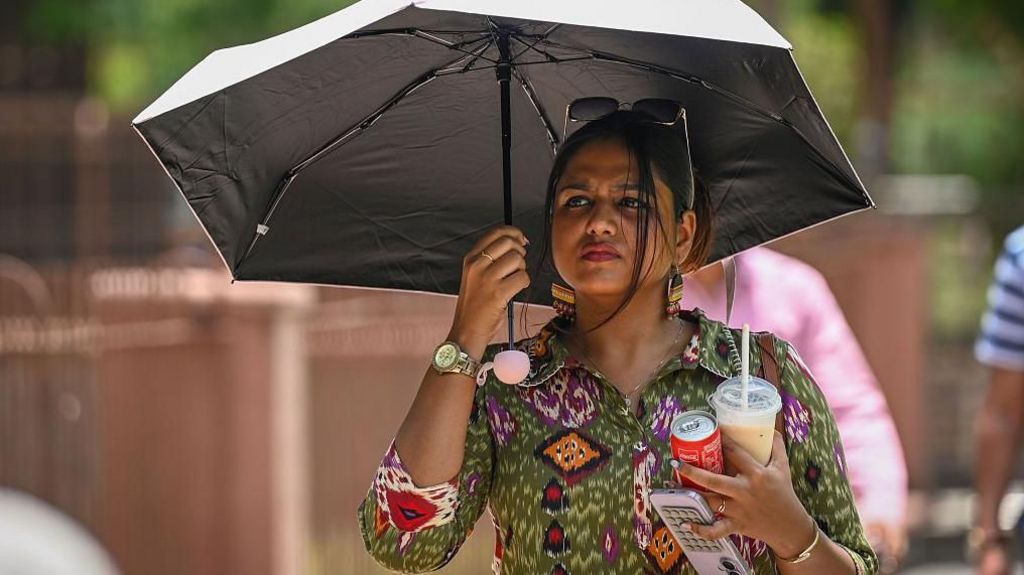
For weeks, New Delhi, India’s bustling capital, has been trapped in the grip of an unrelenting severe heatwave, with official daily air temperatures regularly climbing past the 40-degree Celsius mark. Weather forecasts routinely note that “real feel” temperatures run even higher, but a new on-the-ground investigation by Greenpeace India has laid bare just how stark the gap between official readings and the dangerous heat experienced by street-side workers and low-income residents actually is.
On the Tuesday the survey was conducted, the Indian Meteorological Department (IMD) logged an official maximum air temperature of 43.5C across the capital. But when Greenpeace researchers deployed a high-resolution thermal camera to measure surface temperatures across crowded streetscapes, the readings told a far more alarming story: in sun-exposed spots, surface temperatures hit as high as 64C, more than 20 degrees above the official air measurement.
It is important to note the difference between the two metrics: IMD’s official data measures ambient air temperature under standardized shaded conditions, while thermal imaging captures the temperature of solid exposed surfaces. On intense heat days, asphalt roads, concrete infrastructure, idling vehicles, and open ground absorb solar radiation far more intensely than the surrounding air, pushing their temperatures far higher than official air readings. These extreme surface temperatures amplify heat absorption by the human body through radiant heat, making urban areas feel vastly hotter than official forecasts suggest—especially in areas with almost no tree cover or shade.
The Greenpeace team’s first measurement stop came at midday at the IIT flyover, one of south Delhi’s busiest traffic intersections, where hundreds of thousands of vehicles pass daily and peak-hour waits can stretch to 10 minutes. When researcher Nibedita Saha pointed the camera at shaded areas under the flyover, the reading hit 42C. But when she shifted focus to idling motorcyclists waiting under direct sun at the stop line, the reading spiked to 64C. The open pavement where the team stood registered 61C—yet just 10 feet away under the cover of a single tree, the temperature dropped sharply to 39.8C.
“Consistent exposure to such extreme heat can trigger serious, life-threatening health complications,” Saha explained, noting the transformative impact of even one tree. “We felt immediate relief just moving that short distance. That’s how much difference a single tree can make.”
Medical experts warn that the gap between official temperatures and actual on-the-ground heat creates severe public health risks. Dr. A Fathahudeen, a leading pulmonologist, explains that the human body maintains a core temperature of 37C, and prolonged exposure to high surrounding heat can push this core temperature higher. “When core temperature exceeds 40C, the body stops functioning normally,” he said. “The most common issue is heat exhaustion, marked by extreme sweating, headaches, and fatigue. In more severe cases, people experience confusion, disorientation, and even seizures. Without urgent medical intervention, patients can develop multi-organ failure and die.”
To reduce risk during heatwaves, Dr. Fathahudeen advises the public to drink water regularly even when not thirsty, wear loose light-colored clothing, and use sun protection like umbrellas. He also called on the Indian government to enforce mandatory restrictions banning outdoor labor between 10:30 a.m. and 3 p.m., when heat is at its peak.
But for Delhi’s millions of low-income workers who rely on daily street-side work to survive, following this guidance is not a viable option. When the Greenpeace team traveled to Old Delhi’s iconic Red Fort to speak with street vendors, they found hundreds of people still working through the brutal heat, driven by the need to earn enough to feed their families.
“What choice do poor people like me have?” asked Sanjana Ben, a dry fruit vendor who sells her goods from the pavement. She sat on a thin cloth cushion on the scorching ground, with stacks of dry fruit laid out in front of her. The thermal camera recorded a temperature of nearly 40C on her face, but the ground just inches from her body hit 51.4C, and nearby open pavement registered 57C.
“Sometimes my head starts spinning and my vision blurs,” Sanjana Ben told the reporting team. “When the ground feels too hot, I stand up for a minute, but I can’t stand all day, so I have to sit back down.”
Nearby footwear vendor Mohammad Mahfouz Alam described the unrelenting nature of the heat, which seeps up from the ground and beats down from the sun with no escape. “There’s no relief day or night,” he said. “I feel sluggish all day, my legs ache, and I get home completely exhausted. Even after I bathe, I can’t sleep—the fan just blows hot air, and I toss and turn all night.”
Alam added that Delhi’s weather has grown far more erratic over the years, a shift that hits street-dependent workers the hardest. “Seasons aren’t predictable anymore—summer, winter, monsoon all come and go when they shouldn’t, and it hits us worst of all,” he said. Gesturing to the tree behind his stall, he added, “If this tree wasn’t here, I couldn’t work here at all. The day it’s cut down, that’s the end of me working this spot.” When the thermal camera scanned Alam’s surroundings, it registered 58.65C on nearby open pavement, and 44.8C on his shoulder.
A short walk from the Red Fort stalls lies Chandni Chowk, Delhi’s historic bustling shopping district, where a main pedestrian promenade was built years ago with stone seating areas for visitors to rest. But with no shade covering the open promenade, the seats go unused: the thermal camera registered 56.9C on the concrete pillar where a young toy vendor was sitting.
By the time the team traveled to Sundar Nagri, a lower-middle-class neighborhood in east Delhi’s Seelampur area, it was past 5 p.m. and the sun had begun to weaken. Even so, sun-exposed concrete surfaces were still scorching: a public bench at the neighborhood entrance registered 51.6C.
In this crowded neighborhood, small concrete homes are packed tightly along narrow lanes barely wide enough for one person to pass. For two weeks, 19-year-old Abhishek has kept a “Garmi Khata”, or heat register, for a Greenpeace research project, documenting how the extreme heat has disrupted his family’s health, sleep, income, and daily routines. When the team visited, the thermal camera registered 42C just outside Abhishek’s home. Walking up a narrow flight of stairs to the family’s two-room home, the team found almost no reprieve indoors: temperatures of dishes and kitchen surfaces on the wall hovered around 40C, barely lower than the outdoor reading.
The home has no window or ventilation to let trapped hot air escape, and only a small ceiling fan that circulates the same stale hot air through the rooms. “When it’s this hot, I feel nauseous all the time,” said Abhishek’s sister Kajal. “You can’t stand being outside, but you can’t stand being inside either.”
Abhishek read a recent entry from his register, which detailed how the heat has upended the family’s daily life: “This week’s heat has changed all our routines. Everyone gets home late, and no one can sleep properly,” he wrote. “In the mornings, we turn off the fan to cook, and the heat becomes unbearable. My sister can barely get her chores done, and my mother is more tired than I’ve ever seen her.”
For Abhishek, the worst part of the heatwave is the sweltering nights. “I cut my hair short, I get up multiple times a night to wash my face, I even sleep without a shirt, and I still can’t sleep,” he said. “Outside, at least there’s a little breeze. Inside, it feels like standing right next to a burning oven.”