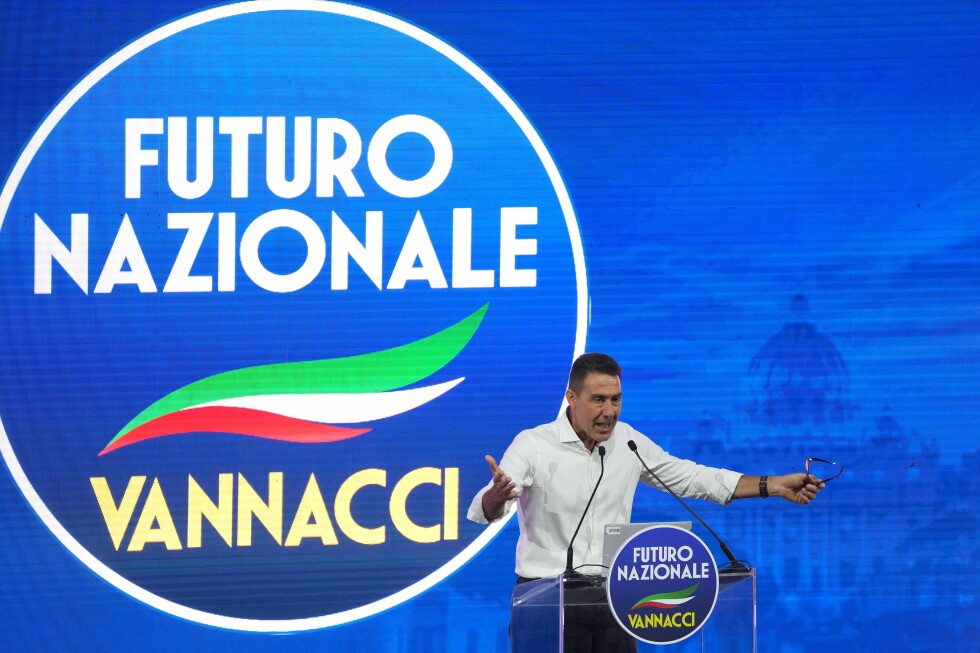
Near the Vatican, in a crowded Rome auditorium, former Italian army commander Roberto Vannacci—dubbed “Il Generale” by his loyal base—stood before supporters of his newly launched political project to declare his challenge to the existing right-wing order and Italian Prime Minister Giorgia Meloni. What began as a fringe political ambition has quickly grown into a major disruption for Meloni’s ruling conservative coalition, injecting unanticipated volatility into Italian politics years ahead of the 2027 national general election.
Political analysts across the country now agree that Vannacci’s influence on the upcoming electoral cycle is no longer a question of if, but how much. He has carved out a solid niche to the far right of Meloni’s Brothers of Italy party, forcing the prime minister to confront an uncomfortable dilemma: can she contain, co-opt, or outmaneuver the rising challenger before his movement irreparably splits the conservative vote?
Vannacci’s rapid ascent is not an isolated Italian political anomaly; it aligns with a broader continental trend of far-right, nationalist movements gaining traction across Europe, reshaping the entire continent’s political landscape by centering polarizing issues of migration, national security, and cultural identity.
At his party’s founding assembly over the weekend, Vannacci positioned his Futuro Nazionale (National Future) movement as the “authentic right” of Italy. “With us, Italy will once again be the home of Italians,” he told the gathered crowd. “Everyone must feel safe in their own home.” He proudly refers to his core group of lawmakers as the “dirty dozen,” leaning hard into his self-styled image as an anti-establishment outsider rejecting the compromised norms of mainstream Italian politics.
The 57-year-old first entered the public consciousness as a political figure in 2023, when he self-published his controversial book *The World Upside Down*, which drew widespread backlash for its vicious attacks on LGBTQ+ people, migrants, and other marginalized groups. A year later, he launched his political career as a member of Matteo Salvini’s anti-migration League party, winning more than 530,000 individual preference votes in the 2024 European Parliament elections. He split from the League this past February to launch Futuro Nazionale, a move Salvini publicly labeled a “betrayal.”
Since his break from the League, Vannacci has rapidly consolidated support. Futuro Nazionale claims to have already topped 100,000 registered members, and currently holds eight seats in Italy’s lower parliamentary chamber—several of which were filled by defectors from the League and the coalition’s centrist partner Forza Italia, a clear sign of simmering discontent within Meloni’s ruling bloc.
Vannacci rejects the traditional “far-right” label, insisting his movement represents the only true conservative voice in Italy. He has openly criticized Meloni for failing to deliver on the shared right-wing policy priorities she campaigned on, and has so far ruled out any formal electoral alliance with the prime minister’s bloc. His policy platform centers on hard-line nationalist positions: aggressive security and migration restrictions, including explicit calls for the “remigration” of foreign-born residents he deems not integrated; staunch opposition to EU policy initiatives like the European Green Deal; and public criticism of Western economic sanctions on Russia over its full-scale invasion of Ukraine.
Political analysts frame Vannacci’s rise as a reflection of a broader shifting political and cultural mood within Italy. “He is leading a sort of political raid for hard-right voters within the main parties of the current ruling coalition,” explained Massimiliano Panarari, a politics professor at the University of Modena and Reggio Emilia. “Meloni’s core political strategy was to leave no viable space to her right. Now that space is occupied.”
Panarari describes Vannacci as “an entrepreneur of fear,” whose rhetoric amplifies polarizing, divisive positions—including open anti-LGBTQ+ and anti-feminist views—that Meloni can no longer publicly embrace now that she is serving as prime minister and leading a national government.
Lorenzo Pregliasco, a political analyst and leading polling expert at Italian analytics firm YouTrend, notes that Vannacci’s movement introduces a dynamic never seen before in current Italian politics: an organized opposition to Meloni’s government coming from the right, rather than the left. “Now there is a force outside the governing majority that challenges it on the most electorally popular issues: migration, security, and the global culture wars,” Pregliasco said.
This shift carries substantial electoral weight. Recent public polling puts support for Futuro Nazionale at between 4% and nearly 5% of the national vote—a share that could prove decisive in a close election, where Italy’s main center-right and center-left blocs consistently run neck and neck. “They could easily be the difference between finishing ahead or behind,” Pregliasco said, labeling Vannacci a potential “wild card” capable of upending the entire electoral result.
For Meloni, the dilemma is fundamentally a strategic one. “In terms of political debate, he introduces instability across the entire right wing,” Pregliasco explained. “She and her allies have to decide whether to absorb him and his movement into the ruling coalition—but that would create significant political problems for her, both domestically and with European partners.”
Speaking to Italian parliament earlier this week, Meloni accused lawmakers aligned with Vannacci of actively undermining her government and inadvertently boosting the political fortunes of the center-left opposition. Her Brothers of Italy party and the coalition’s centrist allies have already publicly ruled out any formal electoral agreements with Futuro Nazionale.
For now, Meloni has opted to avoid direct public confrontation with Vannacci, a strategy political observers see as a calculated bet that his momentum will fade over time. “The core issue is what to do with this loose cannon of Vannacci, which could drag the entire Italian right back toward overt far-right extremism,” Panarari noted. “I’m not sure it would benefit Meloni to shift further to the right ahead of general elections. Her approach will likely be marked by ambiguity and ambivalence, for as long as that strategy remains possible.”