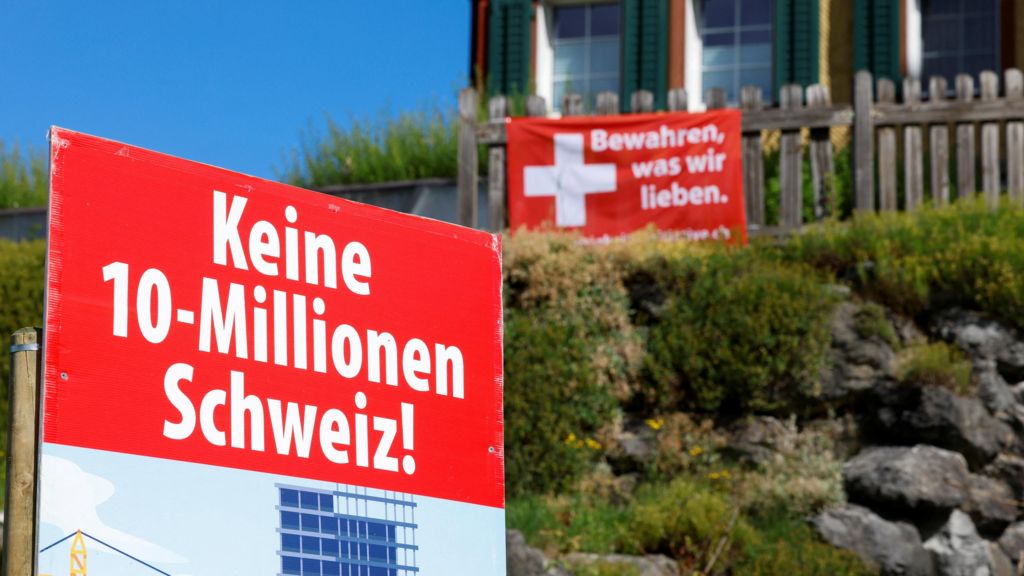
In a closely watched nationwide referendum that carried major implications for Switzerland’s relationship with the European Union and its immigration policy, Swiss voters have rejected a controversial plan to cap the country’s total population at 10 million, early vote projections confirm. With ballots still being finalized, current data shows 55% of voters opposed the measure, while 45% backed it, resulting in a narrow defeat for the proposal.
The plan was put forward by the right-wing Swiss People’s Party (SVP), a political organization that has built its platform around long-standing anti-immigration campaigning. The SVP argued that rapid population growth over the past two decades had stretched public infrastructure, housing, and environmental resources, claiming a cap would ease pressure on these critical systems. Switzerland’s population has climbed from 7.3 million in 2002 to 9.1 million today, with 27% of current residents holding non-Swiss citizenship, a statistic the SVP repeatedly highlighted during campaigning.
Critics of the cap, however, warned the proposal carried far-reaching risks that extended far beyond immigration policy. Most critically, a population cap would have forced Switzerland to abandon its free movement agreement with the EU, a deal that underpins the country’s access to the EU single market – the destination for more than half of all Swiss exports. For a nation deeply integrated into European trade and reliant on cross-border labor, abandoning this agreement would have triggered severe economic consequences and diplomatic isolation, opponents argued.
Leading up to the vote, the debate split the country along political, economic, and generational lines. Speaking to the BBC before the ballot, SVP youth representative Nils Fiechter, who sits in Bern’s cantonal parliament, defended the proposal, arguing that unchecked immigration had eroded Switzerland’s national identity and created crises in housing, transportation, education, and social services. Fiechter’s standing in the debate came with context: in 2022, he and his co-leader of the SVP youth wing were convicted of racial discrimination by the Swiss Federal Supreme Court over a 2018 campaign poster targeting Roma and traveller communities.
Opponents rejected the SVP’s framing, dismissing the party’s claims as harmful scapegoating. Helin Genis, a 31-year-old Social Democrat on Bern’s city council, argued that migration was not the root cause of Switzerland’s challenges with housing costs, rising health insurance premiums, or underinvestment in infrastructure. “Viewing problems through the lens of migration does not lead to solutions, but to division,” Genis told the BBC.
Switzerland’s business community raised urgent alarms about the proposal ahead of the vote. Economiesuisse, the country’s leading business association, warned that approving the cap would upend decades of stable trade relations with the EU. “The EU is still by far the most important trading partner for Switzerland, it is in our interest to have stable and clear relationships with our main trading partner,” said Economiesuisse chief economist Rudolf Minsch. Brussels has long made clear that non-EU members cannot access the single market without accepting the core commitment of free movement of people, meaning a yes vote would have inevitably collapsed the existing trade agreement.
Industry groups also highlighted Switzerland’s deep reliance on foreign labor, pointing to critical sectors facing acute labor shortages. Half of all hotel workers in Switzerland are immigrants, while hospitals and care homes across the country depend heavily on foreign staff to fill gaps left by an ageing native population. With 20% of the Swiss population already over the age of 65, opponents of the cap noted that the country requires young immigrant workers and taxpayers to fund and staff care for its ageing population – a need a population cap would only worsen.
Beyond economic concerns, many politicians and voters warned the cap would leave Switzerland diplomatically isolated at a time of rising global instability. Though Switzerland maintains a long-standing policy of official neutrality, it has recently increased defense spending and moved to deepen security and defense coordination with European neighbors. Social Democratic MP Jon Pult told the BBC that his greatest fear was a yes vote would leave Switzerland isolated in an “unstable and dangerous world.”
The referendum is a product of Switzerland’s unique system of direct democracy, which allows any campaign to force a nationwide vote on a proposal if it can gather 100,000 signatures from eligible voters. While the result was narrow, the rejection of the cap ends weeks of uncertainty for Switzerland’s economy, its European relations, and its immigrant population.