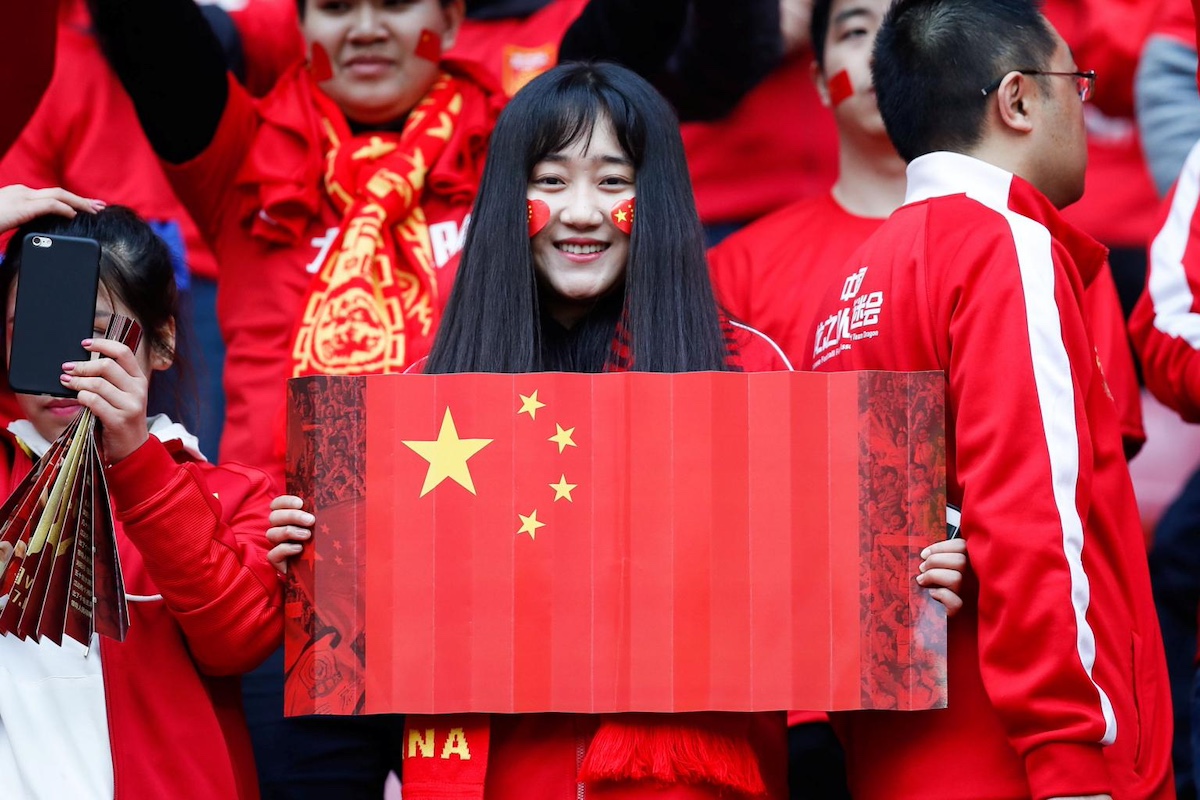
As the 2026 FIFA World Cup kicks off across North America this summer, a familiar pattern has repeated itself: China’s men’s national team is once again watching the tournament from the outside rather than competing inside it.
This absence has long been reduced to a tired punchline: how can a nation of 1.4 billion people fail to field 11 world-class footballers? But this oversimplification erases the full context of China’s qualifying campaign. The team did not crash out in the opening stage of Asian qualifiers; instead, it narrowly advanced to the final third round of 2024 qualifying, keeping alive hopes of a first return to the World Cup finals since their solitary debut in 2002.
Even with the tournament’s expansion to 48 teams and a new, larger allocation of spots for Asian nations, however, China’s run fell short. When their qualifying campaign wrapped, the same longstanding conclusion remained: China’s massive population, growing economic wealth, world-class sports infrastructure and lofty sporting ambitions have not yet combined to produce a consistently competitive men’s national World Cup side.
What is less often discussed is the reality that there are not one, but two distinct Chinas present at this World Cup — and only one is missing. The absent China is the men’s national team, whose only World Cup appearance to date ended with a goalless group-stage exit in 2002, a record that remains unchanged 24 years later.
The other China, by contrast, is impossible to miss across every corner of the tournament. It is woven into the event’s commercial framework, cutting-edge technology systems, global consumer branding, global merchandise supply chains, broadcast infrastructure and even its officiating team.
Major Chinese brands including Lenovo, Hisense and Mengniu are not minor, peripheral players in the multi-billion-dollar World Cup economy. They are core components of the global machinery that makes the event possible, brings it to living rooms across the world and generates revenue from the world’s biggest sporting spectacle. Even Chinese referee Ma Ning has emerged as an unexpected symbol of Chinese participation: with no national team to cheer for, many Chinese football fans have embraced the official as a stand-in for national representation.
This small, telling detail encapsulates the central paradox of China’s relationship with the modern World Cup: China is missing in the way football fans care about most, but omnipresent in almost every other layer of how the tournament operates. It remains peripheral on the match pitch, but central to all the systems that make the World Cup work off it.
This paradox reveals a larger truth: it exposes the limits of a development model that has delivered spectacular success across nearly every other sector for China. The country has mastered the art of mobilizing massive capital, setting centralized national targets, and scaling large-scale infrastructure projects at unmatched speed. It built out a global-leading high-speed rail network, become a world leader in electric vehicle manufacturing, constructed world-class ports and solar panel supply chains, and dominated Olympic medal tables in a matter of decades, all at astonishing pace.
But football defies this top-down, industrial logic. China did not underinvest in the sport — if anything, it over-engineered its development. A landmark national football reform plan released in 2016 promised to build tens of thousands of new pitches and get tens of millions of schoolchildren playing the game regularly. Top-flight Chinese Super League clubs spent hundreds of millions of dollars on high-profile foreign stars, chasing quick global prestige and rapid growth.
For a short window, it looked like Chinese football would become the next disruptive force in the global game. Then, the fragile foundations of the model began to crack.
Most top Chinese professional clubs were tied to real estate developers and local government prestige projects, rather than rooted in sustainable, community-focused sporting institutions. When China’s property sector entered a broad slowdown and the COVID-19 pandemic shut down sports for years, the fragility of the professional game was laid bare. Dozens of clubs folded, league finances deteriorated sharply, and high-profile corruption and match-fixing scandals eroded what little public confidence remained.
The key lesson here is not that China is inherently incapable of producing a world-class football team. It is that football cannot be manufactured like a mass-produced industrial good.
A vibrant football culture is not built simply by counting the number of new pitches constructed. It grows organically through generations of neighborhood rivalries, well-trained trusted youth coaches, deeply rooted local clubs, intergenerational family fandom, unstructured pickup play, and years of accumulated competitive game time for young talent. It requires enough structure to nurture emerging talent, but enough flexibility for spontaneous creativity to flourish.
This is where China’s top-down model has struggled. The same system that can produce Olympic champion divers through years of disciplined repetition or elite gymnasts through early specialization cannot easily generate the on-pitch improvisation of a world-class midfielder, the instinctive finishing of a top striker, or the collective cohesive trust that 11 players need to perform under high pressure.
Compounding this challenge is what analysts call the “academic cliff”: around early adolescence, just as young football talent is starting to mature and deepen, many Chinese children face intensifying pressure from college entrance exams, and most drift away from organized sport. For most Chinese families, pursuing football looks far less like a viable career path and far more like an unnecessary risk to a child’s academic future.
This dynamic shrinks the available talent pool dramatically before young players can reach their full potential. It also explains why China’s football shortfall has never really been a mystery of population size. A large population does not automatically produce elite teams; football success depends on a robust, accessible development pipeline, not just a large national headcount.
Today, the most encouraging signs for Chinese football are not coming from another wave of big-spending marquee signings by wealthy clubs. They are growing from the grassroots up.
Amateur and community-led football has begun to draw growing public and institutional attention. Local amateur leagues, most notably the widely discussed “Suchao” (Village Super League) phenomenon in eastern Jiangsu province, have demonstrated that popular enthusiasm for football in China is far healthier at the social and community level than it is within the formal professional institutional structure. Teachers, software engineers, college students and delivery drivers competing in front of sold-out local crowds will not produce a World Cup-caliber striker overnight, but they are doing something more foundational: they are making football feel like a normal, accessible part of everyday life, which is the first building block of a sustainable national football culture.
China’s deep commercial roots at this World Cup should not be seen as a consolation prize for its on-pitch absence. Instead, it can serve as a unique platform. Chinese brands that reap the benefits of the World Cup’s massive global visibility could invest in open-access youth leagues, international coaching exchange programs, data and analytics tools for lower-tier local clubs, and need-based scholarships that allow young players to pursue football alongside their academic studies.
The end goal should not be another cycle of vanity projects and big-name signing sprees. It should be building a patient, organic ecosystem: sustained school-community partnerships, stable financially viable local clubs, improved coach training and education, transparent youth scouting systems, expanded recreational leagues for both boys and girls, and clear development pathways that reassure parents that sporting participation and academic mobility can coexist, rather than compete.
This last point is non-negotiable. If football is consistently framed as a threat to academic success, China’s pool of young talent will remain artificially small. If it is framed as a complementary activity that builds discipline, teamwork, physical health and long-term opportunity, far more families will allow their children to stay in the game long enough to discover if they have the talent to compete at the highest level.
So will China qualify for the 2030 World Cup? It is a possibility, but far from a guarantee. The expanded 48-team format makes qualification easier, but it cannot close the gap between China’s off-pitch commercial power and its on-pitch footballing depth. What China does not need is more loud, empty slogans about becoming a global football superpower.
What it does need is more ordinary football: more children playing for fun, more parents trusting that the development pathway is safe and worthwhile, more local clubs surviving year to year, more coaches improving their craft, and more local community competitions that matter to the people who play and watch them.
This broader lesson extends far beyond the world of sport. There are some forms of progress that can only grow when centralized authority creates space for local institutions, families and independent clubs to do what top-down national plans cannot. Football rewards patience, spontaneous improvisation and social trust. These are far harder to mandate than large capital investments, but they are exactly the ingredients the game requires to thrive.
In the end, China’s absence from this summer’s World Cup is not just a failure of national sporting ambition. It is a mirror that reflects the strengths and limitations of China’s modern development model. Off the pitch, China is already a World Cup power: commercially sophisticated, technologically integrated, and symbolically present at the heart of the world’s biggest sporting event. On the pitch, the project remains unfinished.
If China eventually earns its way back to football’s biggest global stage, it will not be because it found more money to spend. It will be because it learned how to cultivate the organic, patient culture that elite football actually requires. That would be a better story for China, a better story for Asian football, and a better story for the World Cup as a whole.