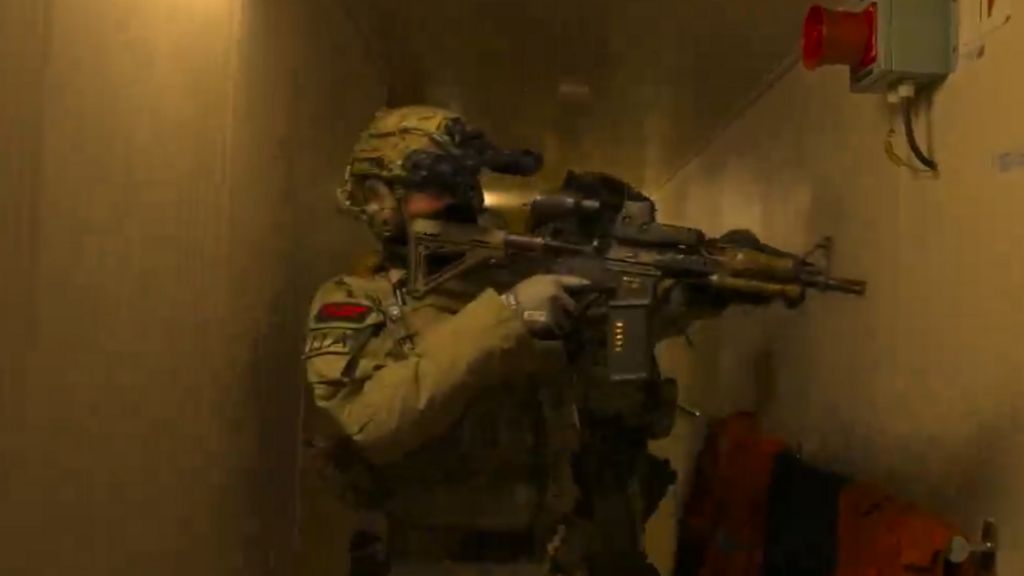
In a landmark first operation to enforce international sanctions against Moscow, British armed forces intercepted and boarded a sanctioned oil tanker linked to Russia’s shadow fleet in the English Channel in the early hours of Sunday. The six-hour mission, carried out by elite Royal Marine Commandos and specialist National Crime Agency law enforcement officers with air support from the Royal Air Force, marks the first seizure of its kind under new powers granted to UK military earlier this year.
The detained vessel, identified as the *Smyrtos*, is currently anchored and under continued monitoring off the UK’s south coast as official investigations proceed, the Ministry of Defence (MoD) confirmed in an official statement. Prime Minister Keir Starmer emphasized that the successful operation delivers another significant blow to Russia’s ability to fund its war in Ukraine, sending a clear message to actors enabling Vladimir Putin’s military campaign that they cannot evade international enforcement.
According to open-source vessel tracking data from MarineTraffic, the *Smyrtos* flies under a Cameroonian flag and is currently anchored off the coast of Weymouth. Independent analysis by BBC Verify traced the tanker’s journey: it departed Russia’s Ust-Luga oil terminal near St. Petersburg on June 5, and entered the English Channel moving westward on Saturday. The vessel was originally added to international sanctions lists in July 2025, and has since evaded restrictions by changing its name from *Myrtos* to *Smyrtos* and switching its registered flag twice — a common tactic used by shadow fleet operators.
Russia’s network of unregulated shadow tankers has become a critical lifeline for the Kremlin, allowing it to bypass Western export sanctions imposed over its full-scale invasion of Ukraine. MoD figures show the more than 700-vessel fleet carries roughly 75% of all Russian oil that falls under international sanctions. Back in March, Starmer’s government announced new legislation granting UK armed forces explicit authority to board sanctioned vessels transiting British territorial waters, and to date the UK has imposed sanctions on more than 500 vessels linked to Russian oil evasion. These measures bar targeted ships from entering UK ports and ban British individuals and companies from offering financial services, insurance, or brokerage support for any vessels carrying sanctioned Russian crude.
The high-profile interception comes amid significant domestic political upheaval for the UK government, coming one week after two senior defence officials resigned in protest over the government’s delayed Defence Investment Plan (DIP). The long-awaited strategy document, which will outline UK military spending priorities for the coming years, is set to be published ahead of next month’s NATO summit after months of delays. Last Thursday, former Defence Secretary John Healey resigned from the cabinet, warning that the level of military spending proposed by Starmer’s government falls well short of the funding required to address current and future security threats to the UK. He was followed shortly by Armed Forces Minister Al Carns, who told the prime minister that the draft DIP was neither transformative enough nor sufficiently funded to match the UK’s security needs.
Speaking to the BBC, current Culture Secretary Lisa Nandy pushed back against claims of division, stating that the prime minister had been clear with his entire cabinet that additional funding for defence must be found, and that discussions over the final shape of the DIP remain ongoing. “We have to transform the way we do defence spending, so that what we’re spending is fit for the threats we face now and in the future,” Nandy told *Sunday with Laura Kuenssberg*.
Sunday’s operation was supported by a full multi-service deployment: an RAF P-8 maritime patrol aircraft from the Maritime Air Group provided surveillance support, while Royal Navy frigates HMS Sutherland and HMS Ledbury provided surface backup. Former minister Al Carns, who stepped down just days before the interception, outlined the high-risk tactics the mission would have entailed: “It would have involved armed forces personnel flying low level over the sea, rearing up before the ship, fast roping onto the ship, securing it and then taking it into our territorial waters.” Carns added that this first successful boarding sets a precedent for future action, noting “we’re probably going to see more, should the opportunities present themselves.”
Attorney General Richard Hermer reaffirmed the government’s commitment to upholding sanctions under international law, saying “This government made clear that we would pursue Russia’s shadow fleet under the full force of international law.” The UK’s core strategic goal in targeting these vessels is to choke off revenue flowing to Russia’s war machine in Ukraine, a government spokesperson reiterated.
Notably, Sunday’s operation was carried out in close coordination with French authorities, continuing a pattern of bilateral cooperation between the two allies on sanctions enforcement. Just last month, on June 1, French President Emmanuel Macron announced that French military forces had intercepted another sanctioned shadow fleet tanker with support from the UK, which provided British helicopter assistance to that mission.