Ahead of the upcoming Group of Seven summit kicking off Monday in France, Canadian Prime Minister Mark Carney has ramped up his diplomatic push to realign Canada’s global partnerships away from the United States and toward deeper integration with Europe, making his case for collective middle-power action during a visit to Dublin this weekend.
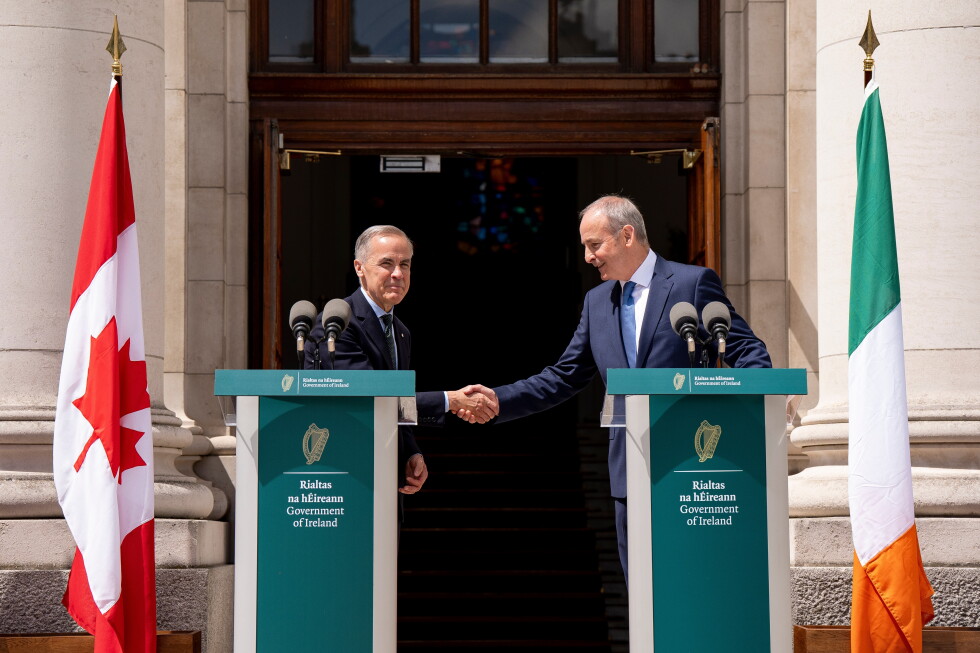
Carney’s European tour began with a meeting with French President Emmanuel Macron on Friday, followed by talks Saturday with Ireland’s Taoiseach Micheál Martin. During a remarks delivered at Dublin’s Trinity College, the Canadian leader laid out a clear alternative path for nations caught in an era of intensifying great power rivalry. Instead of smaller and middle-sized countries competing to win favor from major global powers, Carney argues that uniting with like-minded allies can multiply collective strength to create an independent, influential third way.
“ In a world of great power rivalry, middle powers have a choice — to compete for favor or to combine to create a third path with impact,” Carney told the audience. This framing builds on comments he made earlier this year at the World Economic Forum in Davos, where he made global headlines by declaring the traditional post-Cold War rules-based global order defunct and condemned coercive pressure exerted by great powers on smaller sovereign states.
Carney highlighted the combined scale of Canada and the European Union to back his case for closer cooperation: together, the two blocs hold a combined population more than double that of the United States, a combined GDP matching that of the U.S., and a collective defense budget twice the size of China’s. He framed the Canada-EU partnership as a values-driven force for global good, rooted in shared commitments to human rights, individual dignity, and pluralism.
“The new world order will be built starting with Europe,” Carney stated during a joint press conference with Martin ahead of his Trinity College address. “Canada is the most European of non-European countries. We are transforming our cooperation with Europe.”
This shift toward Europe is already well underway, Carney noted. Just five months ago, Canada became the first non-European country granted membership in the EU’s SAFE defense procurement initiative. In the 15 months since Carney took office as prime minister, this trip marks his ninth visit to the continent, and Canada has already secured 56 critical minerals partnerships across more than 10 European nations. Carney has also set a formal national target to double Canada’s non-U.S. exports over the next decade, a goal shaped by ongoing trade friction with Washington under the second Trump administration.
Ireland, which is set to take over the rotating presidency of the Council of the European Union starting in July, has fully embraced Canada’s ambition. “Prime Minister Carney has spoken with great clarity and conviction about Canada’s desire to deepen its engagement with Europe. Ireland warmly and unreservedly welcomes that ambition, and we will do what we can to strengthen relations between the European union and Canada during our forthcoming presidency,” Martin confirmed.
Even as Canada leans into closer European ties, trade tensions with the U.S. remain a lingering issue, with the upcoming July 1 mandatory review of the U.S.-Mexico-Canada Agreement (USMCA) looming on the horizon. The USMCA, the latest iteration of a North American free trade framework that has linked the three regional economies since the 1990s, has been the subject of conflicting signals from Trump, who said this week he may choose not to renew the pact.
Carney pushed back against fears of a full collapse of the regional trade arrangement, noting that the Trump administration has made clear it has no interest in rewriting the core structure of the agreement. Changing the agreement fundamentally would require congressional approval, a step Carney said the White House has no intention of taking. He added that roughly 85% of Canadian exports to the U.S. already enter tariff-free under the current USMCA framework, a status the administration has chosen to maintain.
A senior anonymous U.S. administration official confirmed that no bilateral meeting between Trump and Carney is scheduled for the G7 summit, and that no major trade breakthroughs are expected during the gathering. The official did note that the White House has viewed Canada’s recent reversal of a regulation requiring foreign streaming platforms to invest a share of their Canadian revenue into local content and news as a positive step, and that Washington has received outreach from Ottawa for further trade discussions.
Carney acknowledged that Trump’s trade policies have created uncertainty for cross-border investment, a key factor driving Canada’s push to diversify its economic and geopolitical partnerships. The new alignment with Europe, he argues, will strengthen both blocs at a time of shifting global power dynamics.