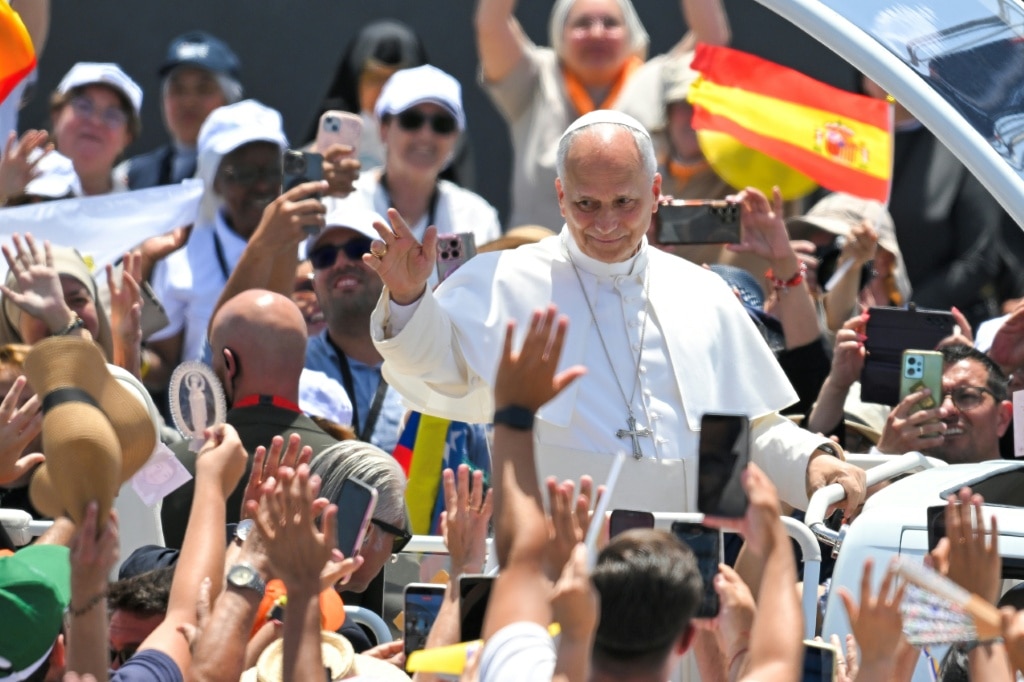
Pope Leo XIV’s seven-day visit to Spain, a trip defined by its laser focus on the global migrant crisis, concluded Friday with an unexpected twist: a last-minute technical fault with his chartered Iberia flight forced a three-hour delay to his return journey to Vatican City.
The 70-year-old head of the global Catholic Church, which counts 1.4 billion adherents worldwide, had already boarded the aircraft at Tenerife’s airport and been formally waved off by Spanish King Felipe VI when the flight captain notified passengers of an unserviceable engine issue. Pope Leo immediately disembarked, and arrangements were quickly made to fly him back to Rome aboard the Spanish royal air force’s Falcon jet, which had carried King Felipe to the Canary Island earlier in the day. The rest of the papal entourage, including accompanying journalists and Vatican officials, were set to depart on a backup plane Iberia dispatched from Madrid.
The departure delay capped a final day heavily focused on the migrant experience in the Canary Islands, which has become the primary entry point for thousands of people undertaking dangerous sea crossings from North Africa to reach European soil. Before traveling to the airport, Pope Leo led an open-air mass at the Port of Santa Cruz de Tenerife, drawing an estimated crowd of 40,000 worshippers and attendees.
Earlier that morning, during a meeting with local migrant support organizations, the pontiff shone a light on the often-overlooked struggles migrants face after reaching European shores, warning of a “silent shipwreck” that leaves many isolated, unemployed, and disconnected from social support. “Too many arrive only to be left alone in a city, without a voice, without community ties, stable work or a sense of security,” he said. He also issued a forceful rebuke to human traffickers who profit from dangerous irregular migration routes, urging them to “stop and repent” — a comment that drew loud applause from the gathered crowd.
During his public remarks, Pope Leo also laid out clear guidance for migrant integration, urging new arrivals to learn the language of their host country, respect local laws, and engage with national customs. He doubled down on a core message of his papacy earlier in the trip: “Human dignity has no passport,” a line he delivered after laying a wreath at sea in Arguineguín, Gran Canaria, to honor the thousands of migrants who have died attempting to cross to the Canary Islands. He also blessed a weathered blue wooden cross crafted from debris from a migrant boat that made landfall on the island.
Attendees at the papal events praised the pope’s unwavering focus on migrant issues. Candida Feo, a 54-year-old local who brought her two children to see the pontiff, told Agence France-Presse that drawing global attention to the crisis was a critical step forward. “If people come here, it’s for a reason. Anything that helps focus attention on the issue seems very good to me,” she said. For 16-year-old Aliu Ceesay, a Gambian migrant who arrived in the Canaries by boat just one month prior to seek work to support his family, the pope’s message felt deeply personal. “He is so kind, so good. He doesn’t care if we are black or white, Muslim or Christian. He wants to help us,” Ceesay said while waiting to catch a glimpse of the pontiff.
Data from the International Organization for Migration underscores the severity of the crisis: nearly 1,200 people died or went missing on the crossing from Africa to the Canary Islands last year alone, making it one of the deadliest irregular migration routes on the planet.
Beyond his work highlighting migration, Pope Leo’s week-long visit included several major stops across mainland Spain. In Madrid, he addressed the Spanish parliament, where he repeated his call for “safe and legal pathways” for migration and a “respectful welcome and real opportunities for integration” for new arrivals. He also celebrated an open-air mass that drew more than one million attendees, and held a private hour-long meeting with six survivors of clerical sexual abuse — a longstanding priority for the modern papacy. In Barcelona, he marked the 100th anniversary of architect Antoni Gaudí’s death by blessing the final completed tower of Gaudí’s iconic Sagrada Família Basilica. The new tower, the tallest of the basilica’s 18 spires, brings the structure to its full planned height of 172.5 meters, making it the tallest church in the world.
The pope’s focus on migrant issues will continue next month, when he is scheduled to travel to Lampedusa, the Italian island that has also emerged as a key entry point for migrants arriving in Europe, further cementing the issue as a defining priority of his early papacy.