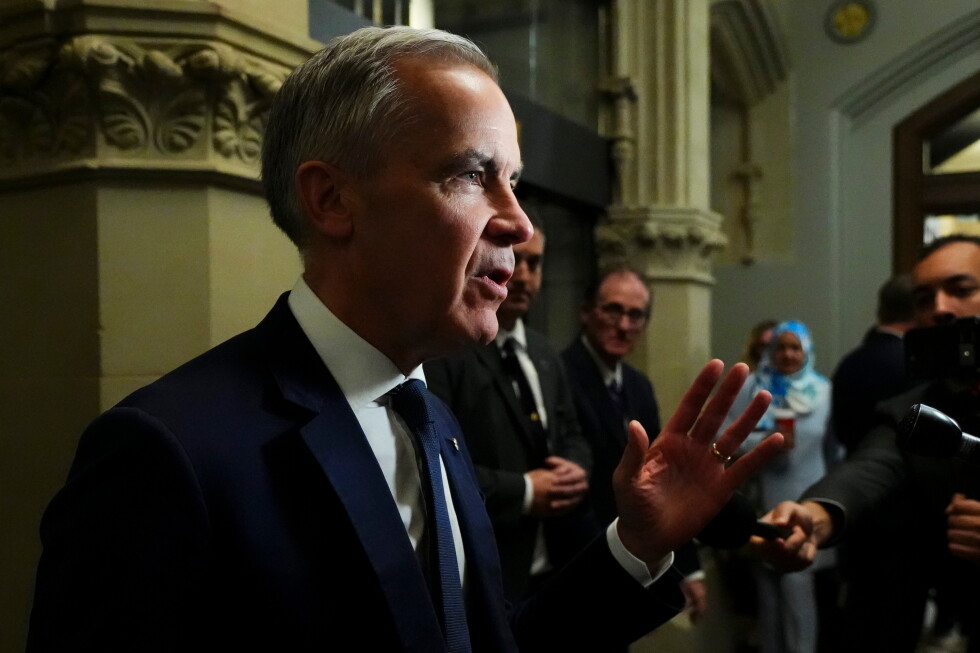
OTTAWA, Ontario — Just months after catapulting to international fame as a leading voice of middle power resistance to great power coercion, Canadian Prime Minister Mark Carney is poised to adopt a far more restrained tone when confronting U.S. President Donald Trump at the upcoming Group of Seven (G7) summit in France, according to political analysts and trade observers.
Carney’s January appearance at the World Economic Forum in Davos, Switzerland, cemented his status as a rising global political star. In a widely celebrated keynote address, he declared the long-standing global rules-based order effectively defunct and delivered a sharp rebuke of large nations using coercion to pressure smaller states. The speech drew global acclaim, overshadowing Trump’s own remarks at the annual gathering and turning Carney into a symbol of pushback against great power overreach.
But the geopolitical calculus has shifted dramatically as the G7 summit, set to open Monday in Évian-les-Bains, arrives just weeks before a mandatory July 1 review of the U.S.-Mexico-Canada Agreement (USMCA). The updated trilateral trade pact, which replaced the original North American Free Trade Agreement in 2020, has interconnected the three North American economies for more than three decades, and its future hangs in the balance ahead of the review. This week, Trump reignited fears by suggesting he may opt not to renew the landmark agreement.
For Canada, the stakes could not be higher. More than 70 percent of the country’s total exports flow across its southern border into the United States, making the preservation of the preferential trade deal an existential economic priority for Ottawa. Canadian historian Robert Bothwell notes that Carney faces far greater risks from Trump’s trade policy than any other G7 leader, explaining “we are more exposed to the United States than anybody else.”
The strained dynamic between the two leaders comes as bilateral tensions have escalated sharply in recent weeks, eroding what has long been one of the world’s most enduring and amicable cross-border alliances. The decades-long partnership, forged by shared geography, common cultural heritage, and centuries of aligned interests, has fractured under repeated friction between the two administrations.
In one recent sign of the souring relations, a planned reception for Ontario Premier Doug Ford — leader of Canada’s most populous province — hosted by the U.S. Chamber of Commerce in Washington was abruptly canceled at the last minute earlier this month. While the reason for the cancellation was not officially confirmed, one senior Ford cabinet minister, Vic Fedeli, struck a defiant tone, saying if Trump pressured the chamber to scrap the event, “Ford should be wearing that as a badge of honor.”
Just this week, Trump doubled down on his dismissive rhetoric toward Canada, claiming the U.S. “doesn’t need anything that Canada has.” In response, Carney has doubled down on his policy of trade diversification, setting a national goal to double Canadian exports to non-U.S. markets over the next 10 years, and citing Trump’s protracted trade war as a major barrier to cross-border investment confidence.
Additional friction emerged this week when the long-planned opening of a major new cross-border bridge spanning the Detroit River — a project Trump previously threatened to block entirely — was pushed back indefinitely, with developers citing unresolved logistical and regulatory issues.
Trump’s confrontational approach to Canada, from launching the 2018 bilateral trade war to his joking (and often repeated) suggestion that Canada should become the 51st U.S. state, has deeply angered Canadian voters. That public backlash directly created the political conditions that allowed Carney to win the 2025 prime ministerial election, after he campaigned on a promise to aggressively confront Trump’s trade aggression.
Yet despite his campaign rhetoric and high-profile Davos rebuke, political observers say Carney has steadily moderated his tone toward the Trump administration in recent months, in a deliberate bid to avoid further damaging bilateral relations ahead of the USMCA review. U.S. Trade Representative Jamieson Greer has repeatedly highlighted that Canada was one of only two countries (alongside China) that retaliated against U.S. trade tariffs during the trade war, labeling those retaliatory measures a major sticking point in ongoing renewal negotiations.
Daniel Béland, a professor of political science at Montreal’s McGill University, points to a clear contradiction between Carney’s global rhetoric and his practical trade priorities. “There is a clear tension between what Prime Minister Carney said in his Davos speech about middle powers standing up to hegemons and his attempt to nudge the U.S. administration ‘in the right direction’ with regard to the USMCA review and trade policy more generally,” Béland explained.
Carney has already downplayed Trump’s recent 51st state comments, framing them as meaningless provocation rather than a serious policy proposal. Canada and Mexico are jointly pushing for a 16-year renewal of the current agreement, while Trump has openly mused about withdrawing from the pact entirely. The most likely outcome, trade insiders say, is a compromise that would replace the fixed renewal with annual reviews over the next decade.
Ahead of the G7 gathering, Carney has embarked on a series of pre-summit diplomatic stops across Europe. He is set to meet French President Emmanuel Macron in Paris on Friday, before traveling to Ireland over the weekend to hold talks with his Irish counterpart — part of his ongoing push to expand Canada’s trade ties beyond the North American market. This trip marks Carney’s ninth visit to Europe in the 15 months since he took office in March 2025.
Even as Carney pursues trade diversification, analysts note that the U.S. will remain Canada’s largest trading partner for the foreseeable future, an unavoidable reality that shapes every step of Carney’s current trade strategy. “That is an inescapable reality that Carney must keep front of mind even as he seeks to make Canada somewhat less dependent on trade with the U.S.,” Béland added.