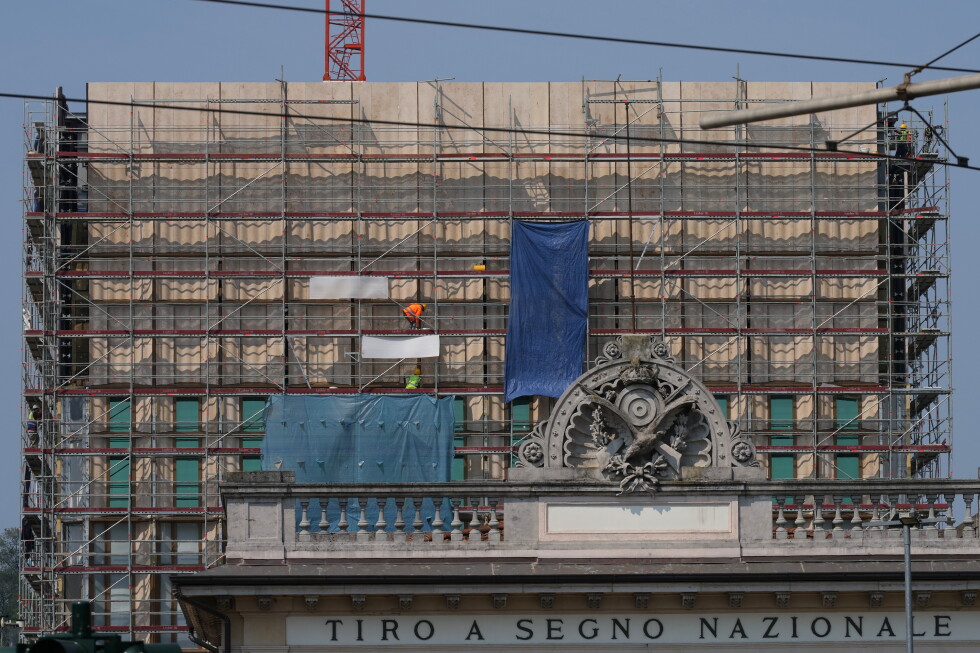
MILAN – A high-profile $350 million American consulate construction project in Milan has become the center of a major labor exploitation investigation that has already led to the arrest of two senior managers, casting a shadow over U.S. diplomatic contracting practices in Europe.
Based on interviews with five former foreign construction workers, combined with reviews of employment correspondence and payroll records, the Associated Press has confirmed that workers on the site were paid less than $2 an hour, a fraction of the fair wages promised to them when they were hired. The contractor at the heart of the scandal, Caddell Construction, an Alabama-based firm that is one of the largest U.S. diplomatic mission builders globally, is the formal target of the probe led by Italian public prosecutor Paolo Storari, an official who has previously led high-profile investigations into illegal sweatshop operations that supply luxury fashion brands.
Authorities launched the investigation roughly six months ago, with the probe covering approximately 70 workers, the vast majority of whom migrated from India and Kenya to work on the project. Two Caddell site managers were taken into custody earlier this month. Prosecutors confirmed that one manager was arrested while attempting to board an outbound flight to leave Italy, while the second was taken into custody just before his planned escape from the country. To date, only Caddell Construction has been named as an official target of the investigation, with no subcontractors facing formal action at this stage.
Prosecutors detailed multiple alleged violations: the firm illegally deducted excessive housing and meal costs from worker wages, forced staff to work 60-hour weeks spread over six days, and left some workers with monthly take-home pay of less than 580 USD after deductions – a rate that works out to under $2 an hour, far below Italian minimum wage standards.
The AP conducted interviews with the five former workers at a Milan trade union center, where they are receiving support including legal aid and emergency housing. All workers requested anonymity out of fear of retaliation and to avoid disrupting the ongoing investigation. Four of the workers interviewed are from Kenya, and one is from India; all five stated they were hired by Caddell after previously working on a major expansion project for the U.S. Embassy in Nairobi, Kenya.
Multiple workers provided formal employment letters on Caddell company letterhead, signed by a company representative, that promised annual salaries of nearly $29,000, equal to more than 2,400 euros a month. In practice, none of the workers received anything close to that agreed-upon rate, and multiple workers reported being threatened by site human resources staff after they questioned the missing pay.
“When you go to the office to ask any question, you are being told, ‘Either you work or you will be returned to your country. That’s the amount you are supposed to be paid,’’’ one Kenyan electrician told the AP. He added that he was promised 2,300 euros a month, but only took home 800 euros after deductions. A second Kenyan electrician said he was threatened with defamation charges after sharing an AI-generated summary of Italian minimum wage laws with management. He was told the 25,000 euro annual salary listed on his employment contract was “for visa purposes,” not an actual binding pay promise.
The Indian worker, a veteran electrician with more than 10 years of experience on major construction projects across the Persian Gulf, reported a similar experience: he was promised 2,500 euros a month, but his pay stub shows he took home just 500 euros a month, equal to an hourly rate of 1.80 USD. All five former workers, aged between their late 20s and early 50s, said they were fired without any formal cause earlier this year. One worker said he returned to Milan from a family visit to Kenya only to find he had lost both his job and his company-provided housing. Two of the former workers are currently homeless and sleeping in Milan parks, while another is staying temporarily with a friend. One worker turned down a new job offer from Caddell at a site in another country after his experience in Milan.
Both the U.S. State Department and Caddell Construction have stated they are investigating the allegations and are fully cooperating with Italian law enforcement. “The U.S. government does not tolerate labor exploitation,” the State Department said in an official statement. Caddell released its own statement saying it is conducting an internal inquiry to confirm that all subcontractors and consulting partners comply with local labor laws and legal standards. “Caddell is committed to treating and paying workers fairly. We will continue to work with authorities in good faith to ensure the welfare of those who work on this important project,” the company said.
This is not the first controversy to hit the firm: more than 10 years ago, Caddell paid millions of dollars in a settlement with the U.S. government to resolve allegations that it submitted false claims to access government contracting incentives. The firm did not respond to requests for comment on this prior case.
The Milan consulate project is a major part of a 20-year construction boom that has reshaped Milan’s skyline and boosted the international profile of Italy’s capital of fashion and finance. Caddell grew to become the leading contractor for U.S. diplomatic facilities after the State Department launched a massive global security upgrade program following the 1998 al-Qaeda bombings of U.S. embassies in East Africa that killed more than 250 people. On its website, the firm noted that very few contractors can meet the strict security requirements to bid on diplomatic facility projects, and as of 2023, the firm had completed 39 embassy and consulate projects valued at a total of $7.4 billion, with four additional projects added since that time.
The new Milan consulate campus is being built on 10 acres of land that was once a public shooting range. The project includes restoration of a historic 100-year-old building, a new five-story main consulate building, restored public gardens, a reflecting pool, and a large outdoor community gathering space. The State Department initially projected the project would employ roughly 500 local workers, though the majority of the workers named in the probe are foreign migrant workers.
Construction work on the site is continuing, but it is now under court supervision. Following the launch of the investigation, the illegal wage deductions have been ended, workers are limited to a 45-hour work week, and they are guaranteed two full days off per week.
Pay stubs provided by the workers confirm the alleged excessive deductions, with monthly charges of roughly 590 USD for housing and more than 350 USD for food, even these large deductions do not account for the full gap between the promised wages and the actual pay workers received. Laura Malguzzi, a labor representative for the Fillea Cgil construction union federation that is supporting the workers, said the union is seeking full damages to recover all unpaid wages owed to the workers. She added that investigators were struck by how the pay stubs openly documented the alleged exploitation, with no attempt to hide the violations, suggesting the firm believed it would face no consequences. “They probably had in their minds the absolute certainty that they were untouchable,” Malguzzi said.
Many of the workers had accepted low pay in their home country of Kenya, where widespread unemployment leaves workers with few other options, but they said they expected far better treatment from a major American contractor working in Western Europe. “They can just hire you, and you just go running,” one worker said. “Because you are poor you have nothing. And you have nothing you can do.” Despite their hardships, the former workers are calling on current employees at the site to speak out about any abuses they have faced. “I believe in justice,” one worker said. “Also the workers there should not be afraid. They should come and speak up.”