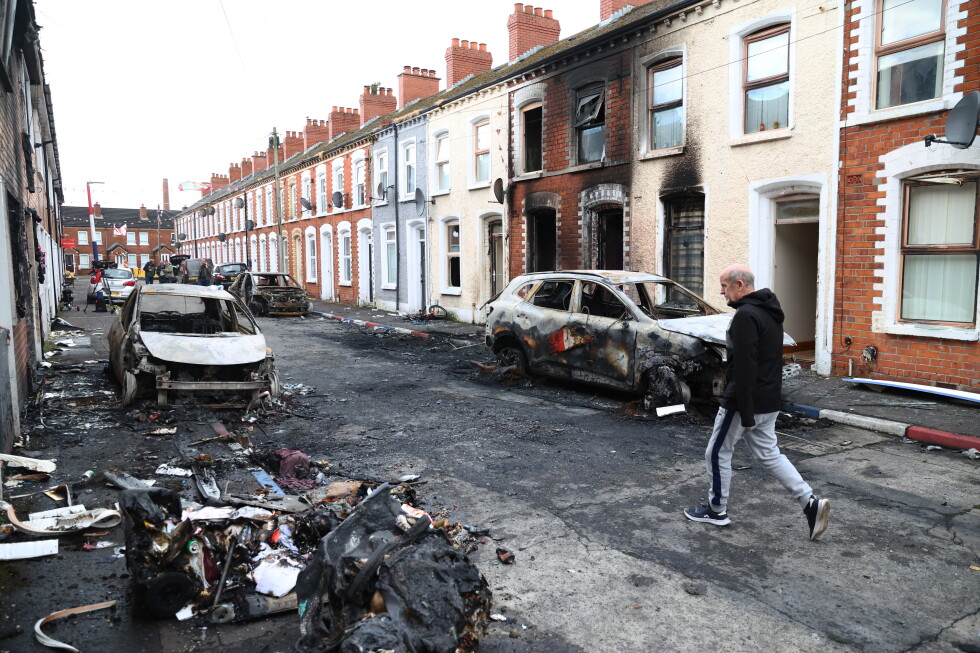
BELFAST, Northern Ireland – A brutal street stabbing committed by an asylum-seeking Sudanese man in Northern Ireland has ignited two consecutive nights of violent, arson-fueled rioting, stoked by preexisting anti-migrant rhetoric that has been spreading across parts of the United Kingdom and Europe. The 30-year-old suspect, Hadi Alodid, made his first court appearance at Belfast Magistrates’ Court on Wednesday, where he faced charges including attempted murder, a separate count of threatening to kill, and illegal possession of a bladed weapon.
According to law enforcement testimony delivered during the hearing, Alodid carried out the attack with a common kitchen knife, leaving his primary victim, Stephen Ogilvie, permanently blinded in the left eye with deep lacerations across the head, face, and back. After the stabbing, while Alodid received medical treatment for a self-inflicted hand wound, he allegedly threatened to kill an attending radiologist. A detective testifying in court shared that Alodid told hospital staff, “I’ve killed someone, I don’t know if they are dead.” To date, investigators have not confirmed a clear motive for the attack, though they have explicitly ruled out terrorism as a driving factor. Alodid declined to secure legal representation through an Arabic interpreter, entered no plea during the Wednesday hearing, and was ordered to remain in custody pending further proceedings.
The first wave of unrest broke out within hours of the attack on Tuesday, when groups of masked rioters took to Belfast’s streets. The mob set fire to multiple residential properties that they claimed housed migrant families, torched a city bus, and launched a barrage of rocks and other projectiles at responding police officers. Firefighters were forced to carry out dramatic rescue operations to pull trapped residents out of burning homes. By the end of the two days of violence, more than 20 local residents had been left homeless, including African migrant communities already settled in the area. Anselme Shima, a Congolese native who has lived in Belfast for nearly a decade, described the chaos as deeply traumatic. “I’ve lived on my street for almost 10 years, I have a good relationship with my neighbors, but last night was a horrific one,” Shima said. “We don’t know what to do. I’m scared. Seeing this, I’m wondering if I’m next.” Police deployed water cannons to disperse the rioters, who tore bricks and stone chunks from local garden walls and patios to hurl at officers.
Senior political leaders from both blocs of Northern Ireland’s power-sharing regional government have unanimously condemned the outbreak of violence. First Minister Michelle O’Neill of the Irish nationalist party Sinn Féin labeled the unrest “thuggery,” echoing widespread cross-party rejection of the rioting.
The current unrest in Belfast mirrors a pattern of anti-migrant violence that has followed recent high-profile stabbing cases across the U.K. over the past two years. Most notably, three young girls were killed in a 2024 stabbing attack at a dance class near Liverpool, which sparked widespread rioting across England and parts of Northern Ireland after false social media claims misidentified the underage suspect as a Muslim asylum seeker. Even after police confirmed the suspect was a British citizen born in Wales, raised by Rwandan Christian parents, violence remained centered on migrant and Muslim communities. The Belfast riots also come just one week after violent clashes between protesters and police in Southampton, which erupted following the sentencing of a man convicted of fatally stabbing university student Henry Nowak.
In the Southampton case, the stabbing, carried out by Vickrum Digwa, exposed deep tensions over policing and immigration. Judge William Mousley found that Digwa, who used an illegal long dagger after initially carrying a traditional Sikh ceremonial knife, misled police by falsely claiming Nowak had attacked him first, resulting in a life prison sentence. Outrage among far-right groups grew after it was revealed that responding officers, called to the scene of a reported racist assault, misidentified Nowak as the perpetrator. Officers dismissed his dying pleas that he had been stabbed and could not breathe, handcuffing him as he lost consciousness. Nigel Farage, leader of the anti-immigration Reform UK party, seized on the case to promote the far-right talking point of “two-tier policing” – the unsubstantiated claim that British policing systems systematically favor ethnic minorities over white residents. While government officials and police leaders have repeatedly denied the existence of such bias, many independent analysts note that multiple major studies, including a 2022 report on London’s Metropolitan Police, the U.K.’s largest force, have confirmed the force is plagued by widespread institutional racism that disadvantages ethnic minority communities.
Far-right and anti-immigration activists across social media have actively organized these post-stabbing protests, with prominent international figures amplifying their rhetoric to stoke division. High-profile far-right British activist Stephen Yaxley-Lennon, better known by his pseudonym Tommy Robinson, has been a key voice calling protesters to action. Tech billionaire Elon Musk, owner of the social platform X, has amplified the outrage over Nowak’s killing, posting more than 100 times about the case around the time of Digwa’s trial and offering to fund a private prosecution of the local police force. U.S. Vice President JD Vance also waded into the debate, posting on X that the killing was proof of “the mass invasion of migrants, many of whom despise the West and the people who love it.” U.K. Prime Minister Keir Starmer pushed back sharply against these foreign interventions, criticizing outside actors “trying to interfere in our democracy and seeking to stir up division on our streets.”
The unrest in Belfast reflects a broader, years-long surge in anti-immigrant sentiment across the U.K. and much of Western Europe, fueled by ongoing political debates over asylum policy, the steady arrival of asylum seekers via small-boat crossings across the English Channel, and rising public pressure on housing and public services.
Some British anti-immigration political figures have blamed the open border policy between the U.K.’s Northern Ireland and the Republic of Ireland for allowing Alodid to enter the region. Alodid reportedly traveled from Paris to Dublin before moving north into Northern Ireland, a path made possible by the free movement policy that has been a core pillar of the 1998 Good Friday Agreement, the peace deal that ended 30 years of sectarian conflict known as “The Troubles” that killed nearly 3,600 people. “There is absolutely no doubt in my mind that this man should not have been in this country,” Farage said Wednesday. “He entered the country illegally. And is it any surprise that people in Belfast and elsewhere are scared?”