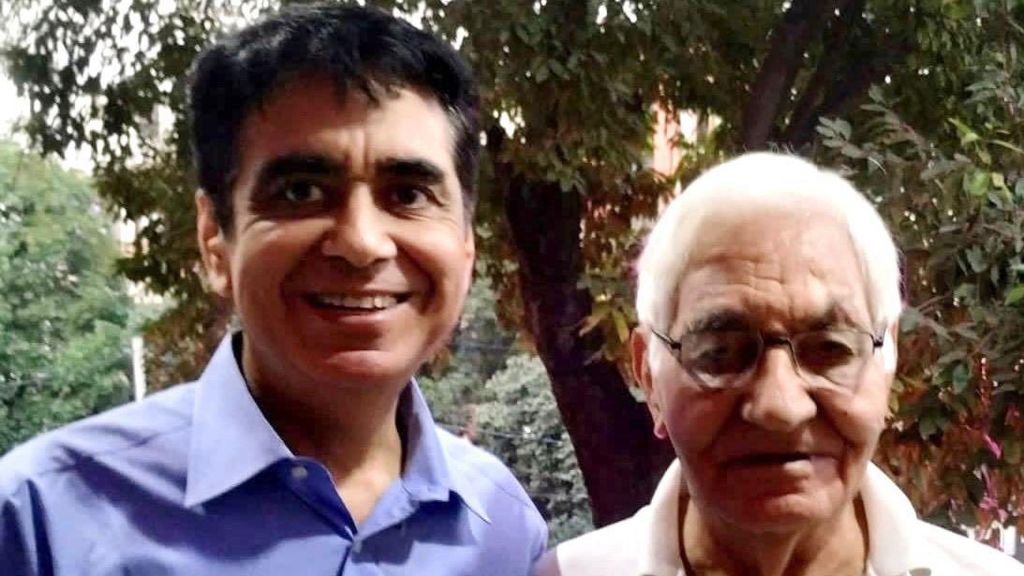
Nearly one year after one of India’s deadliest aviation disasters in recent history, the 90-year-old father of the senior pilot of downed Air India Flight 171 says he will not stop fighting to clear his late son’s name, just days before investigators are set to release a key update into the crash’s causes.
On June 12, 2025, a Boeing 787 Dreamliner operating the London-bound service from Ahmedabad in western India crashed mere seconds after lifting off from the runway, killing all 241 passengers and crew on board as well as 19 people on the ground, bringing the total death toll to at least 260. To date, the exact origin of the catastrophic failure remains undetermined.
A preliminary investigation report published by India’s Aircraft Accident Investigation Bureau (AAIB) last July revealed a critical finding: the fuel control switches for both of the jet’s engines had shifted from their standard “run” setting to the “cut-off” position shortly after takeoff, cutting off fuel flow to the power units and robbing the aircraft of thrust mid-ascent. Cockpit voice recordings captured one crew member asking the other why the switches had been cut off, with the second responding that he had not moved them. Investigators have never publicly attributed either statement to either pilot, nor have they confirmed any intentional action related to the switch movement.
At the time of the crash, Captain Sumeet Sabharwal, the flight’s senior pilot, was in a monitoring role, while co-pilot Clive Kunder was handling the aircraft controls. Days after the preliminary report was released, major international outlets including The Wall Street Journal and Reuters published reports citing anonymous sources claiming that new investigation details were focusing blame on Sabharwal, with Reuters going so far as to state the cockpit recording supported the claim that the captain had cut fuel flow to the engines.
These unconfirmed media reports sparked immediate outcry. Indian pilots’ associations harshly condemned the coverage and rejected all insinuations that the senior pilot was responsible for the crash. The AAIB itself issued a formal rebuke, criticizing what it called “selective and unverified reporting” by segments of the international media, noting that drawing premature conclusions before the full investigation was completed was an “irresponsible” act.
Shortly after the reports emerged, Pushkar Raj Sabharwal, Captain Sabharwal’s 90-year-old father and a retired aviation safety officer, petitioned India’s Supreme Court to demand an independent probe into all possible crash causes. The court ruled in the family’s favor, stating that no one could publicly blame the senior pilot, as the initial investigation report contained no official suggestion of fault on his part.
Even with the court’s ruling, the relentless speculation and unconfirmed accusations have taken a heavy toll on the Sabharwal family, who continue to grieve their loss. Speaking to the BBC from his Mumbai apartment, where Captain Sabharwal lived with his father before the crash, Pushkar Raj said he feels pilots are unfairly scapegoated after aviation accidents because they are often no longer alive to defend themselves.
“You see, every time an accident takes place, the pilot is blamed. Why? It’s the simplest way to close the chapter. He is no more and cannot defend himself,” he told the outlet.
Captain Sabharwal was a veteran flier with 30 years of experience at Air India, logging more than 15,600 total flying hours, nearly 8,600 of which were on the Boeing 787 Dreamliner. He was planning to retire in the near future to care full-time for his elderly father and spend more time at home. Pushkar Raj recalled his son’s last message: he called from Ahmedabad to say he was boarding the aircraft and would call again once he landed at London’s Gatwick Airport. Minutes later, the crash occurred.
Pushkar Raj remembers his son as a gentle, soft-spoken man of deep familial devotion, a trait his late wife compared to Shravan Kumar, the mythological Hindu figure revered for his unwavering commitment to his parents. Even when traveling for work, Captain Sabharwal called his father four to five times a day to check in, and never failed to update him once he reached his destination.
“I can say it is a loss, an unbearable loss,” Pushkar Raj said. “But I have to bear it. Luckily, the rest of my family is with me and I am not alone.” In the wake of the crash, Captain Sabharwal’s daughter and grandson moved from Delhi to Mumbai to support the 90-year-old, and friends and neighbors have rallied around him to help navigate the grief and chaos of the past year. Now, he finds small comfort in his daily routine, including morning walks that once were often accompanied by his son whenever he was home in Mumbai.
Ahead of the AAIB’s upcoming update to the investigation, families of the crash victims, aviation specialists, and pilot advocates alike are waiting for official answers. When asked how he would respond if the final report ultimately rules against his son, Pushkar Raj paused before saying that remaining silent would be impossible: “If I am to keep myself alive and quiet, I must forget – try to forget – which is not possible. That is my situation.” Still, he remains firm in his commitment: “He is no more, but I have to protect his reputation.”
This report is based on original correspondence with Pushkar Raj Sabharwal from the BBC, with additional context from official investigation and court records.