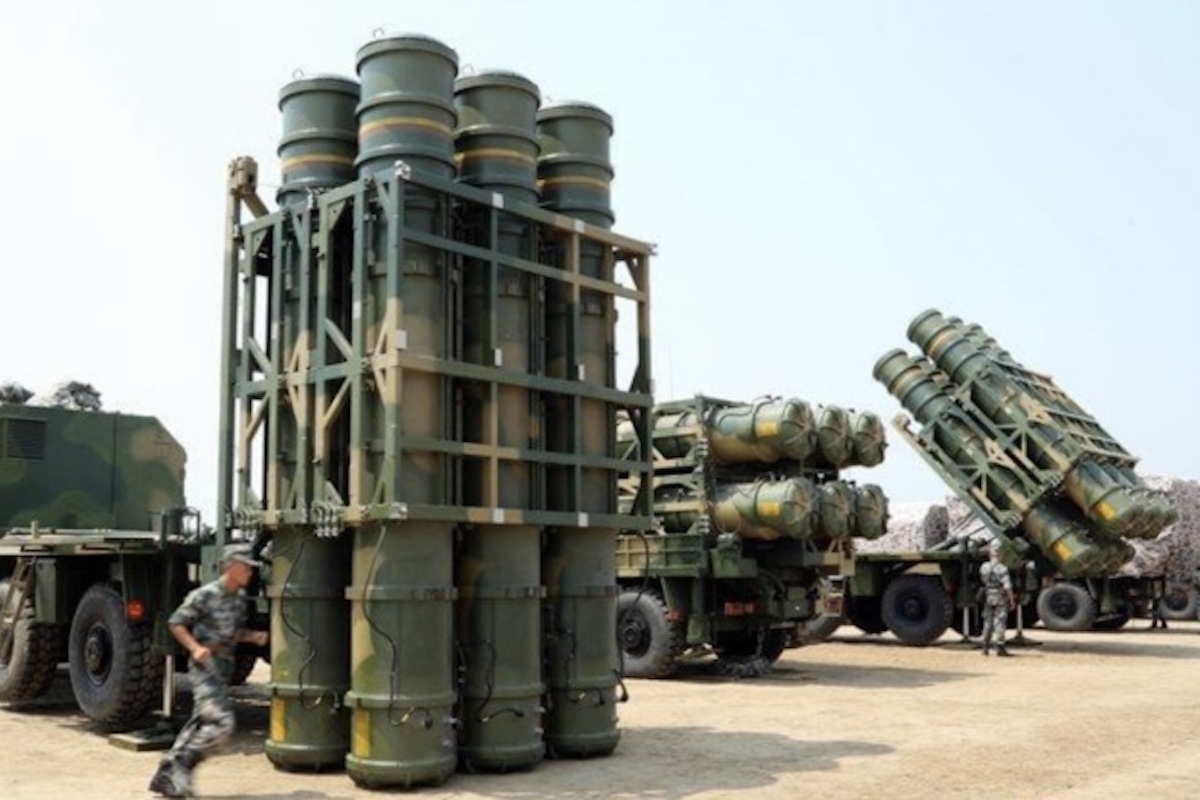
As cross-strait military dynamics evolve rapidly, China’s deployment of an advanced new medium-range air defense system opposite Taiwan signals a critical shift in Beijing’s strategic thinking: growing recognition that any future conflict over the island will not be limited to the Taiwan Strait, but will likely extend deep into mainland Chinese territory.
According to reporting from the South China Morning Post this month, Beijing has deployed the cutting-edge HQ-16F surface-to-air missile (SAM) system to frontline People’s Liberation Army units positioned directly across the strait from Taiwan. Just weeks after the deployment was first reported, China’s state broadcaster CCTV released footage on June 5 showing the 73rd Group Army — a strategic PLA unit headquartered in Fujian’s Xiamen, just across the strait from Taiwan — completing its first live-fire exercises and operational evaluation of the new system.
During the drills, the unit traveled thousands of kilometers to testing grounds in the Gobi Desert of northwest China, where a mobile-launched HQ-16F successfully intercepted an incoming target at a range of 50 kilometers. Designed specifically to boost the defensive capabilities of the PLA’s Eastern Theater Command, which oversees all operations related to Taiwan, the HQ-16F is an advanced wingless missile that incorporates four tail fins, an integrated propulsion motor, and cutting-edge thrust vectoring technology. These design features allow it to engage highly maneuverable threats, including low-altitude infiltrators and supersonic incoming projectiles.
While full technical specifications for the domestic variant remain classified, military analysts note that the HQ-16F’s capabilities meet or outperform those of its export counterpart, the HQ-16FE. The export model is equipped with an active electronically scanned array (AESA) radar that can track targets at distances exceeding 250 kilometers. This latest upgrade significantly narrows the technological gap between Chinese air defense systems and the U.S.-made Patriot PAC-2 and PAC-3 systems that form the core of Taiwan’s current air defense network, while the addition of a directional fragmentation warhead improves its ability to counter existing cross-strait defense infrastructure.
Analysts widely believe the HQ-16F program was accelerated and the system deployed in response to the rapid development of Taiwan’s precision strike capabilities, which can now reach potential invasion staging areas on the mainland. In a February 2026 analysis published by the U.S. Army 75th Reserve Innovation Command, researchers Brennan Deveraux and Kyle Marcrum argued that U.S.-supplied Army Tactical Missile System (ATACMS) platforms give Taiwan the ability to strike targets across a 300-kilometer ring extending from the island into mainland China. This capability, they note, has forced Beijing to position advanced air defense assets like the HQ-16F near key invasion embarkation points and command-and-control facilities within that strike range.
The ATACMS threat poses a particularly difficult challenge for Chinese air defense planners, Deveraux and Marcrum added. At just 180 kilometers across at its narrowest point, the Taiwan Strait places most of China’s coastal military infrastructure well within ATACMS range, and Taiwan has dispersed a large arsenal of the missiles across multiple hidden sites across the island. Additionally, ATACMS missiles travel at Mach 3 during their terminal approach, giving traditional air and missile defense systems only seconds to detect and react to an incoming threat, making interception extremely difficult.
ATACMS is not the only threat driving China’s air defense upgrades. Taiwan has also developed and fielded an arsenal of domestic long-range cruise missiles, most notably the Hsiung Feng IIE. Data from Missile Threat shows that extended-range variants of the Hsiung Feng IIE have a maximum range of 1,200 kilometers — a distance that allows them to strike targets deep inside the Chinese mainland when launched from Taiwan.
Like the U.S. Tomahawk cruise missile, the Hsiung Feng IIE is designed to evade enemy air defenses through low-altitude flight. It can be routed around known radar coverage gaps, follow indirect, unpredictable flight paths instead of the easily detectable ballistic trajectories used by traditional ballistic missiles, fly at high subsonic speeds below radar detection thresholds, and use terrain masking to avoid being picked up by defensive systems — all tactics that drastically reduce the chance of interception.
China’s vast landmass, long considered a key strategic advantage that provides depth for defensive operations, has become a liability in the era of long-range precision strikes, much as it has for Russia in its ongoing invasion of Ukraine. Russia’s experience has shown that defending an enormous territory comprehensively is functionally impossible, allowing attackers to target critical military, industrial, and energy infrastructure far from the front lines.
China faces the same dilemma: its size makes nationwide air defense coverage impractical, forcing military planners to concentrate limited defensive assets around key military, political, and strategic sites rather than protecting the entire country. Taiwan’s long-range missile arsenal, led by ATACMS and the Hsiung Feng IIE, can exploit these gaps in China’s air defense network to target invasion staging areas and critical assets deep in the Chinese mainland. These strikes could inflict major economic damage, undermine public confidence in Beijing’s leadership, and impose significant psychological costs on the Chinese government. While such attacks could theoretically erode public support for a Chinese invasion of Taiwan, they could also harden Chinese public sentiment against the self-governing island and push Beijing to escalate military operations.
Beijing’s security concerns extend beyond Taiwan’s growing strike capabilities to include the threat of advanced conventional strike power from the United States, which can also target strategic sites deep inside the Chinese mainland. Beyond countering Taiwan’s missile arsenal, military analysts believe the HQ-16F will also be used to defend China’s nuclear arsenal and core leadership facilities against potential U.S. intervention in a Taiwan conflict. The June 2025 U.S. airstrikes on Iranian nuclear facilities underscored this risk, proving that U.S. long-range strike capabilities could be used against Chinese strategic assets in the event of a cross-strait conflict. In those strikes, seven U.S. B-2 stealth bombers dropped 14 13,600-kilogram Massive Ordnance Penetrator (MOP) bombs on three key underground Iranian nuclear sites: Natanz, Fordow, and Isfahan. While it remains unclear whether the strikes completely destroyed Iran’s nuclear program, they inflicted severe damage on underground centrifuge facilities, collapsed critical tunnel networks, and likely cut off Iran’s access to its fissile material stockpiles and enrichment infrastructure.
In line with this strategic shift, the HQ-16F is expected to be deployed to defend key strategic sites including the Hami nuclear silo field in northwest China. A May 2026 Reuters report found that the Hami facilities are already protected by camouflaged defensive positions carved into the desert, which are widely believed to house air defense batteries. Beyond nuclear sites, the system will also be used to defend critical leadership and command-and-control facilities, such as the massive underground Beijing Military City complex, which was built to house China’s top leadership and serve as a wartime command center during a large-scale conflict.
Even with the deployment of the advanced HQ-16F system, China cannot fully eliminate its vulnerability to long-range precision strikes against its strategic rear. While the new system strengthens China’s defenses against evolving long-range strike threats, its deployment also highlights a stark new reality: Beijing now openly expects that any conflict over Taiwan will extend far beyond the Taiwan Strait and into core mainland Chinese territory.
For regional and global powers, this shifting strategic landscape creates a new defining challenge: how to maintain deterrence without crossing China’s explicit nuclear red lines in any future Taiwan crisis.