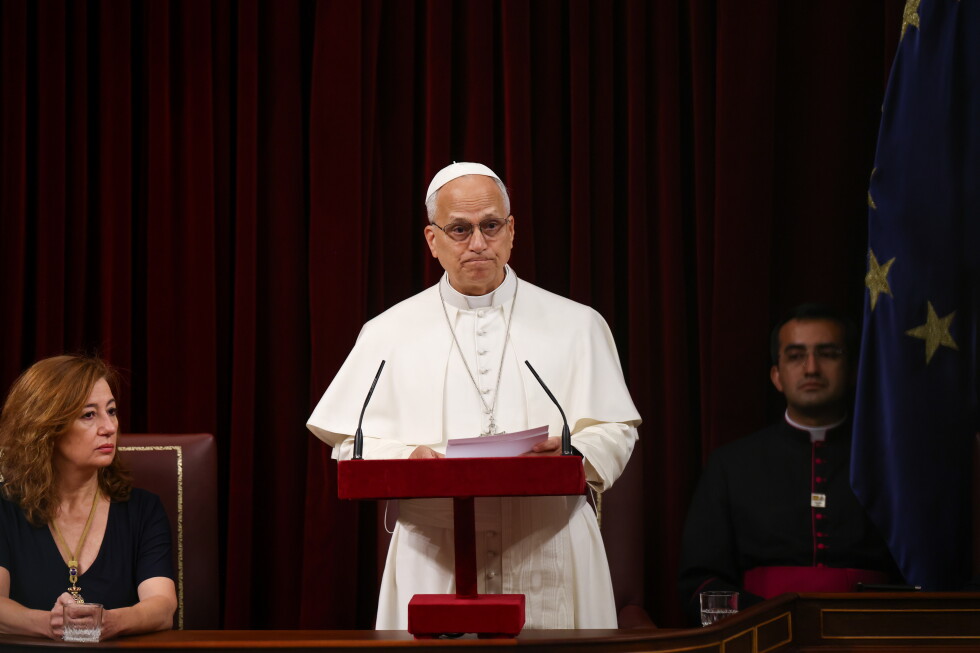
In a groundbreaking moment for Vatican-Spanish relations, Pope Leo XIV delivered the first-ever papal address to Spain’s Cortes Generales on Monday, using the historic platform to urge global respect for migrant rights, international law, and ethical governance, while marking an unexpected shift in the secular country’s acceptance of the Catholic Church in public life.
Addressing assembled lawmakers from across Spain’s deeply polarized political spectrum, the American pontiff framed the core argument of his speech around a universal call for “moral renewal” in public institutions, arguing that a nation’s true moral standing is measured not by its power or wealth, but by how it protects its most vulnerable community members. “The moral greatness of a nation is manifested, above all, in its capacity to accompany, protect and love those lives that are most fragile,” Leo told the chamber. This group, he emphasized, includes migrants, unborn people, and all marginalized populations.
Papal addresses to foreign national legislatures are extremely rare, as the invitation itself signifies formal recognition of a religious leader by a sovereign state’s elected body. Prior precedent includes Pope Francis’ 2015 address to a joint session of the U.S. Congress, and Pope Benedict XVI’s 2011 speech to his native Germany’s Bundestag. For Spain, a nation where the Catholic Church was once a foundational pillar of Francisco Franco’s 20th-century dictatorship, but saw its influence wane dramatically after the transition to democracy in the 1970s, the invitation itself marks a milestone that would have been unthinkable just a few years ago.
Today, despite the fact that a majority of Spaniards still identify as Catholic, religious participation has plummeted amid widespread secularization, mirroring trends across other historically Christian European nations. Yet the address drew a rare show of cross-partisan enthusiasm: at the conclusion of Leo’s remarks, lawmakers from every ideological bloc rose to a minutes-long standing ovation, chanting “Viva el Papa!” (Long live the pope!).
Leo delivered his address against the backdrop of escalating regional tensions between Israel and Iran, as retaliatory airstrikes between the two nations raised fears of a full-scale regional war in the Middle East. Reiterating his longstanding call for diplomatic conflict resolution, the pontiff emphasized that peace can only be built through dialogue, not force. “Peace demands diplomatic courage, ethical responsibility and a vision for the future grounded in respect for the identity of every people and in the obligation of states to resolve their disputes through the peaceful means offered by international law,” he said.
He also voiced deep concern over the growing trend of rearmament across Europe, driven by the ongoing threat of Russian aggression following the invasion of Ukraine, and the Trump administration’s repeated threats to cut U.S. military and financial support for the continent. “It is therefore a cause for concern that, in various parts of the world — and in Europe as well — rearmament is once again being presented as an almost inevitable response to the fragility of the international situation,” he noted. In addition, Leo called for strict ethical regulation of artificial intelligence-powered autonomous weapons, stressing that life-or-death decisions must never be left to automated systems, and must remain rooted in human moral accountability.
In a nod to Spain’s colonial history and the Catholic Church’s role in that era, Leo invoked the 16th-century School of Salamanca, a Spanish intellectual movement that laid early groundwork for modern international law and universal human rights in the aftermath of Spain’s conquest of the Americas. He praised the movement’s theologians for recognizing that power and self-interest could never be justified by force alone, and that all exercise of power has inherent moral limits. Acknowledging past failures, Leo admitted that both society and the Catholic Church itself often failed to live up to these moral principles, referencing his recent formal apology for the Holy See’s role in legitimizing the transatlantic slave trade and the colonial conquests of the Americas by Spanish and Portuguese rulers.
A central focus of Leo’s address was the global migration crisis, echoing the priority placed on migrant rights by his predecessor Pope Francis, and doubling down on his own criticism of the Trump administration’s hardline crackdown on migration in the United States. Leo called for strengthened global action to dismantle human smuggling networks, and to create economic and social conditions that allow people to thrive in their home countries. But for those forced to flee conflict, poverty, and climate change, he demanded compassionate welcome and full integration. “This gives rise to a twofold demand for social justice: to offer safe and legal pathways, a respectful welcome and real opportunities for integration; and, at the same time, to promote the right to remain in one’s own land, working to ensure that no one has to leave their home due to a lack of peace, security or decent living conditions, including economic inequalities and the effects of the climate crisis,” he said.
Leo’s address to Spanish lawmakers comes amid a delicate political moment for Spanish Prime Minister Pedro Sánchez, whose Socialist-led minority government has been rocked by a series of corruption scandals affecting former officials and close allies, though Sánchez himself has not been directly implicated. For three years, Sánchez’s government has been unable to pass core legislation, including a national budget, as Spain grapples with deepening political polarization. In a direct reference to this division, Leo warned that political pluralism should never devolve into constant demonization of political opponents.
Notably, the atheist prime minister and the American pope have found uncommon common ground on a range of major global policy issues, despite the Catholic Church’s historical alignment with Spain’s conservative Popular Party. After meeting Leo at the Vatican last month, Sánchez praised the pontiff as a “moral compass” for global politics. Both leaders have emerged as outspoken critics of military escalation in the Middle East, with Leo labeling recent Israeli strikes on Iran as unjust, and Sánchez positioning himself as Europe’s most vocal advocate for diplomatic negotiation over conflict. Echoing Sánchez’s stance, Leo declared: “Weapons may impose a temporary silence; but they can never build a genuine and lasting peace.” This alignment has created an unlikely alliance between Spain’s progressive government and the Vatican, particularly on migration policy: Sánchez’s government has broken with the restrictive trend seen across much of Europe and the U.S., launching a major legalization campaign earlier this year for hundreds of thousands of unauthorized immigrants already living and working in Spain, arguing that migration is critical to shoring up the country’s aging workforce and sluggish economy.