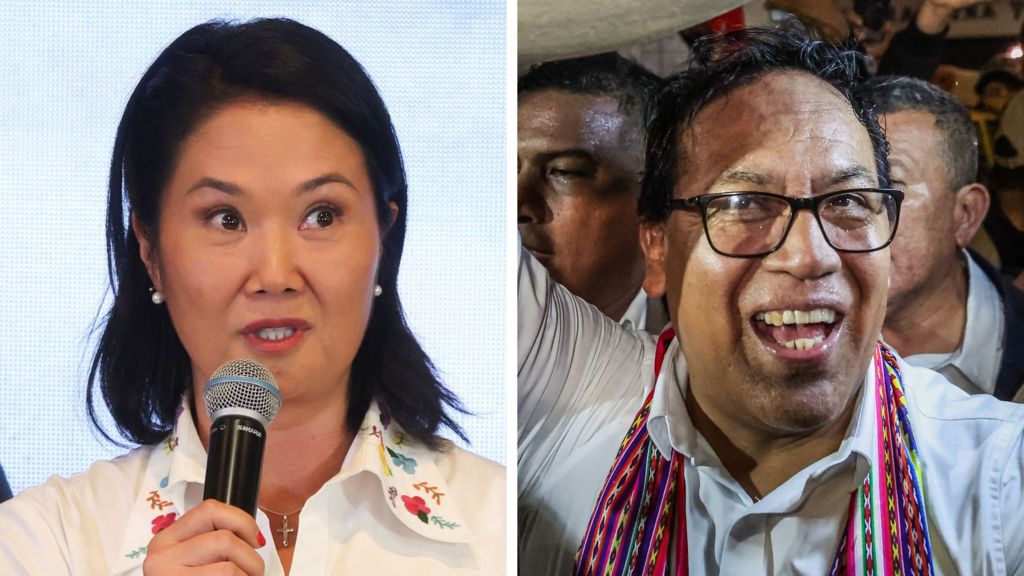
Peru’s high-stakes presidential runoff has devolved into a razor-thin deadlock, leaving the nation facing a prolonged period of political uncertainty that echoes chaotic electoral battles from recent years. Early independent vote tracking by leading pollster Ipsos places left-wing candidate Roberto Sánchez on a narrow 50.3% to 49.7% edge over right-wing veteran Keiko Fujimori, a margin so tight it qualifies as a statistical tie. Though this tally is not the official count, Ipsos’ tracking has proven a reliable predictor of final outcomes in past Peruvian elections. Official counting, which has processed over 85% of all ballots, confirms the race remains too close to call, with a full recount widely expected to take weeks to resolve.
The contest brings two fundamentally opposing visions for Peru to the ballot box, pitting a veteran of national politics against a first-time presidential frontrunner campaigning for systemic change. Fujimori, a household name in Peruvian politics who is making her fourth bid for the presidency, has leaned heavily into the controversial legacy of her late father, former President Alberto Fujimori. Though Alberto Fujimori was ultimately imprisoned for crimes against humanity, his base credits him with crushing violent insurgencies and delivering tangible social support to impoverished communities. Keiko Fujimori has centered her campaign on one key voter priority: a brutal military crackdown on soaring organized crime and extortion, issues that have dominated voter anger across the country.
On election day, Fujimori kicked off her voting in San Juan de Lurigancho, Lima’s most populous district, where informal impoverished settlements cling to steep, arid mountains. She was greeted by throngs of enthusiastic supporters, who voiced urgent hope that she would deliver on her anti-crime pledges. “She will fight crime like her father did years ago,” supporter Alicia told reporters. Another voter, Catalina Solana Guamá, noted that previous administrations had ignored the needs of working-class hillside communities like hers. “It’s about time a woman governed us, one who makes us feel valued,” she said, adding that she backed Fujimori’s promise to deploy the military against gangs that have targeted transportation workers for extortion. “It’s not right that we go out to work and don’t know if we’ll come back alive.” Jennifer, another local voter, echoed that frustration, saying “right now things are very bad, especially in this district… there’s extortions and killings, she wants to fight that.”
Sánchez, by contrast, is running on a platform of sweeping left-wing economic and state reforms, including expanding the government’s role in regulating Peru’s lucrative natural resource sector, increasing public investment in marginalized rural regions, overhauling the national tax system, and renegotiating existing mining contracts. He frames these changes as critical to redressing deep systemic inequality, arguing that wealth from Peru’s vast copper and gold reserves has failed to reach most working and poor Peruvians. His platform has earned him intense support in rural and highland Andean regions, but has also spooked domestic financial markets, echoing the investor anxiety that marked the 2021 election of former left-wing President Pedro Castillo.
Sánchez’s campaign is closely tied to Castillo, who he served under as a cabinet minister. A key campaign pledge from Sánchez has been his promise to issue a presidential pardon for Castillo, who was jailed in 2022 after attempting to illegally dissolve Congress and rule by emergency decree. The 2021 election, which also pitted Castillo against Fujimori, ended in a similarly razor-thin result that dragged on for weeks of vote counting and political chaos, a parallel that has amplified anxiety around the current deadlock.
Ipsos’ early tracking lays bare the deep geographic divide shaping the 2026 result: Fujimori carried the capital Lima, urban centers, and coastal regions, while Sánchez swept rural areas and the Andean highlands. Analysts expect Sánchez to gain additional ground as the last remaining rural ballots are processed, a dynamic that keeps the final outcome too uncertain to call.
In statements to their supporters following the release of early counts, both candidates stuck to sharply differing narratives. Sánchez framed his narrow lead as a reflection of popular demand for systemic change, calling it an “important lead that reaffirms the will of the people, who want democracy and justice.” Fujimori, by contrast, described the race as an unambiguous “dead heat” warning that “there will be long days ahead” before a winner can be declared. She argued it would be “irresponsible” to call the result based on early partial tallies, stressing that “every single tally sheet must be counted.”
Sánchez’s supporters in Lima voiced similar determination to see their candidate win, with many warning that they would take to the streets in protest if the result does not go their way. Many cited Castillo’s ouster and imprisonment as a core motivation for backing Sánchez this cycle. Giovanna, a Sánchez supporter gathered to hear him speak Sunday night, condemned the Fujimori family’s legacy, referencing the forced sterilization program carried out under Alberto Fujimori that harmed thousands of Indigenous and poor Peruvian women. “If we have to rise up, at the very least I would do it,” she said. Street vendor Hilda, who voted for Castillo in 2021, echoed that threat, saying “We voted for change… Previously we voted for Pedro Castillo, but our president who was elected has been removed and is in prison. That’s why we’re voting for Sánchez. Everyone is going to protest, we are going to go out into the streets.”
The runoff comes after a chaotic first round marked by delays in delivering electoral materials to polling stations, with both sides trading accusations of electoral fraud. For the second round, however, independent election observers and Peru’s National Office of Electoral Processes (ONPE) have confirmed that voting proceeded without major disruptions or irregularities. Still, the prospect of weeks of recounting and political wrangling leaves Peru facing a fresh period of instability, a challenge that has plagued the country’s electoral system for much of the last decade.