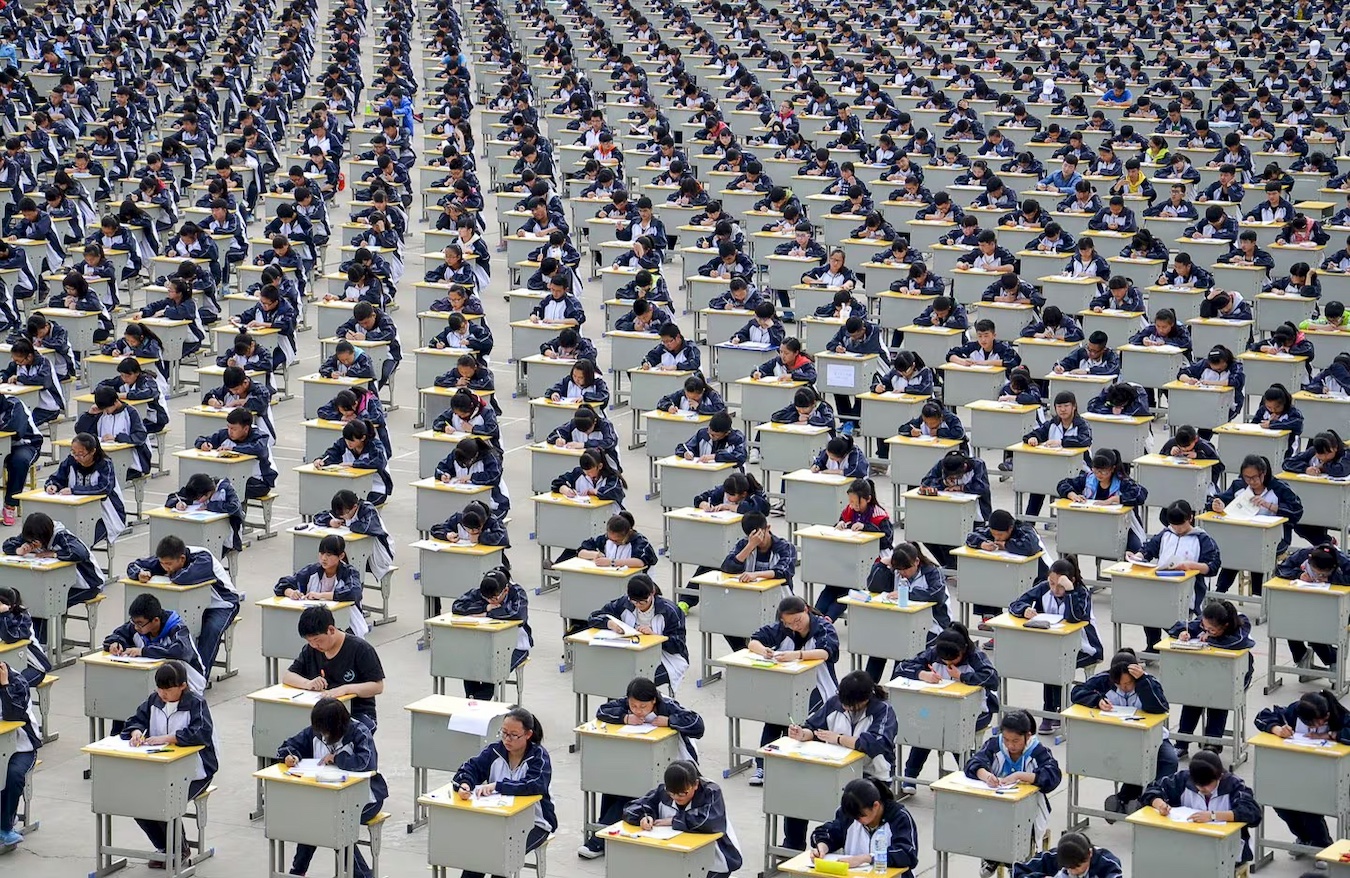
This month, as 12.9 million Chinese students sat for the gaokao — the world’s largest annual standardized college entrance examination — anxious family members gathered outside test centers across the country, many wearing traditional red qipao to wish their students good luck. Half a world away, on the opposite side of the Pacific Ocean, the American higher education system has been moving in the exact opposite direction on standardized testing: roughly 90% of ranked four-year U.S. colleges have dropped mandatory SAT or ACT score requirements for admissions in recent years.
These two of the world’s largest national education systems now stand at opposing crossroads on one core question: how can we fairly evaluate the potential of a young student? Increasingly, the rapid rise of artificial intelligence is rewriting the global answer to that longstanding debate, forcing both systems to confront unforeseen challenges and unexpected tradeoffs.
China has doubled down on its high-stakes centralized exam model. Researchers describe the gaokao as a longstanding pillar of educational equity and social mobility, offering a clear, merit-based path for students from all socioeconomic backgrounds to access higher education. Even as Chinese policymakers work to expand the evaluation framework beyond pure exam scores, the core standardized test remains the foundation of the country’s admissions system. More than that, the gaokao is now being aligned to meet national strategic priorities: this year’s reforms added new undergraduate majors in cutting-edge, high-priority fields including embodied intelligence, rare-earth science and low-altitude economy, explicitly directing students toward industries facing critical workforce gaps.
The U.S. took the opposite turn for decades, moving away from standardized testing after widespread test access inequalities were amplified during the COVID-19 pandemic. But now, many institutions are rethinking that choice. Elite schools including Yale, MIT and Dartmouth have already reinstated mandatory standardized test requirements, and a growing cohort of educators are sounding the alarm about falling academic preparedness. This spring, more than 1,000 faculty across the University of California system publicly called for the restoration of at least a mandatory math test requirement, pointing to alarming preparation gaps so severe that college instructors now have to reteach middle-school level mathematics to incoming undergraduates.
National data backs up these concerns: fewer than 40% of students who take the SAT now meet the College Board’s own college readiness benchmarks, the threshold defined as giving students a 75% chance of earning at least a C in entry-level college courses. Widespread grade inflation at the high school level, UC faculty argued, has left high school transcripts “nearly meaningless” as a signal of actual student ability.
The most consequential shift, however, has less to do with long-running debates over which assessment model is superior, and more to do with AI’s ability to expose unspoken flaws in every existing framework. For the U.S. holistic admissions system, the personal essay was long celebrated as a human-centered counterpoint to rigid multiple-choice test scores, allowing admissions officers to see a student’s unique voice and experiences beyond numbers. Today, that essay has become the system’s most vulnerable point.
A growing share of college applicants now use generative AI to brainstorm, outline, or even fully draft their personal statements. Survey data cited by Inside Higher Ed shows that roughly half of all applicants use AI for brainstorming, while one in five use it to produce a first draft of their essay. A small commercial industry has even emerged to refine AI-generated text to make it indistinguishable from authentic student writing. For U.S. admissions offices, this has upended long-held assumptions about holistic assessment.
The UC faculty drew a clear, ironic conclusion: in an era of AI-assisted essays and inflated high school grades, a standardized test score is the most reliable, difficult-to-fake signal of student ability that colleges have. The subjectivity that once made holistic admissions feel more fair and inclusive has become its greatest weakness in the age of AI.
China faces the mirror image of this challenge. Because the entire gaokao is held as a single, tightly proctored, synchronized, sealed exam, the system is already structured to resist AI disruption. During the 2025 gaokao, all of China’s leading domestic chatbots — including ByteDance’s Doubao, Alibaba’s Qwen, Tencent’s Yuanbao, Moonshot’s Kimi and DeepSeek — temporarily disabled image recognition and question-answering functions during testing hours, a coordinated move explicitly designed to protect exam fairness. A tightly controlled, in-person standardized exam is structurally far more resistant to AI-assisted cheating than any open-ended, take-home admissions materials that U.S. colleges rely on. The standardization that critics for decades have dismissed as rigid has actually turned into a powerful integrity firewall against AI fraud.
But that same rigidity creates its own limitations. A system built first to be cheat-proof and uniform is inherently poorly suited to measuring the creativity, critical thinking and adaptive judgment that an AI-saturated global economy will increasingly demand from new graduates.
Stepping back from common framing of Chinese vs. American education models, a counterintuitive lesson emerges: AI is not pushing assessment toward more open-ended, human-centered evaluation as many early experts predicted. Instead, for now, it is pushing the world in the opposite direction — toward assessment measures that are harder to automate or fake, and easier to independently verify.
The U.S. is rediscovering the value of standardized testing out of necessity, not nostalgia: AI eroded the credibility of alternative assessment methods far faster than most education leaders expected. Meanwhile, China’s exam-centric model, long criticized in Western circles as an overly pressured, rigid system, has turned out to be uniquely resilient to the threat of AI-enabled cheating.
But resilience against fraud does not equal a model that measures what truly matters for the 21st century. A test that machines cannot beat is not automatically a test that accurately measures the skills students will need to thrive in an AI-driven economy. The deeper, unanswered question remains: can any single assessment tool — whether a personal essay, a multiple-choice exam, or a cumulative GPA — survive in an era where AI can imitate or solve nearly every task we once used to measure student ability?
Even the UC faculty who called for restoring test requirements acknowledged that scores should be used as a college readiness check, not a rigid, sole ranking tool for admissions. The most productive framing of this global shift is not China versus the U.S., or standardized exams versus holistic essay assessment. All existing assessment models were designed for a world that no longer exists: a world without generative AI capable of replicating nearly all traditional student work.
The 12.9 million students who took the gaokao this week, and the thousands of American teenagers now debating whether to register for the SAT, are all early participants in this global, unprecedented experiment. The education system that adapts fastest will not be the one with the toughest exam rules or the most polished holistic admissions process. It will be the system willing to ask an honest, foundational question: what do we actually need to measure, now that a machine can fake almost everything we once relied on?