In the frontline-adjacent Ukrainian city of Zaporizhzhia, Marharyta Nekhoroshyva knows all too well the dual terror of raising a child in a war zone. When her son Mark was born at just 26 weeks gestation, weighing a mere 940 grams, Nekhoroshyva — a self-described non-believer — found herself praying desperately for his survival. Now nine months old, Mark is active, but he lives with chronic respiratory conditions that require frequent hospitalizations. What makes her struggle even heavier is that she bears it alone: her husband is on the front lines fighting Russian forces, and Russian missile and glide bomb strikes are a constant threat that has left local hospitals boarding up windows to mitigate blast damage.
Mark’s story is far from unique. Three years into Russia’s full-scale invasion of Ukraine, official United Nations data and independent scientific research have confirmed a stark, alarming trend: while the total number of births across Ukraine has fallen sharply due to mass displacement, wartime emigration and economic uncertainty, the share of babies born prematurely (before 37 weeks of pregnancy) has jumped dramatically, almost doubling in some of the regions closest to active combat.
Data compiled by the U.N. tracks the sharp escalation across hard-hit regions: in southern Ukraine’s Kherson, where frontline combat and regular strikes on civilian infrastructure have devastated communities, the preterm birth rate climbed from 5.4% in pre-war 2019 to 9.8% in 2025. In neighboring Zaporizhzhia, another frontline southern region, the rate rose from 5.7% to 7.6% over the same period. Even in Poltava, a northeastern region further from active ground combat but regularly targeted by Russian airstrikes, the rate grew from 7.7% to 9.8% between 2019 and 2025.
Medical experts explain that while multiple factors contribute to preterm birth, the unrelenting psychological and physical stress of living through a full-scale invasion is a key driver of this upward trend. Dr. Andrew Weeks, a professor of international maternal healthcare at the University of Liverpool, notes that existing research has long linked prolonged psychological strain to elevated preterm birth risk, particularly because stress can increase vulnerability to infections — a well-documented trigger for premature labor. Access to timely, appropriate diagnosis and treatment for these infections is often severely limited in war zones, further pushing up risk. Beyond premature births, the U.N. Population Fund has also recorded increases in emergency cesarean sections and other life-threatening pregnancy complications across Ukraine. Isaac Hurskin, a spokesperson for the fund, says the data makes the connection clear: acute wartime stress directly correlates to poor pregnancy outcomes.
This public health crisis risks deepening Ukraine’s already severe demographic crisis. Hurskin notes that Ukraine’s national fertility rate has plummeted to roughly one child per woman, one of the lowest rates in the world and far below the 2.1 replacement rate needed to sustain a stable population.
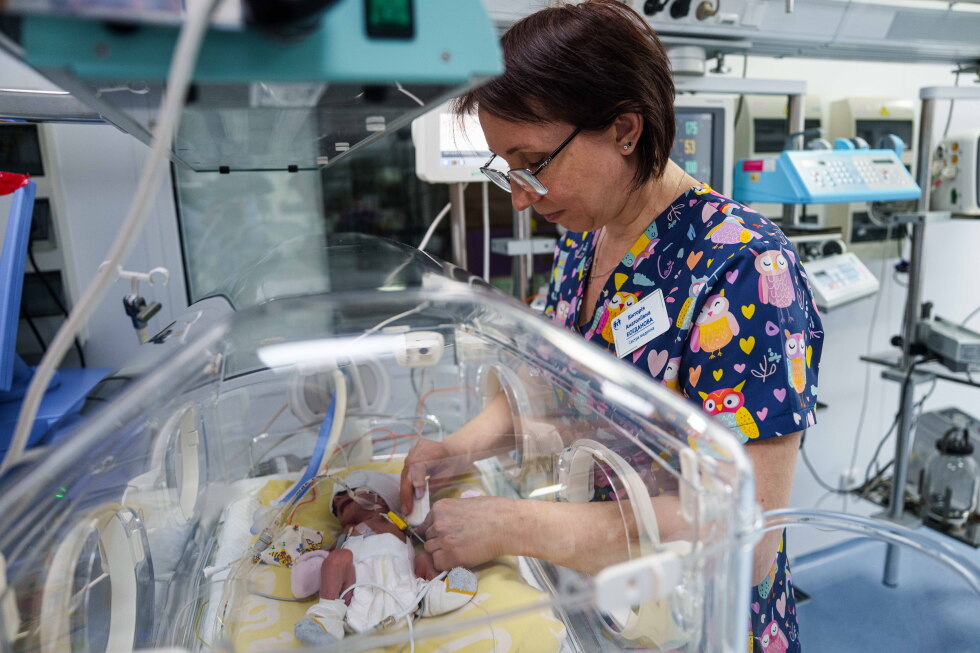
Providing life-sustaining care to these fragile preterm infants is an extraordinary challenge amid constant conflict. At Zaporizhzhia’s maternity hospital neonatal intensive care unit, a 30-week gestational newborn weighing just 700 grams — well below the World Health Organization’s 2,500 gram threshold for low birth weight — lies in a temperature-controlled incubator, sustained by IV nutrients, medication and a mechanical ventilator. A blanket is draped over the incubator to protect the baby’s developing eyes from harsh ward lighting. Dr. Andrii Lobanov, head of neonatology at Zaporizhzhia’s children’s hospital, explains that even minor missteps in care, such as improper oxygen level management, can cause permanent damage like blindness. Many preterm infants require lifelong care for respiratory, neurological, developmental or immune system conditions, placing a massive financial strain on Ukraine’s war-budgeted healthcare system.
“It is very expensive and of course a country in a war situation has to decide what it’s going to spend on, so hospital services invariably get hit. Both literally and metaphorically,” Weeks said.
Air raid sirens are now a constant background presence in neonatal intensive care units across frontline regions. When alerts sound, doctors do not evacuate the most fragile infants to underground shelters: moving the incubator-bound newborns would be far more dangerous than remaining in place, and sirens sound too frequently to halt care every time. Dr. Nataliia Bohuslavska, head of the neonatal unit at Zaporizhzhia’s maternity hospital, who has worked at the facility for 26 years and was born there herself, recalls a recent typical day: it began with incoming missile alerts, and by afternoon a Russian glide bomb had struck a local commercial district, killing 12 civilians. Through it all, care continued: doctors performed two cesarean sections, delivered a full-term infant, and treated a 42-year-old woman who suffered a miscarriage after witnessing the airstrike. The next day, a black mourning flag hung at the hospital entrance.
Bohuslavska knows every mother on her ward personally, aware of their fears and their unique struggles. Many, like Nekhoroshyva, are going through the experience alone while their partners fight on the front lines. For some, the trauma goes even deeper: when a mother calls to report her husband has been killed in combat, Bohuslavska’s only promise is that the hospital team will stand by her. “We have to support her constantly, so that even in the midst of this terrible loss, she can find the strength to give new life a chance and save her baby,” she said.
Not all stories end in despair, however. For Mariia Skladan, who was told her rare liver disease made conception almost impossible, the birth of her daughter Elina at 26 weeks in January was already a miracle. After five months of intensive care, Elina grew to a healthy 3.5 kilograms, and doctors cleared her for discharge. When Skladan walked out of the hospital with her daughter, her family waited outside with flowers, and Skladan wept tears of joy. “If there’s a war, what does it mean? Not to live?” she said. “You want to keep going.” But even this small victory was fragile: just one day after going home, Elina was readmitted to intensive care after contracting a viral infection, a reminder that the fight for these preterm infants is never over.