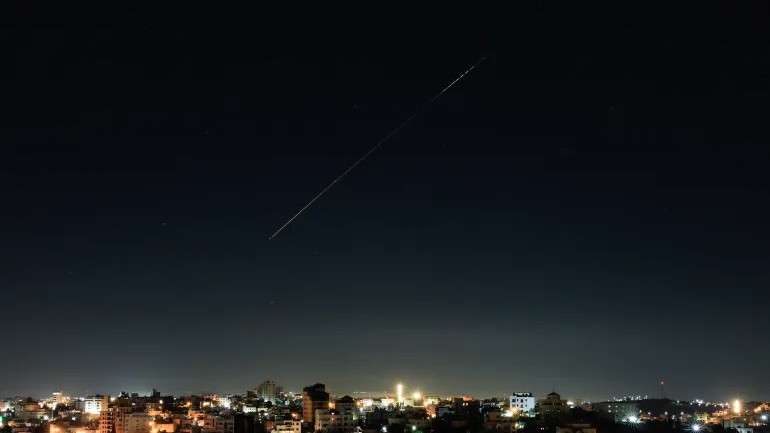
In a sharp escalation of Middle East tensions that has upended months of tentative ceasefire efforts, Iran launched a barrage of missiles toward northern Israel on Sunday, carrying out a long-threatened retaliation for Israel’s expanding military campaign in Lebanon. The attack marks the first direct Iranian strike on Israeli territory since a fragile truce was reached in April, and it has pushed the region closer to a full-scale regional conflict that risks drawing in major global powers.
Prior to launching the strikes, Iranian leaders issued a clear ultimatum: Israel must immediately halt its air assaults across Lebanon, particularly intensified targeting of Beirut’s southern Dahieh suburb, or face severe consequences. Following the missile launch, the Islamic Revolutionary Guard Corps (IRGC) explicitly tied the operation to Israel’s recent escalation in Lebanon, confirming that the attack was a direct response to Israeli strikes that had crossed what Iran called “all red lines.”
“We had previously warned that if the crimes in the Dahieh area of Beirut expand, we will attack targets in the occupied territories,” the IRGC’s top joint military command stated in an official announcement after the strikes.
Israeli military officials confirmed that they detected the incoming missile launches immediately and activated their layered air defense networks to intercept the projectiles. Despite interception efforts, the incident has dramatically raised stakes, with an unnamed Israeli official warning that any direct Iranian attack on Israeli soil would trigger an immediate military retaliation, and could even open a window for Israel to restart its full cross-regional military campaign.
General Ali Abollahi, commander of Iran’s Khatam al-Anbiya Central Headquarters, doubled down on Iran’s warnings Sunday, as Israeli air defense crews worked to neutralize the incoming missile salvos. “The Israeli army must stop its attacks on southern Lebanon and the suburbs, and if it expands its attacks to that region or responds to Iran’s action, it will face more devastating and regrettable blows,” Abollahi said.
The escalation has already derailed ongoing diplomatic efforts to reach a permanent ceasefire deal, according to U.S. President Donald Trump. Speaking to Fox News, Trump said that Sunday’s Israeli strike on Beirut had ruined momentum that had been building toward a final agreement, which he said was expected to be finalized as early as this week.
“I had expected an agreement could be signed “on Monday, Tuesday or Wednesday and now this takes place,” Trump said. He added that he was “not happy” about the Beirut strike that prompted Iran’s retaliation, and confirmed that the Israeli operation had not been coordinated with the U.S. government.
Trump also noted that Iran’s missile launch would only further hinder diplomatic progress, saying “it is certainly not going to help negotiations.” Amid the escalating crisis, the U.S. president confirmed that American military forces positioned across the Middle East have been placed on high alert.
The current tensions grow out of a broader conflict that began in February, when Trump launched U.S. air strikes alongside Israel against Iran. Negotiations between Washington and Tehran have remained deadlocked in recent weeks, even as the Trump administration has pushed for a quick final deal. Just days before the latest escalation, in an interview recorded Friday and broadcast Sunday during Trump’s visit to his New Jersey golf course, he repeated his aggressive threat to resume large-scale bombing if Iran did not accept a deal swiftly.
“We’re very close to a deal, or I’m going to blow the hell out of them,” Trump told NBC News.
The rapid sequence of escalations — from Israel’s expanded strikes in Beirut to Iran’s direct missile attack on Israel — has once again stoked widespread fears that the localized conflict could spiral into a full-scale regional war that draws in multiple neighboring countries and major powers beyond the immediate combatants.