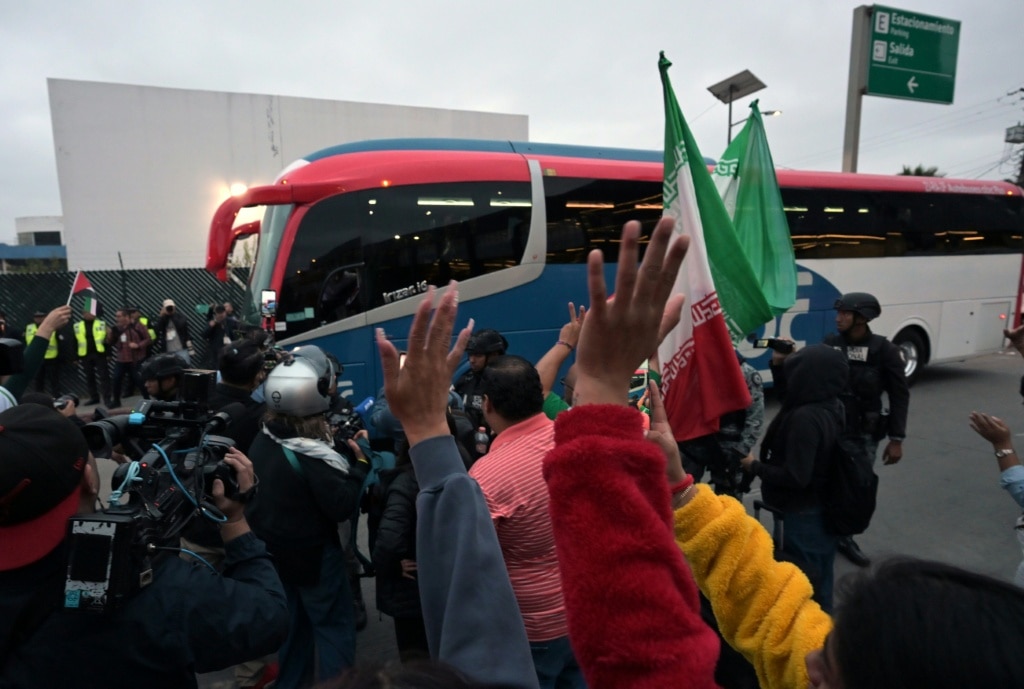
As the 2026 FIFA World Cup co-hosted by the United States, Mexico and Canada approaches, Iran’s national men’s football team, commonly known as Team Melli, has touched down in Tijuana, Mexico — their pre-tournament training base ahead of three group-stage matches to be held across the U.S. While a small but passionate group of Iranian supporters gathered at the crack of dawn Sunday to welcome the squad, the joyful occasion was overshadowed by a contentious visa controversy that has left the Iranian football community frustrated and disappointed.
Among the cheering crowd at Tijuana’s airport was Sadegh Galavi, a 30-something mechanic and long-time Tijuana resident who lives just a short distance from the U.S. border. Galavi rose before sunrise to greet the team when their flight landed at 5 a.m., wearing the iconic Iranian national team white jersey trimmed with green and red. For him, showing up to welcome the squad was a non-negotiable gesture of national pride. “My national team is coming to my city, and being here is a small thing I can do just to welcome them,” he told AFP. His excitement quickly shifted to criticism, however, over the visa denials that have disrupted the team’s delegation.
In total, roughly 15 accompanying Iranian delegation members were denied U.S. visas required to enter the country for the tournament. That list includes the head of the Iranian Football Federation, Mehdi Taj, who previously held a role in Iran’s Islamic Revolutionary Guard Corps — an organization Washington has designated as a terrorist group. While all 26 players successfully received the necessary visas to compete in their group matches against New Zealand, Belgium and Egypt scheduled for Los Angeles and Seattle, the denial of entry for top officials has deepened anger over the entanglement of politics and sports at the world’s biggest football event. “It makes no sense to me. Sport is supposed to be a symbol of peace, so when you mix politics and sports, it doesn’t work,” Galavi said.
This visa row is only the latest in a string of off-field disruptions that have plagued Iran’s World Cup preparation. The unprecedented situation stems from the ongoing open conflict between Iran and the United States, which began with joint Israeli-American strikes on Iran in late February. Never before has a World Cup participant been actively at war with one of the tournament’s host nations, leaving Iran’s participation in doubt for months amid global diplomatic uncertainty. It was only after repeated insistence from FIFA that Iran ultimately confirmed its team would compete, with the governing body prioritizing the right of athletes to participate on sport’s biggest stage.
Even after confirmation of participation, further changes came two weeks ago, when rising geopolitical tensions forced the Iranian Football Federation to scrap its original plan to base the team in Tucson, Arizona. Instead, the squad relocated its training base to Tijuana, a decision that fans and officials say offers greater safety and stability for the players ahead of the tournament. Tight security arrangements have already been put in place to protect the team: a large convoy of heavily armed Mexican police and military escorted the squad from the airport, and increased security measures have been deployed around the team’s hotel and Estadio Caliente, the venue where Iran will hold its public training sessions.
For Iranian supporters, the string of setbacks has done little to dim their enthusiasm for Team Melli, which is still chasing its first ever berth in the World Cup knockout stage. Sina Moghadam, an Iranian-American retired self-described patriot who traveled from San Diego, California just across the border to welcome the team, said off-field adversity would only strengthen the squad’s resolve. “Iran’s history goes back thousands of years. Things like this only make us stronger; they won’t destabilize the team,” he said, holding an enormous Iranian flag. Moghadam even said he hopes Iran advances far enough to face the U.S. in the knockout stage, calling for his national team to pull off an iconic victory against the host nation. “I hope they’re going to kick the US team’s ass,” he laughed as the players’ bus pulled away from the airport.
The new base in Tijuana has offered some comfort to fans concerned for the team’s safety. Hossein Nikyar, a 40-something engineer who drove overnight from Los Angeles with his son to welcome the team, noted that the relocation to Mexico removes the risk of disruption from anti-government Iranian opposition groups concentrated in Southern California. “It’s safer for them to be here than in Los Angeles anyway, because many Iranians in LA are royalists who want to take down the government,” he explained. Nikyar already holds tickets to Iran’s matches in Los Angeles, but he echoed the widespread frustration over the visa dispute, calling out FIFA’s long-held stance that sports should remain separate from politics. “FIFA claims that there’s no politics in the World Cup, and it’s all about the football fair play. But in fact, we see that it’s not true,” he sighed.
As Team Melli settles into its new training base in Tijuana, all eyes will be on whether the squad can overcome weeks of off-field chaos and political interference to deliver the breakthrough performance that Iranian football has waited decades to achieve.