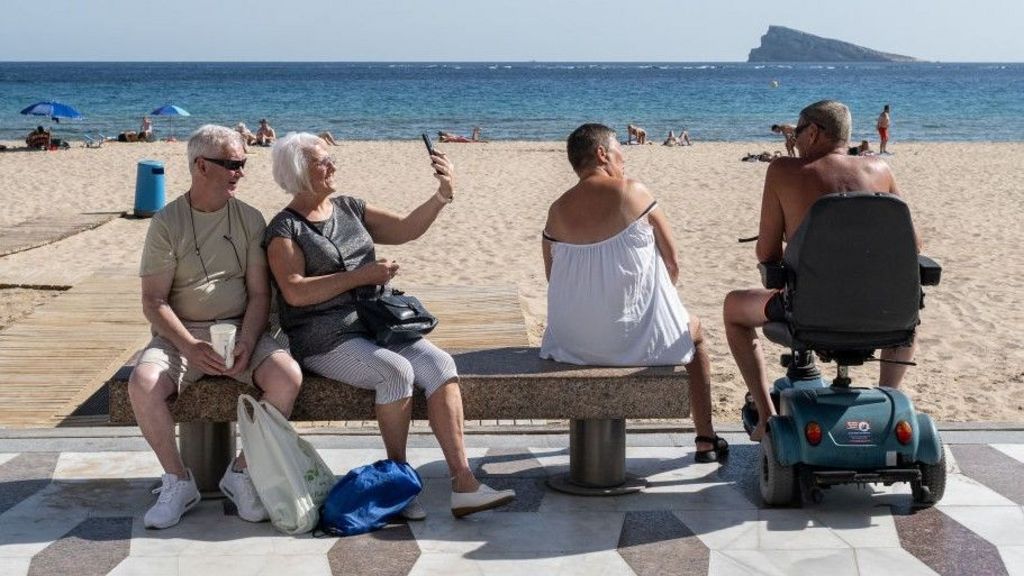
Standing on a sun-drenched hotel rooftop in Benidorm, Fede Fuster, president of the city’s local tourism association, gazes out over a skyline of high-rises stretching toward the iconic sweeping Mediterranean coastline. A third-generation tourism industry leader – his family was among the first to build a hotel here in the 1950s – Fuster says of the resort, “With all its virtues and its defects this is a place we feel proud of. It’s a place of opportunities.”
Benidorm, a permanent home to just 77,000 residents, regularly swells to five times that population at the peak of summer, making it one of Spain’s most valuable coastal tourism hubs. Like destinations across the country, it has staged a remarkable comeback since the Covid-19 pandemic left resorts empty and the national tourism industry at a complete standstill. Since borders reopened, annual international visitor arrivals have broken records year after year, hitting 97 million in 2025. Today, Spain ranks as the world’s second most popular tourist destination, trailing only France, and industry leaders are gearing up for an even stronger 2026.
Fuster is bullish on the coming year, predicting Spain will hit the historic milestone of 100 million international visitors and claim the top global ranking before long. What was originally projected to be a year of modest growth has been boosted by an unexpected tailwind: escalating geopolitical tensions between the U.S.-Israeli coalition and Iran have driven holidaymakers away from traditional Middle Eastern and Eastern Mediterranean destinations, turning Spain into a safe alternative. Fuster notes that this pattern is not new – demand for Spanish holidays jumped during the 2011 Arab Spring uprisings – though he emphasizes he would rather compete on equal footing than gain market share from global instability.
Francisco Femenia-Serra, a geography lecturer at Madrid’s Complutense University, explains that the safety dividend reshapes tourist flows across the region. “In these moments of crisis, of military strikes or wars, the bookings always increase,” he says, adding that price-sensitive travelers who would normally visit lower-cost destinations like Turkey or Egypt are now diverting to Spain. Official national visitor data backs this up: Spain welcomed 9.1 million international travelers in April 2026, a new all-time high for the month, representing a 5.2% increase (450,000 additional visitors) over April 2025. By contrast, Dubai International Airport reported a 66% drop in passenger numbers in March 2026, as flight cancellations and canceled bookings hammered the emirate’s travel sector in the wake of escalating tensions.
For Spain’s national economy, the tourism boom could not come at a better time: the sector directly contributes 13% of national GDP, and has driven overall economic growth that has outpaced major European peers including France, Germany, Italy and the United Kingdom in recent years. But despite the record-breaking numbers, two major threats loom on the horizon that could undermine the industry’s momentum. The first is a global risk: rising fuel costs that could push up airfares and discourage Europeans from taking international holidays. The second is a growing domestic crisis: rising public anger among local residents over the negative impacts of mass tourism on daily life.
Public opinion has shifted dramatically over the past decade. “Tourism was always accepted as a positive economic sector for Spain,” says Femenia-Serra. “That changed from 2016, 2017, with the label of over-tourism being put on some cities, like Barcelona. And now, most young Spaniards under 45 have a different image of tourism. They see it as a sector that obviously has a positive impact but also some negative outcomes in their lives.”
Since 2024, summer protests against excessive visitor numbers have spread across popular tourist destinations, from Mediterranean coastal hubs to the Balearic and Canary Islands. A 2024 Europe-wide YouGov poll found that 28% of Spaniards hold a negative view of foreign tourism – the highest share of any European country by a wide margin – and two-thirds of respondents sympathized with anti-over-tourism protests.
Local grievances center on three core issues: chronic congestion in city centers, increased environmental strain, and most critically, the role of short-term tourist accommodation in worsening Spain’s ongoing housing affordability crisis. In recent weeks, a new wave of protests has targeted soaring residential rents, with tourism repeatedly singled out as a key driver of the problem.
In a central Valencia bookshop, members of the local tenants’ union Sindicat de Llogateres gather regularly to help local residents navigate rental disputes. Many attendees have faced sharp rent hikes when their contracts come up for renewal, as landlords increasingly pivot to higher-yield short-term tourist stays. “When it comes to renewing rental contracts, the owners of properties no longer think about setting rents according to local salaries, but rather the salaries of people visiting from abroad, which might be three or four times higher,” says union representative Jordi Vila. “So local people end up getting pushed out of their homes.”
Vila points to Barcelona as the clearest example of this displacement, describing the city’s historic center as “a kind of theme park” where the proliferation of short-term tourist rentals has pushed long-term residents out to suburban areas. Even in smaller, northern destinations like Asturias, anger has boiled over into direct action: graffiti targeting holiday rental properties has appeared in recent days, bearing the slogan “Your business, our ruin.”
Both national and local governments have moved to address public anger, implementing new rules to curb the growth of unregulated short-term accommodation. In 2025, Prime Minister Pedro Sánchez’s left-wing coalition government warned that “there are too many Airbnbs and not enough homes,” and later fined the short-term rental platform €65 million ($75.5 million) for advertising unlicensed properties. Local authorities have gone further: many city councils have halted the issuance of new permits for tourist apartments, and Barcelona has announced plans to revoke licenses for all 10,000 of its existing short-term rental units by 2028, while doubling the city’s tourist tax to €8 for short-stay cruise ship visitors.
While tenant activists and protest groups have welcomed these measures, they say far more action is needed to protect local communities. But the tourism industry has pushed back against aggressive regulation. Exceltur, Spain’s leading national tourism industry association, has called for “the reparation of the links between the tourism sector and local residents,” warning that overly strict rules will harm both jobs and economic growth. The short-term rental sector has cited a PwC analysis of Barcelona’s license revocation plan, which warns the policy could erode the city’s tourism competitiveness and lead to the loss of thousands of local jobs.
Femenia-Serra notes that policymakers are still struggling to find a balanced solution that addresses local grievances without damaging the critical tourism economy. “We have measures that try to alleviate the impact that tourism has and that try to distribute tourists in cities in a different way,” he says. “But we still haven’t seen a single measure that is effective in reducing the number of tourists.”
Back in Benidorm, as Fuster prepares for what is projected to be another record-breaking summer, he acknowledges the legitimacy of local discontent and says the industry must adapt to retain social license. “We say we are the industry of happiness,” he says. “But we also have to realise that we impact the normal life of citizens. The way we welcome people and we care about them and our happiness, the way we live, I think that’s something the tourist really appreciates – that’s the key. That’s why we have to work a lot in these places, mostly in cities, where there is a feeling of not welcoming tourists. It’s very important for us because if we lose that, we’re dead.” To Fuster, making visitors feel welcome while respecting the needs of local communities is not just a social good – it is the foundation of the industry’s long-term survival.