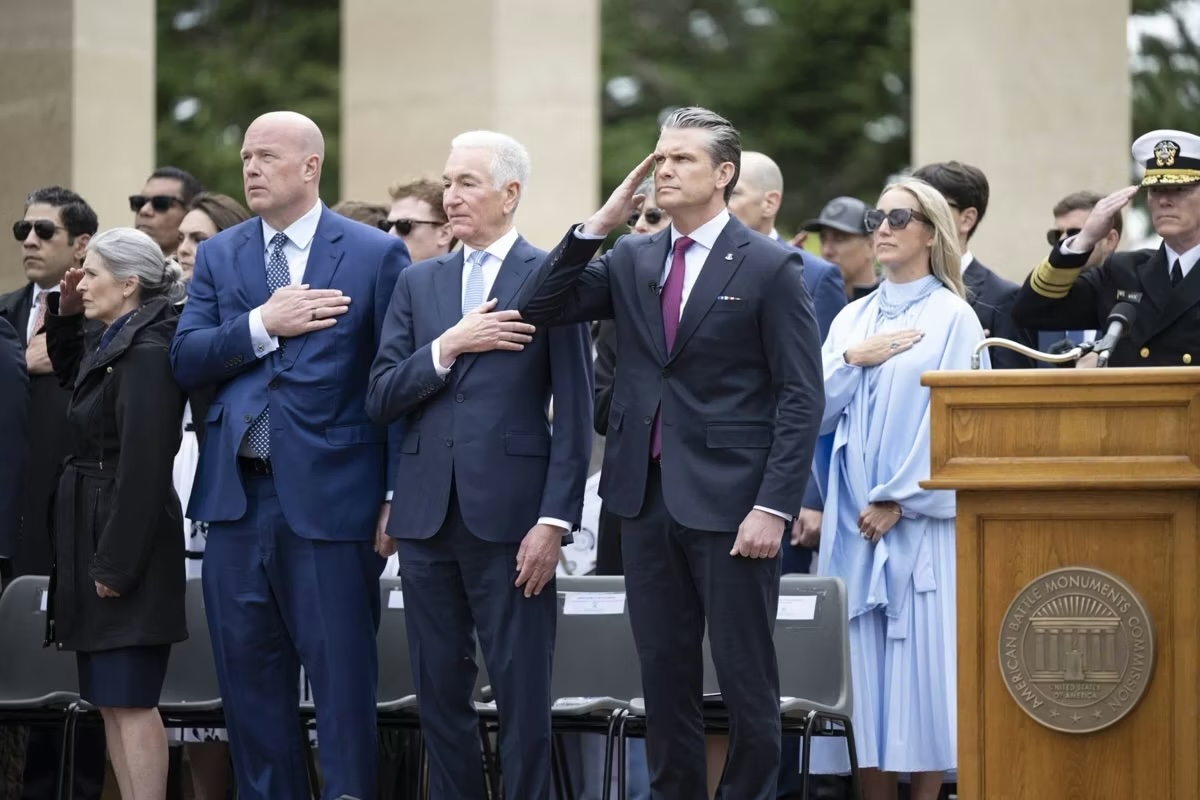
On the 80-plus anniversary of one of World War II’s most consequential moments, a controversy has erupted after US Defense Secretary Pete Hegseth turned a solemn D-Day memorial event into a platform for anti-migrant rhetoric that has drawn widespread condemnation from political leaders, veterans, and European community groups alike.
June 6, 1944, stands as one of modern history’s defining turning points: on that day, hundreds of thousands of Allied troops launched a massive amphibious invasion of Nazi-occupied Normandy, France, suffering thousands of fatal casualties but ultimately opening the western front that would bring down the Third Reich. Eighty years on, Hegseth returned for a second consecutive year to the Normandy American Cemetery in Colleville-sur-Mer, a site honoring the US service members who lost their lives in the landings, to deliver remarks at a Saturday D-Day remembrance event.
In his speech, Hegseth, a top cabinet official in the second Trump administration, drew a deeply controversial parallel between the 1944 Nazi invasion of Western Europe and modern irregular migration to the continent. “Sadly, today, different European beaches are stormed by different dangerous ideologies,” he said. “Beaches in Spain, in Italy, in Greece, and Bulgaria – boats and men arrive. When will European capitals do something about that invasion? Or is it too late? I pray not, and I believe not.”
Critics across the political and ideological spectrum were quick to denounce the remarks, labeling the speech a racist and white nationalist diatribe that disrespected the legacy of the D-Day fallen, who gave their lives to defeat fascist and racist authoritarianism. Multiple US political leaders joined the rebuke: House Minority Leader Hakeem Jeffries, a New York Democrat, noted that thousands of American heroes died on D-Day to defend freedom and defeat fascism, saying “Pete Hegseth should honor and respect their memory. Not politicize their ultimate sacrifice. May God Bless the Greatest Generation on D-Day and every day.”
Senator Tim Kaine of Virginia also condemned the speech on social media, writing, “Apparently our nitwit secretary of war(drobe) thinks a D-Day commemoration is an appropriate time to push his far-right ideology in Europe.” US Army veteran and progressive advocate Mike Lavigne went further, calling Hegseth “a disgrace to his office and to the nation.”
The backlash extended across the Atlantic to France, host of the commemoration events. Following his speech, Hegseth notably skipped the main international D-Day anniversary ceremony held in the coastal village of Langrune-sur-Mer that afternoon, according to French outlet France 24. Even if he had attended, local residents made clear he would not have been welcomed. A local municipal civic association, Langrune en commun, had previously called for Hegseth’s planned visit to be canceled outright, arguing the Pentagon chief “espouses values contrary to democracy, human rights and peace” and has a record of “numerous anti-European remarks,” “warlike statements,” and “American supremacist pronouncements.”
Association member Sylvie Lamy Thepaut told French broadcaster BFM TV, “He has very warlike views and it seems to us that this man does not share our democratic values.” The group’s formal statement added, “The honor of Langrune, that of France, and the memory of the young Allied soldiers – American, British, Canadian – who died on our beaches in the name of democracy would dictate canceling this individual’s visit.”
Hegseth’s inflammatory comments came just 24 hours after another top Trump administration official, US Vice President JD Vance, similarly stoked controversy with anti-migrant rhetoric tied to a high-profile killing in the United Kingdom. Vance claimed on social media that Henry Nowak, an 18-year-old student fatally stabbed in the UK last year by a British national who has since been sentenced to life in prison, would still be alive “if the last few generations of European elites had stood their ground against the politics of self-hatred and the mass invasion of migrants, many of whom despise the West and the people who love it.”
Vance added that “stopping the flow of mass migration and defending national sovereignty is a matter of political will and leadership” – a core priority of the second Trump administration, he argued.
A spokesperson for UK Prime Minister Keir Starmer rejected Vance’s framing, noting that the Nowak family had explicitly asked that the teen’s death not be exploited to stoke further division, hatred, or tension. “In recent days we have seen people trying to interfere in our democracy and seeking to stir up division on our streets,” the spokesperson said. “They have said they don’t want his death to be used to create further division, hatred, or tension. We should be respecting their wishes. Our politics should bring people together even in the most terrible of circumstances. That is who we are as a country.”
Both Vance and Hegseth’s recent remarks are fully aligned with the Trump administration’s December 2025 National Security Strategy, a policy document that heavily embraces rhetoric commonly associated with far-right white nationalist circles. The strategy accuses the European Union of pursuing migration policies that “are transforming the continent and creating strife,” warns that “should present trends continue, the continent will be unrecognizable in 20 years or less,” and states that US policy aims to help “Europe to remain European, to regain its civilizational self-confidence, and to abandon its failed focus on regulatory suffocation.”
The controversy comes as the 27-member European Union recently advanced a sweeping overhaul of its bloc-wide migration policy, a move that human rights advocates have criticized as echoing the hardline immigration enforcement model the Trump administration has implemented through US Immigration and Customs Enforcement (ICE) in the United States. Silvia Carter, spokesperson for the Brussels-based Platform for International Cooperation on Undocumented Migrants, told The Associated Press that “Across the Atlantic, we see the violence and fear created by ICE’s brutal immigration enforcement. Europe should be learning from the harms of that model, not building its own version of it.”
Irregular migration to Europe already carries a devastating human cost: the International Organization for Migration reported in February 2026 that at least 7,667 people died or went missing on global migration routes in 2025 alone. That toll includes more than 2,185 people who died or disappeared crossing the Mediterranean Sea, and another 1,214 on the Western Africa/Atlantic route toward Spain’s Canary Islands, with the organization noting the true death toll is almost certainly higher than recorded figures.