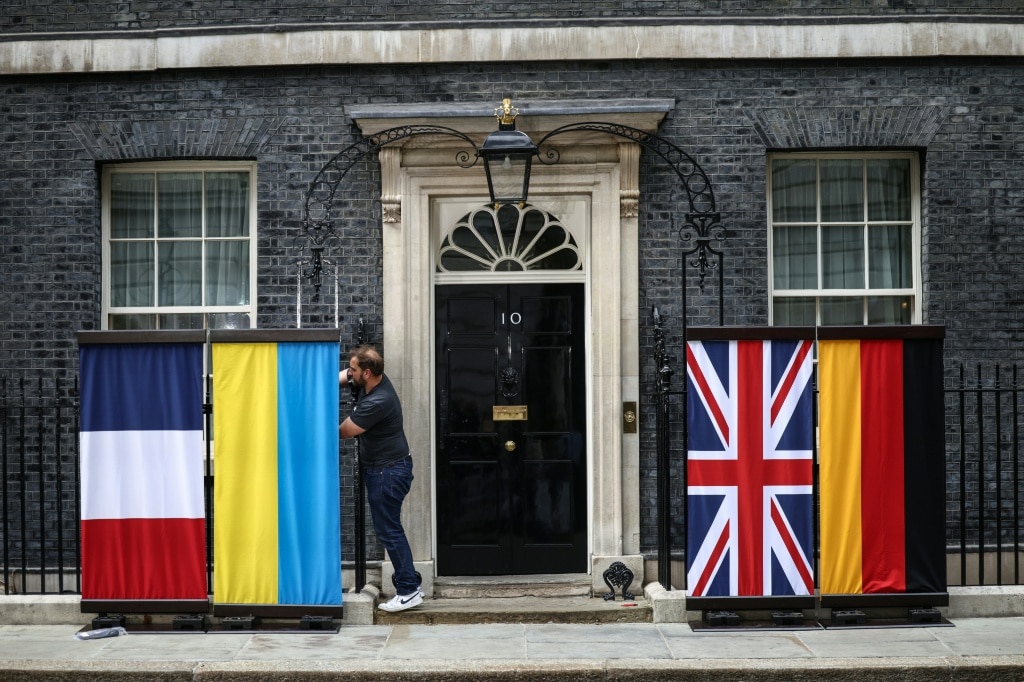
On a high-stakes diplomatic trip Sunday, Ukrainian President Volodymyr Zelensky touched down in London to hold urgent defense-focused talks with top leaders from the United Kingdom, France and Germany, just hours after a new wave of Russian cross-border strikes left five civilians dead and damaged a nuclear storage facility at the Chernobyl disaster site.
In a social media statement confirming his arrival, Zelensky outlined two core priorities for the talks: securing accelerated shipments of additional ammunition for Ukraine’s frontline air defense systems, which are strained by daily Russian bombardment across Ukrainian territory, and coordinating new, stronger collective pressure measures against Moscow to force an end to the full-scale invasion that launched more than three years ago.
Hours ahead of Zelensky’s London arrival, Russian forces launched a multi-wave assault combining drones and other long-range munitions across Ukraine. According to Ukrainian nuclear officials, one Russian munition struck a spent nuclear fuel storage facility located within the exclusion zone surrounding the long-decommissioned Chernobyl nuclear power plant, the site of the 1986 catastrophic nuclear disaster. Ukraine’s state-run nuclear energy operator Energoatom confirmed the strike partially destroyed the facility’s fuel reception building, but added that radiation monitoring readings remained well within safe, normal limits following the attack.
Zelensky, who early confirmed the strike was carried out by an Iranian-designed Shahed drone supplied to Russia, noted that while radiation levels have not spiked, the attack demonstrates a dangerous escalation in Moscow’s willingness to target critical nuclear infrastructure. “There is certainly an increase in Russia’s brazenness, which long ago went off the charts,” he said in a social media post.
The United Nations’ nuclear watchdog, the International Atomic Energy Agency (IAEA), responded quickly to the incident, saying it was deploying an expert inspection team to Chernobyl to assess the full extent of the damage and verify safety conditions. The agency called the strike on the facility “deeply concerning.” The storage facility, located roughly 12 kilometers from the original 1986 disaster site in a remote, unpopulated forested area, is purpose-built to hold spent nuclear fuel from Ukraine’s three operating commercial nuclear power plants.
The Sunday strikes extended beyond the Chernobyl exclusion zone, with deadly attacks on civilian areas across multiple Ukrainian regions. In southern Ukraine’s Zaporizhzhia region, Russian shelling hit a public transport stop, killing at least two civilians, while a separate drone strike in the area killed a 56-year-old minibus driver. In central Ukraine’s Dnipropetrovsk region, two more civilian men were killed in additional Russian attacks, regional governor Oleksandr Ganzha confirmed via Telegram.
Ukrainian forces also launched a reciprocal drone strike on Russian territory, killing a civilian woman and injuring her husband in a car attack in Russia’s border Belgorod region, local Russian authorities confirmed. The tit-for-tat strikes mark an escalation in the mutual cross-border drone campaign that has intensified over recent months, amid a broader stalemate in peace negotiations.
More than three years into the war, which began with Russia’s full-scale invasion in February 2022, U.S.-led diplomatic efforts to end the conflict remain stalled, with international focus largely diverted by the ongoing conflict in the Middle East. Russian President Vladimir Putin has repeatedly rejected direct peace negotiations proposed by Zelensky, and Russian forces currently hold roughly one-fifth of Ukrainian territory, including the Crimean Peninsula annexed in 2014, most of the eastern Donbas regions of Donetsk and Luhansk, and large swathes of southern Zaporizhzhia and Kherson. The war has left hundreds of thousands dead and forced millions of Ukrainians to flee their homes.