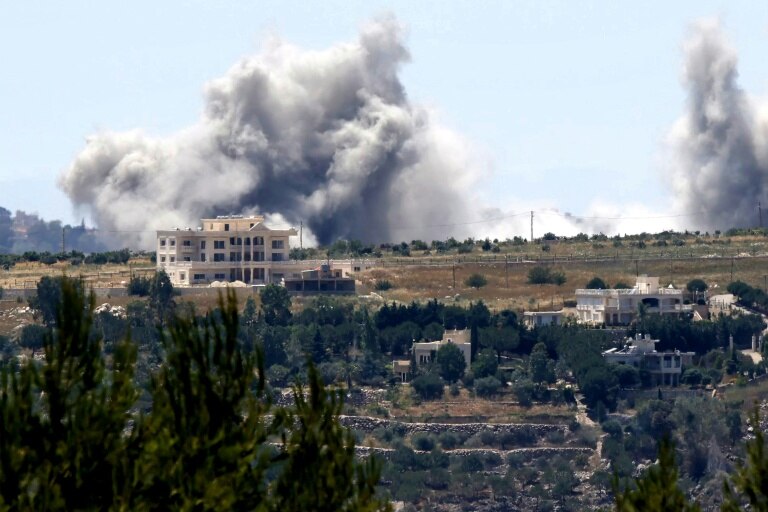
Fresh cross-border violence has sent tensions soaring between Israel and Lebanon’s Iran-backed militant group Hezbollah, after Israel carried out targeted airstrikes on Beirut’s southern suburbs Sunday, responding to what it says were rocket launches by Hezbollah targeting Israeli civilian areas.
Sunday’s strikes marked only the third time that southern Beirut—an area long considered a core Hezbollah stronghold—has been hit by Israeli attacks since mid-April, a zone that had remained relatively quiet amid months of routine cross-border fire exchanges between the two sides. In an official confirmation of the operation, Israeli Prime Minister Benjamin Netanyahu’s office stated the military had just targeted a Hezbollah militant command center in Beirut’s Dahiyeh district, launching the assault in direct response to Hezbollah fire directed at Israeli territory.
A separate statement from the Israel Defense Forces (IDF) elaborated on the operation, noting that after Hezbollah fired projectiles toward civilian communities inside Israel, the IDF executed a “precise strike” against a key Hezbollah command post. The military added that it had taken multiple proactive steps to minimize civilian harm before the attack, including the use of precision-guided munitions and advanced aerial surveillance to reduce unintended civilian casualties. Lebanon’s state-run National News Agency (NNA) confirmed the strikes hit two residential apartments located in separate multi-story buildings. An Agence France-Presse (AFP) photographer on the ground documented visible damage to two apartments in one residential building on a narrow Beirut side street, while widespread traffic gridlock formed as panicked local residents attempted to evacuate the suburb, and Lebanese military units deployed to secure the affected area.
Earlier on Sunday, air raid sirens triggered across northern Israel, and the IDF confirmed it had successfully intercepted two projectiles that had crossed the border from Lebanese territory. Hezbollah has not issued an immediate public response to the Beirut strikes, though the group did confirm separate offensive operations targeting Israeli military personnel along the Lebanese border earlier the same day.
This latest escalation comes just days after indirect negotiations in Washington, where Lebanese and Israeli diplomatic representatives presented a conditional ceasefire proposal that would have required Hezbollah to halt all cross-border fire and withdraw its fighters from positions near the Israeli-Lebanese border. The proposal collapsed after Hezbollah rejected the terms, demanding that Israel fully withdraw from all contested Lebanese territory before any ceasefire can take effect. Even before Sunday’s strike, Israeli officials had explicitly warned they would target southern Beirut if Hezbollah resumed attacks on northern Israel.
The current unrest in Lebanon grew out of the broader Middle East conflict, when Hezbollah opened the border front on March 2, launching rockets at Israel in a show of support for its regional patron Iran. Tehran has since maintained that any comprehensive agreement to end the wider regional conflict—currently paused by a separate ceasefire reached in April—must also include an end to hostilities along the Israel-Lebanon border.
Iranian officials have already issued sharp threats of retaliation over Sunday’s strikes. Iranian parliamentary speaker and chief negotiator Mohammad Bagher Ghalibaf accused the United States of giving Israel a “green light” to carry out the Beirut attack, warning that “our armed forces, as always, are free to act” in response. Ebrahim Rezaei, spokesman for the Iranian parliament’s national security commission, echoed the threat, promising a “decisive and painful response” to the Israeli operation.
Iran’s position tying the Lebanon conflict to the broader regional war has significantly complicated diplomatic efforts led by the United States to de-escalate tensions. In an interview aired Sunday on U.S. network NBC’s *Meet the Press*, recorded one day before the strike, U.S. President Donald Trump called on Israel to adopt more targeted military tactics. “I’d like to see a more surgical attack on Hezbollah,” he said. “I’d like to see Lebanon have a better life.”
Sunday’s violence extended far beyond the capital, with the NNA reporting a wave of additional Israeli strikes across multiple locations in southern Lebanon. The attacks come one day after Lebanese authorities confirmed at least five people, including a Lebanese army general, were killed in separate Israeli strikes across the region.
On Sunday, the IDF also issued a mandatory evacuation warning for most of the coastal city of Tyre and its surrounding outskirts. The city currently shelters thousands of internally displaced people who fled earlier fighting near the border, and it has faced heavy sustained bombardment since hostilities began. An AFP correspondent on the ground reported that Lebanese civil defense teams evacuated roughly 500 families from school buildings that had been repurposed as emergency shelters, moving them to the city’s Christian quarter, which was not included in the evacuation order.
Further north near the coastal city of Sidon, public funerals were held Sunday for four people killed in an Israeli airstrike a day prior: three members of one extended family and a local rescue worker. Lebanon’s ministry of health reports that at least 131 rescue workers have been killed by Israeli strikes since the conflict began. “We do not carry rockets, our only weapon is the bread we deliver to people,” Qassem Foani, a fellow rescuer, told AFP. “They went and gave the family bread, but as they were leaving, a drone struck them.”
According to updated counts from Lebanon’s health ministry, Israel’s wide-ranging air campaign and ground invasion of southern Lebanon have killed more than 3,600 people in the country since hostilities escalated earlier this year.