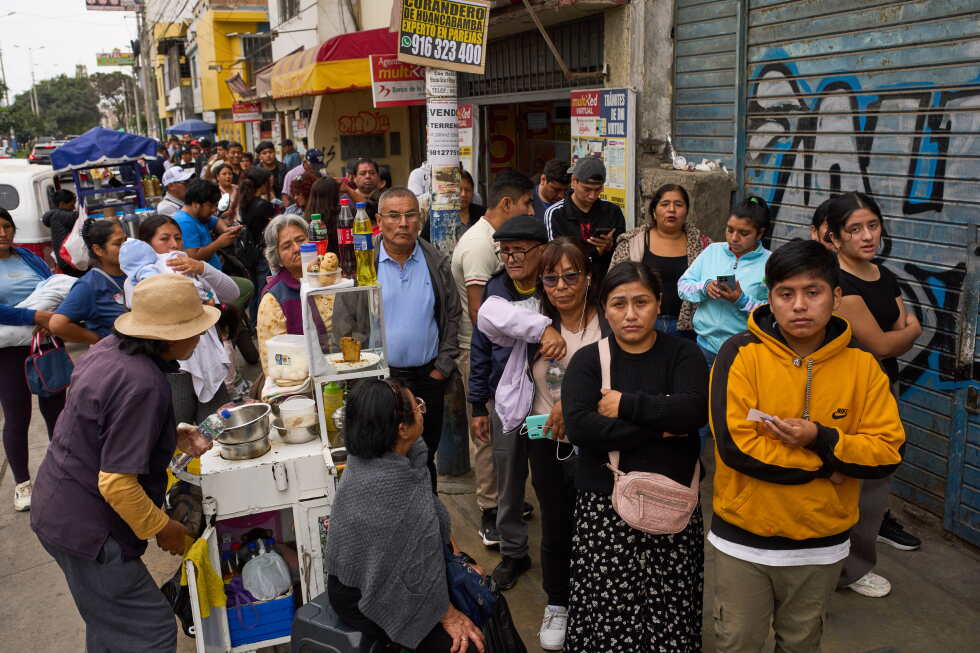
Peru is set to select its ninth head of state in a decade on Sunday, as voters weigh two ideologically opposed candidates in a tightly contested runoff election dominated by widespread anxiety over rising violent and organized crime. Conservative Keiko Fujimori, daughter of the late disgraced former president Alberto Fujimori, and nationalist congressman Roberto Sánchez, a close ally of imprisoned former president Pedro Castillo, advanced to the runoff after topping an April first-round field of 35 candidates. Notably, neither candidate secured even 20% of the first-round vote, and pollsters still show roughly 30% of the electorate remains undecided heading into the final vote.
Voting is compulsory for all Peruvian citizens between the ages of 18 and 70, with more than 27 million registered voters nationwide. Roughly 1.2 million of those registered voters will cast ballots from abroad, with the largest groups voting from the United States and Argentina. Given the close split in voter support, election observers expect Sunday’s final results to be extremely close, echoing the first-round uncertainty that saw electoral officials take more than a full month to officially confirm Fujimori and Sánchez as the top two finishers. Many political analysts warn a final official outcome could take days to emerge this round as well.
Official first-round results put Fujimori at 17% of the vote, with Sánchez trailing at 12%, and a mid-June Ipsos national poll found support for the two candidates remains nearly identical, with undecided voters still holding the balance of power. Fujimori carries the dual legacy of her father’s 1990s administration, which is credited with defeating the violent Shining Path insurgency but tainted by widespread authoritarian corruption. After her parents separated in 1994, she stepped into the role of Peru’s first lady at a young age, and this marks her fourth bid for the presidency.
For Sánchez, his closest political ties are to Pedro Castillo, the populist former president ousted and imprisoned following a 2022 attempted dissolution of congress. Castillo’s turbulent 16-month term saw more than 70 cabinet reshuffles, leaving many voters wary of his close affiliation with the candidate. The 57-year-old, who often wears a wide-brimmed peasant hat gifted to him by Castillo, draws his strongest support from rural Peruvian communities. He has sought to ease investor concerns about his presidency, explicitly ruling out nationalization of foreign-owned mining and gas assets, and has openly welcomed continued Chinese investment in Peru’s key natural resource sectors.
Crime and public safety have emerged as the defining issue of the campaign, with recent data underscoring the depth of public anxiety. A 2025 national survey from Peru’s National Institute of Statistics and Informatics found that 84% of urban residents fear they will fall victim to a crime over the coming 12 months, with extortion identified as one of the fastest-growing threats. Policy experts trace the growing power of organized criminal groups to massive profits from decades of illegal gold mining operations in the Andes and Amazon regions, which have allowed networks to expand their influence across the country.
Both candidates have centered their campaigns on aggressive crime-fighting pledges, though their approaches differ sharply. Fujimori, 51, has run on a hard-line platform that echoes her father’s counter-insurgency successes. Her policy proposals include deploying new digital tracking tools to target extortion rings, militarizing Peru’s border regions, increasing the presence of police and military personnel in high-crime areas, and mandating that incarcerated people work to “repay society” for their crimes. During the only pre-runoff debate, she defended her father’s record, telling voters a vote for her would restore the safety that would let Peruvians leave their homes without fear of attack.
By contrast, Sánchez has focused his security platform on rooting out corruption within Peru’s national police force, while advancing reforms that allow the military to formally support domestic security operations. With the entire country watching Sunday’s vote, the election will not only shape Peru’s response to its growing crime crisis but also set the course for the nation’s economic and political future after a decade of constant executive turnover.