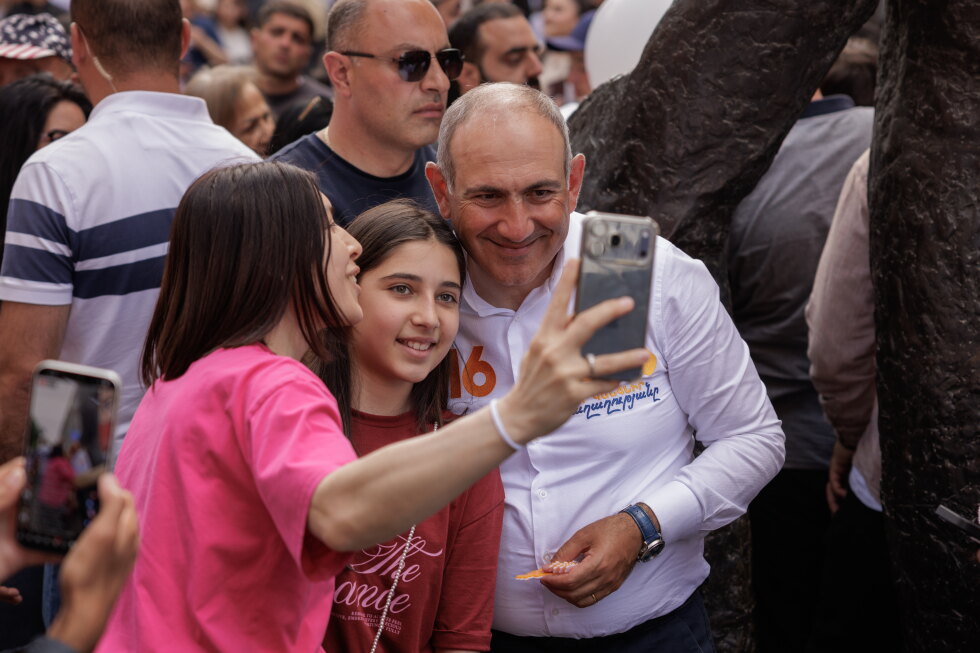
YEREVAN, Armenia — As Armenians head to the polls for a critical parliamentary election Sunday, the small South Caucasus nation finds itself at a defining geopolitical turning point, with the incumbent government pushing to reorient its foreign policy away from historical reliance on Moscow toward deeper engagement with Western powers – a shift that has drawn escalating retaliation from the Kremlin.
Prime Minister Nikol Pashinyan, who rose to power in 2018 on a wave of popular street protests, and his ruling Civil Contract party are seeking a solid parliamentary mandate to cement their new geopolitical course. They face a fragmented opposition largely dominated by factions that openly advocate for closer alignment with Russia.
In the weeks leading up to the vote, Russian authorities have imposed a sweeping set of trade restrictions on Armenian exports, covering everything from cut flowers, select cognac and wine varieties to fresh produce like eggplants and potatoes, dried fruit, and fish. Moscow claims the bans stem from violations of agricultural import standards, but the European Union has decried the measures as blatant political coercion. Beyond economic pressure, top Russian officials including President Vladimir Putin have issued thinly veiled warnings that echo the path that led to open conflict in Ukraine, drawing a direct parallel between Armenia’s Western overtures and Ukraine’s pre-2022 EU integration efforts.
“If the Armenian people see benefits in joining the European Union then we will certainly have nothing to say against it,” Putin told reporters following Russia’s May 9 Victory Day parade. He quickly added a sharp caveat, however: “We are currently living through everything that is happening in respect of Ukraine. And how did it start? It started with Ukraine’s joining or attempting to join the EU.” Putin has also stressed that Armenia cannot simultaneously remain a member of the Russian-led Eurasian Economic Union (EEU) and integrate with the EU’s customs union, calling the dual alignment “simply impossible by definition.” Moscow also retains major control over Armenia’s energy and infrastructure networks, and has regularly leveraged its supply of subsidized natural gas as a reminder of Armenia’s existing economic dependence.
In pre-election developments, Armenian law enforcement issued six arrest warrants for members of the pro-Russian opposition Strong Armenia party on the eve of the vote, alleging the group engaged in widespread vote-buying. The country’s Central Election Commission had previously rejected calls from another opposition faction, the Republic party, to bar Strong Armenia from running over corruption allegations, clearing the way for the party to participate. Strong Armenia is led by Armenian-Russian billionaire Samvel Karapetyan, who is currently under house arrest facing trial on charges of advocating for the overthrow of the Pashinyan government – charges Karapetyan dismisses as a politically motivated smear. He has overseen the party’s campaign from detention, with support from his nephew Narek Karapetyan. The faction frames Pashinyan’s course as a reckless push toward conflict with Russia and prioritizes expanding economic and political ties with Moscow.
Other key pro-Russian opposition contenders include former Armenian President Robert Kocharyan, leader of the Hayastan opposition bloc, who has accused Pashinyan of severely damaging Armenia’s long-standing relationship with Russia. Another major faction is the Prosperous Armenia Party, headed by pro-Russian business leader Gagic Tsarukyan. All major opposition groups have also blasted Pashinyan’s ongoing efforts to normalize relations with neighboring Azerbaijan, a process brokered in part by the West. The two countries have been locked in a decades-long dispute over the Karabakh region, which was held by ethnic Armenian forces backed by Armenia for nearly 30 years before Azerbaijan reclaimed full control of the entire territory in a 2023 military offensive. In August last year, Pashinyan and Azerbaijani President Ilham Aliyev initialed a framework for a peace deal at the White House, with U.S. President Donald Trump in attendance.
“I want this government to change because the condition of our country is getting worse,” Sahakyan Elina, a Prosperous Armenia supporter, told the Associated Press at an opposition rally Thursday. “I don’t want to live with my enemies in unity.”
Pashinyan has publicly framed his foreign policy as a balanced approach that aims to maintain positive relations with Russia, alongside building stronger ties with the U.S., Europe, and regional powers including Turkey and Iran. Despite this framing, his government has been received far more favorably in Western capitals than in Moscow. Notably, Donald Trump has publicly endorsed Pashinyan’s re-election bid, taking to social media to call the Armenian prime minister “a great friend and Leader” who “is making his Country strong, wealthy, and very secure,” and urging Armenian voters to “Make (Armenia) Great Again.”
Under Armenia’s electoral law, the 101-seat National Assembly is elected for five-year terms, with a 4% vote threshold for individual parties to gain representation, and an 8% threshold for multi-party blocs. A total of 17 individual parties and two electoral blocs are contesting Sunday’s vote. Most independent pollsters and regional analysts currently project that Pashinyan and Civil Contract will emerge from the election with a leading share of seats. “I think Armenians expect, first of all, a peaceful, independent and prosperous Armenia from this election, as we have today,” said Hripsime Grigoryan, an outgoing Civil Contract member of parliament.