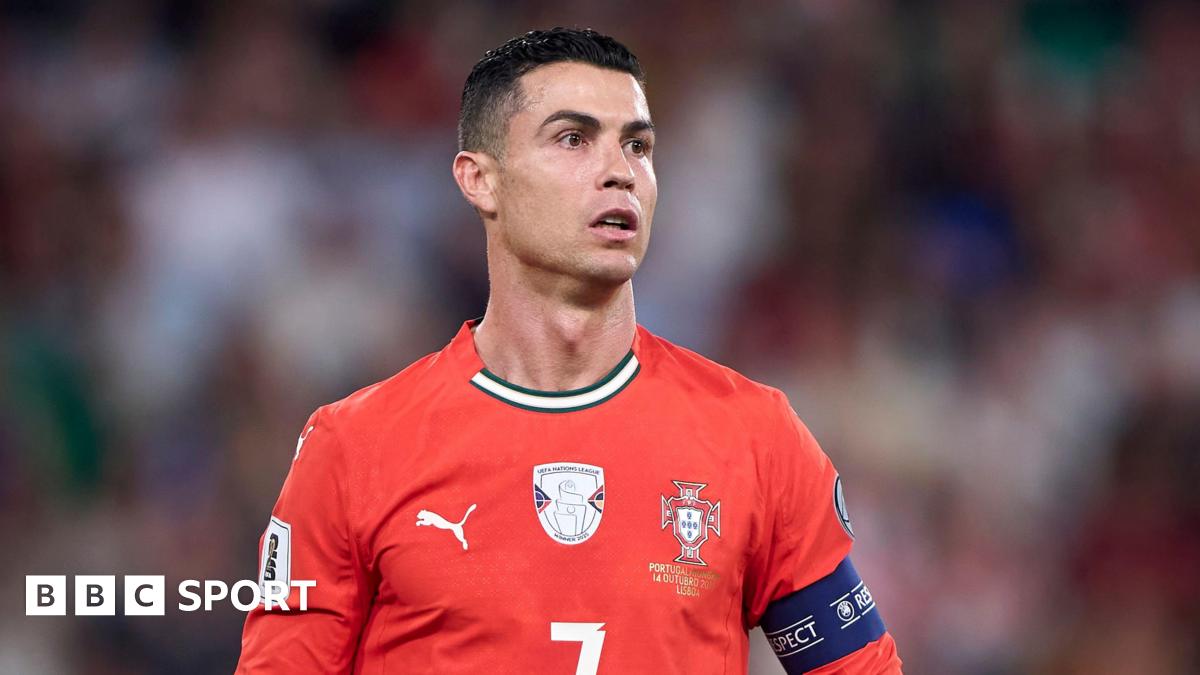
It has been nearly 21 years since Cristiano Ronaldo first stepped onto the pitch as a senior Portugal national team player, a moment that took place in a forgettable-looking friendly against a newly UEFA-affiliated Kazakhstan in the northern Portuguese city of Chaves. The 1-0 narrow win was hosted in front of a sold-out crowd of just 8,000 spectators, on a pitch so poorly maintained that groundskeepers had to paint the grass to improve its visible condition. Few could have predicted that the young Madeira native would go on to build a legacy that would redefine Portuguese football, and make history by qualifying for a sixth FIFA World Cup in 2026 – joining only Lionel Messi of Argentina and Guillermo Ochoa of Mexico in this exclusive club of six-time World Cup participants.
Today, at 41 years old, Ronaldo holds the record for the most international goals in men’s football history, with 143 strikes to his name. Beyond the statistics, he has reshaped the national team’s mentality and expanded the global profile of the small European nation. As former Sporting CP and Portugal national team coach Joao Aroso told BBC Sport: ‘We are a small country that rarely has global impact outside football. Cristiano allows our small country to be known worldwide for something great – because of all the positive things he stands for.’
For decades, questioning Ronaldo’s place in the Selecao was widely seen as taboo in Portugal. But since the 2022 Qatar World Cup, public and internal debate over his role has intensified, splitting opinion across the football community in the country. Critics, including 1966 World Cup third-place finisher Antonio Simoes, argue that Ronaldo’s priority has shifted to being the center of attention rather than prioritizing team success, a contrast to legendary Portuguese striker Eusebio.
Portugal’s head coach Roberto Martinez has repeatedly pushed back on this discourse, dismissing it as inconsequential ‘lift talk’. In all recent press conferences addressing the five-time Ballon d’Or winner, Martinez has highlighted a single key stat: Ronaldo has notched 25 goals in his last 31 appearances for the national side. ‘We are talking about the greatest player of all time. He is here because he is still performing at a very high level, not because of what he achieved in the past,’ Martinez explained.
Having already scored at each of his five previous World Cup appearances, Ronaldo will get one final chance to prove his critics wrong on the game’s biggest stage. The Al-Nassr forward has eight World Cup goals to his name, just one shy of Eusebio’s all-time Portuguese record, but his ultimate goal remains clear: leading Portugal to their first ever World Cup trophy. Ronaldo himself has already confirmed that the 2026 tournament will be his last World Cup, regardless of the outcome.
Even as age has slowed his raw physical pace, supporters and former teammates insist his impact stretches far beyond goals. ‘Cristiano understands the big moments better than almost anyone in football,’ former Portugal international Abel Xavier told BBC World Service. ‘That experience can be decisive in a World Cup. His presence is very important. People focus on the physical side, but there is also the technical side and especially the mental side. The younger players look up to him and he always gives something to the team.’
Ricardo, the former Portugal goalkeeper who was on the pitch for Ronaldo’s 2003 senior debut and now serves on the national team’s coaching staff, echoed that sentiment. ‘The speed may no longer be quite the same. Instead of running at 200km/h, he is running at 195km/h now. It is still incredibly high,’ he said. ‘As long as the physical, technical and mental qualities are still there, he remains a devastating force. With him, danger is never far away.’
Under Martinez, who took over the Portugal job in 2023 after stepping down from his role with Belgium, Ronaldo has featured in 31 of the manager’s 39 games in charge to date, with most of his absences coming from injury or suspension. Critics have pointed to two of Portugal’s biggest recent victories that came without Ronaldo in the squad: a 9-0 thrashing of Luxembourg in Faro in September 2023, and a 9-1 blowout of Armenia in Porto that November. Those results reignited long-running debates over whether the team performs better without their iconic captain.
Portuguese football pundit Sofia Oliveira, who works with CNN Portugal, DAZN Portugal and TSF radio, argues that Ronaldo no longer has the elite form to start for a title-contending side, and notes that the national team has not prepared for a tournament without him in the starting lineup. ‘But it is easy to arrive at this tournament and say Ronaldo should not be starting, which I agree with. The problem is that the national team has not been preparing for it,’ she explained.
Managing a figure of Ronaldo’s cultural and sporting stature has always been fraught with risk. Former Portugal manager Fernando Santos learned this lesson after benching Ronaldo during the 2022 Qatar World Cup. The decision sparked a fierce public backlash from Ronaldo’s family members on social media, and Santos stepped down from his role shortly after the tournament.
When asked earlier this year if he feared the same fate if he benched Ronaldo in 2026, Martinez downplayed the concern. The star’s outsized influence in Portugal has led to ongoing questions about his influence off the pitch, too: when the Portuguese Football Federation (FPF) announced a February 2024 partnership with AVA CR7, a physical recovery company owned by Ronaldo, the move immediately drew criticism over potential conflicts of interest. The FPF has pushed back against these claims, releasing a statement to BBC Sport noting that the partnership complies with all internal and regulatory rules, that Ronaldo himself was never involved in the negotiations, and that all discussions were held exclusively with AVA’s management team.
As Ronaldo nears the end of his decorated professional career, growing attention has turned to whether the FPF and Portuguese football are prepared for a future without their biggest star. The federation has stated that it is ready for the transition, after closing 13 consecutive financial years in profit and approving a 2026-2027 budget that projects a record €161 million in revenue. FPF president Pedro Proenca noted that Ronaldo’s legacy will forever be tied to Portugal, and confirmed that the federation’s financial stability is secure regardless of the star’s eventual retirement.
‘Cristiano will always be intrinsically linked not to the federation, but to Portugal as a country,’ Proenca said. ‘The FPF has always prepared for its present and its future. Of course, we know the importance Cristiano has. The two brands overlap – Cristiano Ronaldo and the FPF – I have to be honest and sincere about that. What I can guarantee is that the federation’s operating revenues are secure for the continuity of a cycle that will happen naturally and normally, which is Cristiano’s departure.’
More than two decades after that unassuming night in Chaves that launched his international journey, Ronaldo remains the undeniable center of Portuguese football, and all eyes will turn to him as he kicks off what he says will be his final World Cup campaign.