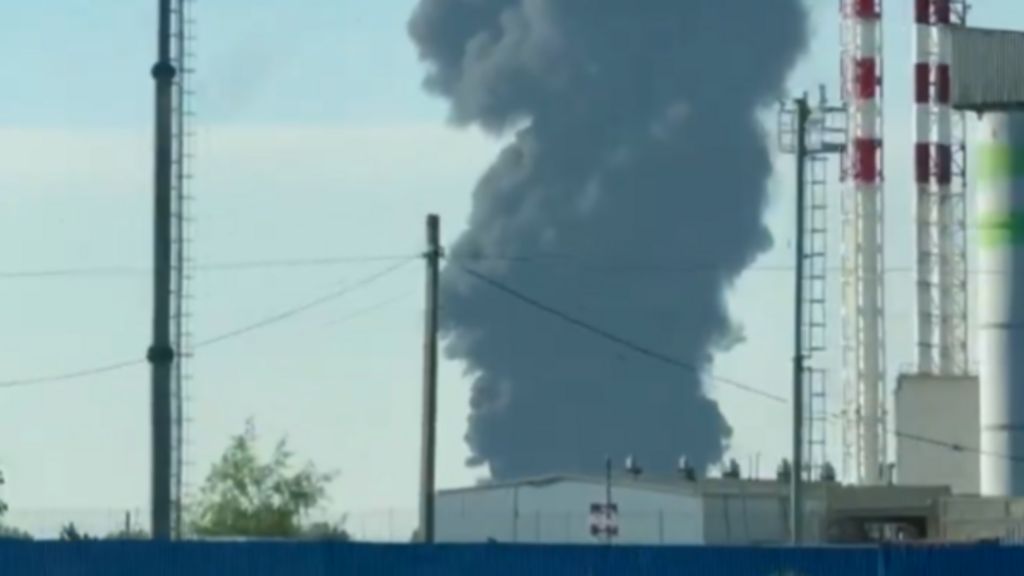
In a dramatic escalation of the ongoing conflict that has gripped Eastern Europe since 2022, Ukraine launched what Russian authorities have labeled an “unprecedented attack” using drones targeting locations in and around St. Petersburg, timed to coincide with the final day of Russia’s flagship annual international economic forum. This major offensive came just 24 hours after Russian President Vladimir Putin rejected a long-awaited call for direct, face-to-face peace talks with Ukrainian President Volodymyr Zelenskyy, setting off a new cycle of military action amid stalled diplomatic efforts.
Russian regional officials confirmed that more than 140 unmanned aerial vehicles were intercepted and shot down across the Leningrad Oblast, the administrative region surrounding St. Petersburg. In an extraordinary step not seen since the full-scale invasion began, St. Petersburg Governor Alexander Beglov issued an urgent order for all local residents to stay indoors throughout the attack, a directive that underscored the severity of the incursion deep into Russian territory.
Shortly after the strikes, Zelenskyy confirmed the operation via a social media video post, framing the action as a proportional and just response to repeated Russian attacks on Ukrainian territory. He detailed that Ukrainian military forces targeted Russian weapons arsenals and a key Russian naval base located in Kronstadt, a strategically significant port just off the St. Petersburg coast. The drone sortie marked an extraordinary 1,000-kilometer deep strike into Russian heartland, demonstrating Ukraine’s expanding long-range strike capabilities. Zelenskyy added that a second target, an oil storage depot in Russia’s southern Krasnodar Krai, roughly 500 kilometers from the Ukrainian border, was also successfully hit in coordinated operations.
The attack capped off three days of rapid diplomatic developments. On Thursday, Zelenskyy released an open letter formally calling for direct one-on-one negotiations with Putin to end the full-scale war Russia launched in February 2022. He argued that waiting for external intervention, specifically renewed focus from the United States, was a strategic mistake that only prolonged the conflict. A day later, during his keynote address at the St. Petersburg Economic Forum, Putin flatly rejected the overture. He reaffirmed Russia’s longstanding position that formal peace negotiations must precede any ceasefire agreement, and stated that Russia would only end military operations once all of its stated war goals had been achieved. Those goals, Moscow has repeatedly made clear, require Ukraine to cede full control of four partially occupied regions—Donetsk, Luhansk, Kherson, and Zaporizhzhia—and permanently abandon its bid to join the North Atlantic Treaty Organization.
Alongside the strike on St. Petersburg, Ukrainian drone operations have intensified in Russian-occupied territories of Ukraine in recent weeks, specifically targeting Russian military logistics networks. In occupied Luhansk Oblast, the Moscow-installed puppet administration was forced to suspend intercity bus service along two major motorways, issuing a public warning for locals to avoid the routes “for security reasons” following a string of successful Ukrainian strikes. The administration also suspended regional commuter rail service and implemented a ban on group travel for minors across the occupied region. This disruption comes despite Putin’s prior claims that Russia holds full and complete control over the self-proclaimed “Luhansk People’s Republic.”
Speaking to the BBC, one regional security analyst noted that the scale of Ukraine’s targeting campaign has been substantial: since the start of May, Ukrainian drones have destroyed or damaged more than 200 military cargo trucks and over 30 fuel tankers supporting Russian frontline operations, severely straining Russian supply lines in occupied areas.