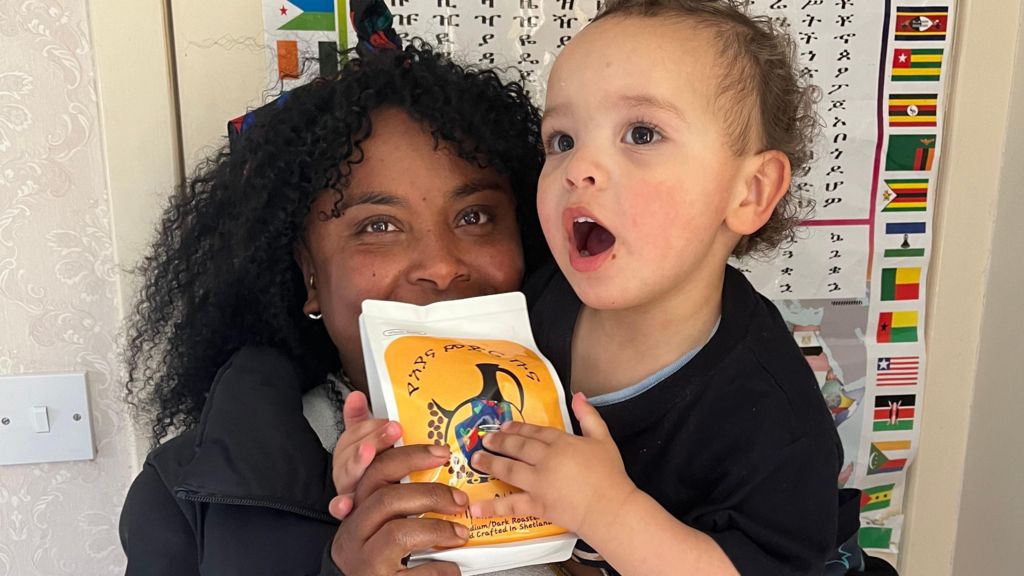
Nestled in the rugged Shetland archipelago off the northern coast of Scotland, the small island of Whalsay has long been home to a beloved local tradition: honesty boxes, unstaffed roadside stalls stocked with everything from fresh farm eggs to homemade baked goods. In a charming new twist on this community custom, a recent addition to the island’s lineup of stalls offers something far out of the ordinary – hand-roasted Ethiopian coffee, brought to the 1,000-person community by Netsanet Sori, an Ethiopian immigrant who goes by the nickname Netsi.
Sori’s connection to coffee runs deeper than a simple love of the drink. Raised on her family’s small-scale coffee farm in the rural Ethiopian highlands, coffee has been woven into her daily life since early childhood. Tragically, she lost her mother at a young age, and was raised by her grandmother and great-grandmother on the farm, an experience that forced her to mature quickly. “How I was raised there, compared to here, it’s completely different,” she reflected in an interview.
After nine years living and working in Orkney, another northern Scottish island group, Sori relocated to Whalsay in October 2025. Even thousands of miles from her native home, she has never lost touch with her roots. She imports raw green coffee beans directly from the family farm where she grew up, turning her lifelong connection to the crop into a way to share Ethiopian culture with her new Scottish neighbors. For Sori, this project is about more than just selling coffee – it is a way to preserve tradition for the next generation. “It’s very important to me and I will teach my children about it as well,” she said.
In Ethiopia, coffee is far more than a morning pick-me-up: it is the center of a daily community ritual, traditionally led by women, that brings neighbors together. “Neighbours and villagers gather once or twice in a day to share information, good news or bad news, and love,” Sori explained. “It’s also about community belonging. If you make a coffee, you can’t drink it alone. You have to share what you have and help others.”
Sori’s process mirrors the traditional methods she learned growing up, with only small adjustments for modern convenience. When raw, pale green beans arrive at her Whalsay home, they carry a soft, earthy scent before roasting. She cleans the beans by hand, then roasts them in a single pot, shaking the container constantly over heat to ensure an even roast. As the beans cook, they deepen into a rich chestnut brown and release fragrant oils – a sign, Sori says, of high-quality, well-roasted coffee. While traditional Ethiopian roasting uses a manual mortar and pestle to grind finished beans, she now uses a small electric grinder to speed up the process for commercial sales.
Before moving to Whalsay, Sori only roasted small batches for herself, friends, and local charity events during her time in Orkney. But after settling into her new home, she realized there was an unmet demand for artisanal, small-batch roasted coffee across Shetland. “After a little research, I realised that nobody else is roasting coffee like this in Shetland, so I thought I can do it,” she said. “It’s worked brilliantly. People seem to really like it.”
Local residents have embraced Sori’s unique offering wholeheartedly. Ingrid Sutherland, a Whalsay local and self-described coffee lover, first tried the beans at a community Christmas fair and has been a repeat customer ever since. “I’m a bit of a coffee drinker, I love a good cup of coffee in the morning – real coffee, not instant, so I was just blown away with how cool it is,” Sutherland said. She added that the convenience of the honesty box model fits perfectly with island life: “It’s local as well, so I can just nip along the road and get a bag, rather than going out of the isle. We have plenty of egg boxes and cake fridges here in Shetland, but we didn’t have a coffee box. It’s fantastic to have a coffee box here.”