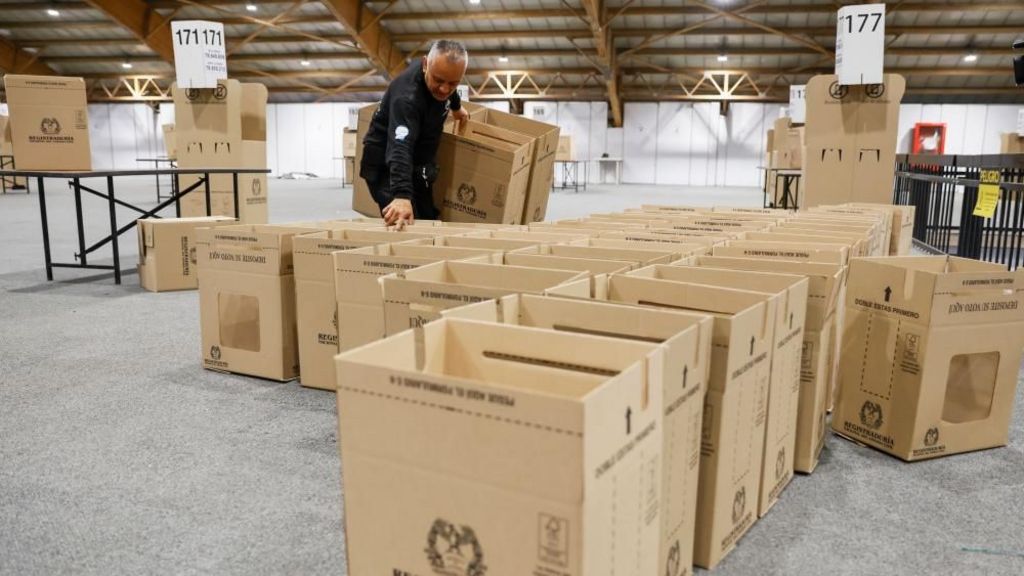
Colombia is entering a critical electoral moment on Sunday, as millions of voters head to the polls to select the country’s next president, wrapping up a campaign defined by deep domestic division and months of tense diplomatic friction between the outgoing left-wing administration and the U.S. government under former President turned incumbent Donald Trump.
Outgoing Colombian President Gustavo Petro, who is term-limited and cannot run for re-election, has spent months locked in public sparring with Trump over a range of divisive issues, from bilateral drug policy to Washington’s long history of intervention in Latin America. Petro has thrown his full political weight behind his preferred successor, Iván Cepeda, who is running against two prominent centre-right challengers: Abelardo de la Espriella and Paloma Valencia. As of pre-election polling, Cepeda holds a narrow lead over de la Espriella, but no candidate is on track to secure the outright majority needed to win the contest outright, making a June 21 run-off vote almost certain.
Voting opened at 8 a.m. local time (1 p.m. GMT) and will conclude at 4 p.m. local time, with results expected to trickle in through the evening. The outcome of this election carries sweeping stakes for both Colombia’s domestic future and its international posture: a win for Cepeda would lock in the Petro administration’s existing progressive agenda, while a centre-right victory would likely trigger a sharp pivot back toward closer security and diplomatic alignment with the United States.
Cepeda has run on a pledge to continue the outgoing government’s flagship “total peace” policy, an initiative that sought to negotiate ceasefires and long-term settlements with the armed insurgent groups and criminal gangs that have long controlled large swathes of Colombia’s territory and dominated the multi-billion dollar cocaine trade. The policy has faced harsh criticism in recent years, however, as many negotiated talks have stalled or collapsed entirely, leading to a sharp resurgence in armed violence across the country. A 2025 report from the International Committee of the Red Cross confirmed that civilian casualties from armed conflict in Colombia reached a 10-year high last year, underscoring the urgency of the next government’s response to security challenges.
By contrast, Cepeda’s centre-right opponents have vowed to abandon the negotiation strategy entirely, promising a full military crackdown on all armed groups and drug trafficking networks if they win power. The campaign has unfolded against a grim backdrop of persistent political violence: one local candidate was fatally shot during the campaign season last summer, and last week de la Espriella was forced to speak from behind bulletproof glass during a public rally in Medellín, a stark reminder of the risks facing political figures in the current climate.
The diplomatic rift between Petro and Trump has dominated the national conversation throughout the campaign. The capture of former Venezuelan President Nicolás Maduro by U.S. forces in January left Petro as one of the last remaining left-wing leaders in Latin America who openly opposes the Trump administration’s regional agenda. Trump has repeatedly attacked Petro over cocaine production, accusing him of failing to stop the flow of Colombian cocaine into U.S. communities. At one particularly heated moment, Trump called Petro “a sick man who likes selling cocaine to the United States” and implied that Colombia could be targeted for U.S. military intervention next.
Trump’s criticisms are partially backed by data: the 2025 United Nations World Drug Report recorded that cocaine production in Colombia has surged to all-time record highs during Petro’s time in office. Petro has pushed back against these claims, arguing that his government has seized more illicit drugs than any previous Colombian administration, and disputes the United Nations’ methodology for counting production. While the two leaders appeared to repair their public relationship during a White House meeting in February, where Trump referred to Petro as “terrific”, the underlying tensions between the two governments have shaped the campaign’s core ideological divides.
Cepeda has echoed Petro’s core stance on U.S.-Colombia relations, insisting that Colombia must maintain its full sovereignty and refuse to become a “vassal state” to Washington. Even so, regional policy observers note that longstanding anti-drug cooperation between the two countries has continued uninterrupted through even the most heated public disputes. For their part, de la Espriella and Valencia have both promised to immediately restore the close security alliance with the U.S. that they argue the Petro administration has eroded.
As voters cast their ballots on Sunday, the entire world is watching: the result will not only determine how Colombia addresses its ongoing spiraling violence and drug trade, but will also reshape regional geopolitics at a moment of heightened U.S. influence across Latin America.