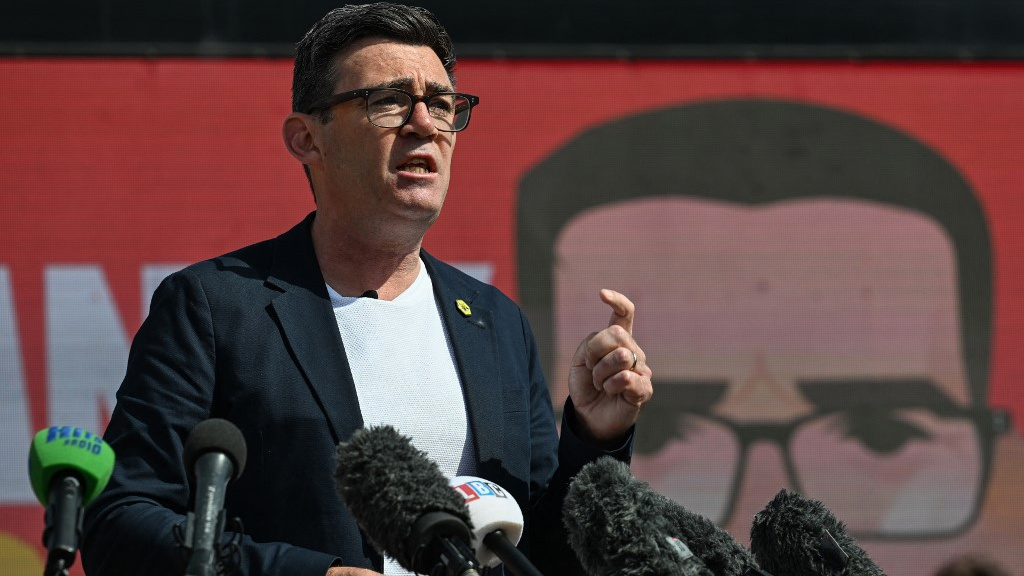
As the race for leadership of Britain’s Labour Party slowly takes shape ahead of a upcoming by-election, two prospective contenders have staked out contrasting positions on the highly charged question of whether Israel’s military campaign in Gaza amounts to genocide, exposing deep internal divides within the party over Middle East policy.
Andy Burnham, the sitting Mayor of Greater Manchester who is running to become Member of Parliament for Makerfield in the June 18 by-election — a step widely seen as paving his way to challenge Keir Starmer for the party leadership and eventually the post of prime minister — laid out his stance in a Thursday interview with *The Guardian*. When pressed to label Israel’s actions in Gaza as genocide, Burnham declined, arguing that the gravity of such an accusation puts it beyond his ability to rule on from his current position. “I can’t judge things of that enormity from where I am as mayor of Greater Manchester,” he told the outlet.
That said, Burnham did not shy away from criticizing the scale of Israel’s military operation. He made clear he holds serious concerns about what he described as the disproportionate level of destruction inflicted on Gaza, and called for a full independent investigation to hold responsible parties to account. His comments come against a backdrop of mounting death and humanitarian catastrophe in the enclave: since the October 7, 2023 Hamas attack that killed roughly 1,200 people in Israel, Israeli military operations have killed nearly 73,000 Palestinians in Gaza, with an additional 170,000 wounded. Thousands more remain unaccounted for, presumed dead under rubble from Israeli airstrikes and ground operations. Humanitarian groups have also documented that Israel has implemented a deliberate policy of blocking entry of food, clean water, medicine and other essential supplies to Gaza’s civilian population, creating widespread famine; even when aid has been allowed in after global public outcry, the volume has been far too insufficient to meet the needs of Gaza’s 2 million trapped residents.
Multiple prominent human rights organizations, including Amnesty International, Human Rights Watch, and leading Israeli human rights groups, have formally concluded that Israel’s actions in Gaza meet the legal definition of genocide, a finding echoed by dozens of leading global genocide studies experts. Last year, a United Nations commission of inquiry also reached the conclusion that Israel is committing genocide in Gaza.
Burnham’s position is notably more muted than that of another likely Labour leadership challenger, Wes Streeting, the recently resigned UK Health Secretary who has also publicly stated his ambition to replace Starmer as prime minister. While Streeting has never publicly accused Israel of genocide or war crimes, internal details that emerged late last year revealed he privately stated that Israel was carrying out war crimes “before our eyes” and that the Israeli government was using the “language of ethnic cleansing.” This week, while he did not repeat those private accusations publicly, Streeting defended his decision to share a dossier of graphic images showing injured Palestinian children in Gaza with fellow cabinet ministers. He told reporters he was “horrified by the war in Gaza” and had worked behind closed doors to pressure the British government to act with what he called the moral urgency the crisis demands. “That included sharing the eyewitness testimony of doctors on the ground in Gaza, whose accounts needed to be heard at the highest levels of government to ensure that what was happening in Gaza wasn’t a war without witnesses,” Streeting explained.
Streeting also launched a sharp rebuke of Starmer’s leadership on the issue, saying that while multiple cabinet ministers pushed for a stronger policy shift on Gaza, their efforts repeatedly ran into intransigence from the top. “We often felt like we were hitting up against a brick wall. Our concerns and motives were dismissed,” he said. Streeting sought to frame his position as balanced, noting that he has long backed both Israel’s right to self-defense and the Palestinian people’s right to an independent sovereign state, pointing to his past record as a backbench lawmaker when he called for sanctions on illegal Israeli settlements in the West Bank, his meeting with survivors of the October 7 attack, and his status as the first shadow cabinet minister to visit Israel.
Disclosed documents released earlier this week showed a sharp negative reaction from senior Labour figure Peter Mandelson, the disgraced former cabinet minister, Labour peer and former UK ambassador to the U.S., who described Streeting’s criticisms of Israel as “wild” and “hysterical” and claimed the contender was “experiencing an early midlife crisis.”
Unlike Streeting, who publicly backed the Labour leadership’s initial support for Israel’s post-October 7 war on Gaza, Burnham broke ranks with Starmer’s team just weeks after the conflict began, joining London Mayor Sadiq Khan and Scottish Labour leader Anas Sarwar to issue a joint statement calling for an immediate permanent ceasefire. Their statement expressed “profound concerns about the loss of thousands of lives in Gaza, the displacement of many more and widespread suffering through the ongoing blockade of essential goods and services.” Burnham also became one of the most prominent proponents within the Labour Party of pressing the government to formally recognize a Palestinian state, a step Starmer’s government ultimately took last September.
In a rare show of unity with Starmer, however, Burnham defended the Labour leader’s recent diplomatic clash with U.S. President Donald Trump. Trump had publicly attacked Starmer, claiming the UK had failed to provide sufficient support for the U.S.-Israeli assault on Iranian military targets, despite Britain granting the U.S. access to British military bases to carry out strikes on Iranian missile sites. Burnham argued that Starmer’s approach had been correct, noting that “normally you would want a good relationship with the US, but if you can’t agree with them, then say that as well. That’s the only way I think to deal with him [Trump].” He added that while the US-UK special relationship remains important to Britain, that does not mean the UK should blindly align with every U.S. policy position. “We’ve got in trouble in the past when that happens, so no, I think the approach that Keir has taken is the right one”, Burnham said.
This report was originally published by Middle East Eye, a media outlet that provides independent, in-depth coverage of the Middle East, North Africa and broader global affairs.