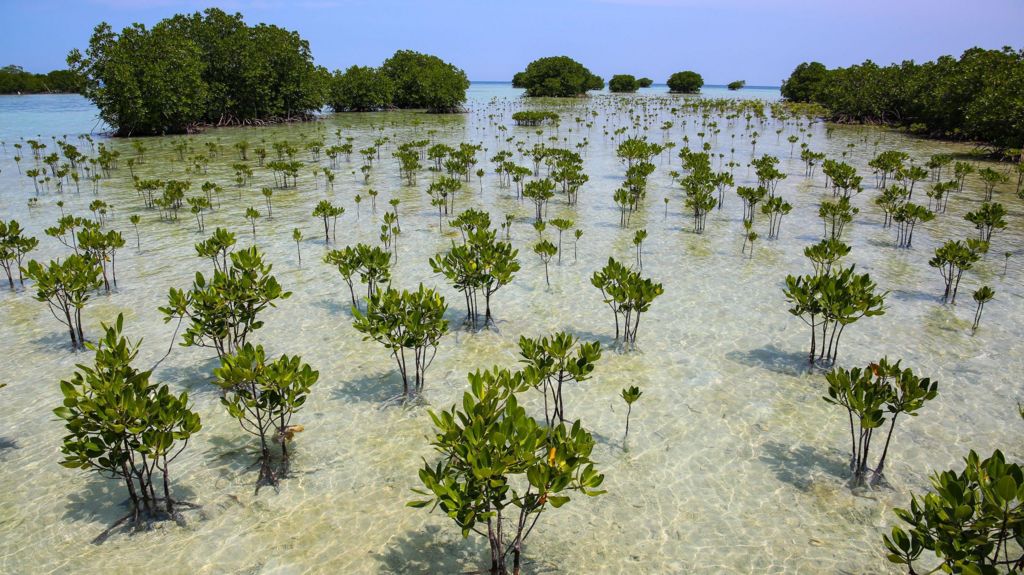
Long known as one of the planet’s most underappreciated environmental workhorses, coastal mangrove forests are now making a surprising global recovery, according to new research published by an international team of scientists. For nearly half a century, these salt-tolerant swampy trees faced rapid, widespread clearing as coastal development, industrial aquaculture, and agricultural expansion pushed human activity deeper into tropical and subtropical shorelines. But the latest study reveals a striking reversal of this decades-long trend: since 2010, global mangrove coverage has grown at a faster rate than it has declined.
Mangroves deliver a rare stack of interconnected ecological and community benefits that few other ecosystems can match. Their dense, tangled root systems act as natural coastal barriers, dissipating wave energy from storm surges and tsunamis to shield millions of people living in low-lying coastal communities. They are also unparalleled carbon sinks, storing up to five times more carbon dioxide per hectare than most terrestrial forests, making them a critical natural tool in the fight against anthropogenic climate change. Beyond climate and protection, their root networks form thriving nurseries for hundreds of species of fish, crustaceans, and other marine life, supporting global fisheries and coastal biodiversity.
From the 1980s through 2010, this vital ecosystem suffered devastating losses: more than 12,000 square kilometers of mangrove forest—an area roughly equal to the entire island nation of Jamaica—was cleared across Asia, Africa, and the Americas. Today, that net loss has shrunk dramatically to just 849 square kilometers total since the 1980s, a staggering reduction that points to widespread, meaningful change in how communities and governments value these forests.
Researchers attribute this shift to multiple interconnected factors, starting with shifting public and policy attitudes spurred by high-profile climate disasters. The 2004 Indian Ocean tsunami, which killed hundreds of thousands of people across the region, was a turning point: communities observed that shorelines protected by intact mangrove forests suffered far less damage and loss of life than those where forests had been cleared. In Indonesia, one of the world’s most mangrove-dense nations, this awareness led to a sharp slowdown in clearing mangroves for commercial fish farms. A similar shift followed Cyclone Nargis in Myanmar in 2008, reinforced by a national logging ban implemented in 2016; today, mangrove coverage is growing steadily there, while it has stabilized in Indonesia after decades of decline.
Beyond policy and awareness, researchers highlight mangroves’ extraordinary natural resilience as a key driver of recovery. Once human clearing activity stops, these forests can regenerate naturally and expand on their own far faster than many restoration projects can achieve. Improved satellite imaging technology also played a role in documenting this recovery: the study used high-resolution Landsat satellite data, which is far more sensitive to small changes in forest canopy coverage than older mapping systems, allowing scientists to detect new growth that previous global assessments missed. Independent experts note this new data marks a major advance in global mangrove monitoring.
Even with this encouraging trend, the research warns of remaining threats and uneven progress across regions. West and Central Africa have emerged as new hotspots of mangrove destruction, with the Niger Delta standing out as a particularly hard-hit area. Oil exploration and pipeline construction have left clear, permanent cut through large swathes of the delta’s mangroves, with ongoing pollution degrading remaining stands. Additionally, some new mangrove growth has a hidden environmental cost: in regions like Brazil, increased nutrient runoff from upstream deforestation and mining has created fertile growing conditions for downstream mangroves, meaning one ecosystem’s loss is fueling another’s gain. Intense tropical cyclones also continue to cause large, sudden annual losses from Australia to the Caribbean, threatening long-term recovery in storm-prone regions.
Despite these caveats, the study’s authors frame the overall trend as a clear win for conservation. Not only has net loss slowed to a near standstill, but existing mangrove forests are also growing healthier: the proportion of closed-canopy mangroves—the most carbon-dense and biodiverse form of the ecosystem—has increased by nearly 20% since the 1980s. Lead researcher Dr. Zhen Zhang of Tulane University emphasized that the global trajectory is clearly moving in the right direction, proving that intentional conservation policy and increased public awareness can reverse even decades of ecosystem decline.