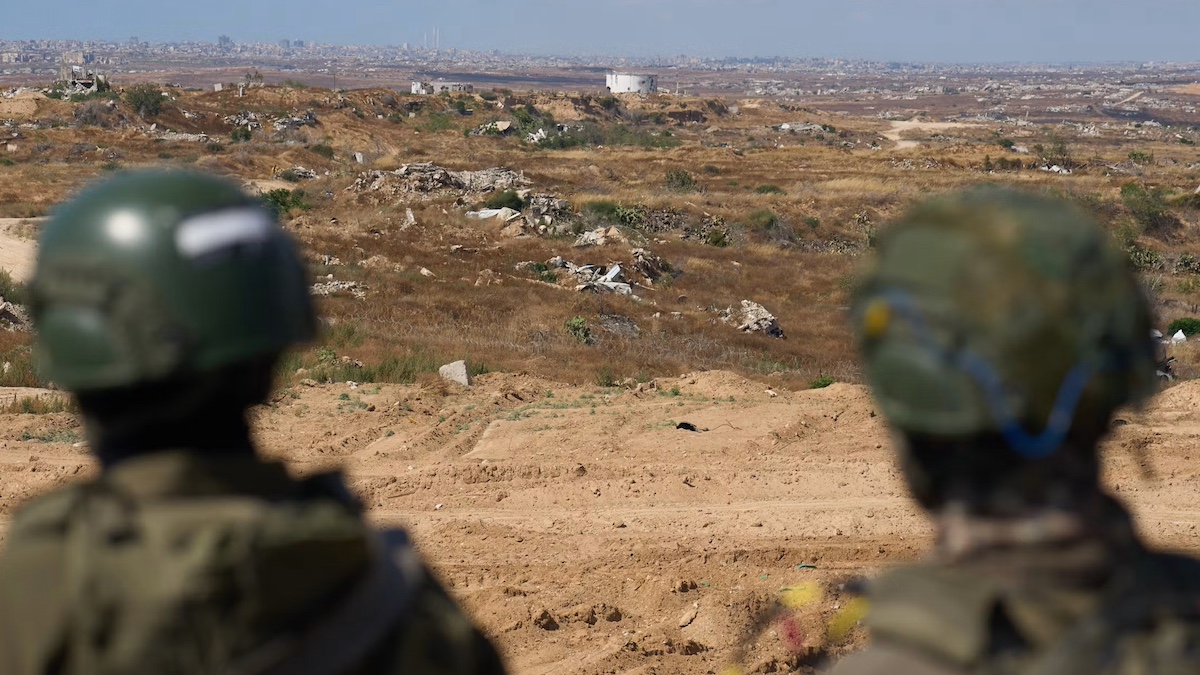
In recent weeks, Israeli Prime Minister Benjamin Netanyahu has directed the Israel Defense Forces to expand its territorial control in Gaza to 70% of the enclave, marking an 11% increase from the roughly 60% the military already holds. This new expansion aligns with an updated map distributed to Gaza-based aid agencies in late March, which draws a new “orange line” marking Israel’s newly claimed restricted military zone. This boundary extends 11% beyond the “yellow line” demarcation agreed upon during the October 2024 ceasefire deal with Hamas.
Compounding this territorial shift, Israeli Defense Minister Yoav Gallant has publicly reaffirmed the Israeli government’s plan to relocate large numbers of Palestinian residents out of Gaza “when conditions are appropriate and the process is carried out appropriately.” These unfolding moves come amid heightened domestic political upheaval in Israel: the country’s parliament, the Knesset, voted to dissolve itself on May 20, clearing the path for a snap national election to be held as early as this September.
Experts and international observers have already flagged that Israel’s expanding push directly contradicts the 20-point Gaza peace plan brokered by the U.S.-led Board of Peace. That framework explicitly calls for a phased withdrawal of Israeli military forces from the enclave and includes explicit language guaranteeing that “No one will be forced to leave Gaza, and those who wish to leave will be free to do so and free to return. We will encourage people to stay and offer them the opportunity to build a better Gaza.” Even U.S. Secretary of State Marco Rubio acknowledged this mismatch during a recent congressional hearing, confirming that the peace plan “doesn’t call for” expanded Israeli military control over Gaza.
As Israel expands its hold, the 2.1 million Palestinian residents of Gaza are increasingly squeezed into a shrinking, war-ravaged, overcrowded strip of coastal land, with little meaningful intervention from the global community to halt the territorial shift. To understand the gravity of these actions, it is necessary to examine them through the lens of established international law, which places clear limits on military occupation of foreign territory. While international law permits temporary occupation to achieve legitimate wartime objectives, two core rules are non-negotiable.
First, an occupying force cannot assert a permanent legal claim to the territory it seizes. Article 2(4) of the United Nations Charter explicitly outlaws territorial conquest as an instrument of war, a principle the global community enforced firmly in response to Russia’s full-scale invasion of Ukraine, where breaches were widely recognized as the crime of aggression. The International Court of Justice (ICJ) reaffirmed this principle in its 2024 advisory opinion on Israeli actions in occupied Palestinian territories, making clear that Israel cannot claim sovereignty over any part of Gaza.
Second, all occupying powers are bound by international humanitarian and human rights law, which requires them to protect the welfare of the civilian population under their control and preserve the existing demographic composition of the occupied territory. This means forced displacement of the local population and transfer of the occupying power’s own civilian settlers into the territory are strictly prohibited. These obligations have applied to Israel since it seized Gaza from Egypt during the 1967 Six-Day War, launching a decades-long occupation that continued in a legal sense even after Israel withdrew its ground troops and dismantled settlements in 2005.
Despite these clear legal standards, enforcing compliance with Israel’s international obligations has proven slow, fragmented, and largely ineffective to date. After the ICJ’s 2024 ruling ordered a full Israeli withdrawal from all occupied Palestinian territories on the grounds that Israel’s presence violates the core principles of Palestinian self-determination and the ban on territorial conquest, the UN General Assembly endorsed the ruling and set a September 14, 2025 deadline for completion of the withdrawal. Israel simply ignored the deadline. Enforcement of ICJ rulings falls exclusively to the UN Security Council, where the U.S.’s permanent veto power has blocked any meaningful action to compel compliance.
Worse still, the clear legal prohibitions on conquest, forced displacement, and settlements are being intentionally muddied by the Trump administration-brokered 20-point peace plan and the Board of Peace overseeing its implementation. In November 2025, the UN Security Council endorsed the plan, which aimed to end the conflict, disarm Hamas, and establish a transitional Palestinian government overseen by the Board of Peace and a multinational International Stabilisation Force. But from its inception, the ceasefire deal was riddled with critical gaps: it included no binding provisions defining the scope of Israel’s military presence in Gaza, no mechanism for holding actors accountable for alleged war crimes, and no clear roadmap for demilitarization.
Unsurprisingly, the entire peace process has ground to a standstill since the ceasefire took effect. Israeli airstrikes and ground operations have continued, killing more than 900 Palestinians, aid deliveries remain drastically insufficient to meet the desperate needs of the civilian population, and Hamas has refused to disarm without concrete, binding guarantees for full Palestinian self-determination in the future.
This stalemate works entirely in Israel’s strategic interests. Under the original ceasefire map, Israel was allowed to maintain military control of all territory behind the “yellow line”, which already gave it control of just over half the enclave, squeezing the majority of Gaza’s population into a small coastal pocket. Within the territory it already controlled, Israel has already undertaken two key projects that reveal its long-term political goals.
First, the military has completely flattened entire residential neighborhoods and hundreds of civilian structures, turning large swathes of northern and eastern Gaza into uninhabited wasteland cleared of all civilian infrastructure and residents. On this cleared land, Israel has since built an extensive network of permanent military infrastructure, including new access roads, fortified outposts, barriers, and tall earthen berms. This creates a de facto permanent Israeli-controlled zone emptied of its Palestinian population, a status quo that amounts to unlawful forced displacement and territorial conquest under international law.
Day by day, the area available to Palestinian residents of Gaza shrinks, as Israel reshapes the territory’s borders through bulldozers and permanent fortifications. Netanyahu has already indicated that Israel has no intention of stopping at 70% control and depopulation. The Israeli government may seek to establish a large permanent buffer zone across much of Gaza, mirroring similar permanent Israeli military presences it has built in southern Lebanon and occupied Syrian territory, or it could even revive plans to establish new Israeli settlements in the strip – a project already being aggressively expanded across the occupied West Bank.
All of these unfolding moves violate clear international law and the text of the very “peace plan” that was supposed to resolve the conflict, while offering no viable long-term path to justice or self-determination for the Palestinian people. This analysis is by Michelle Burgis-Kasthala, Professor of International Law at La Trobe University, republished with permission under Creative Commons license.