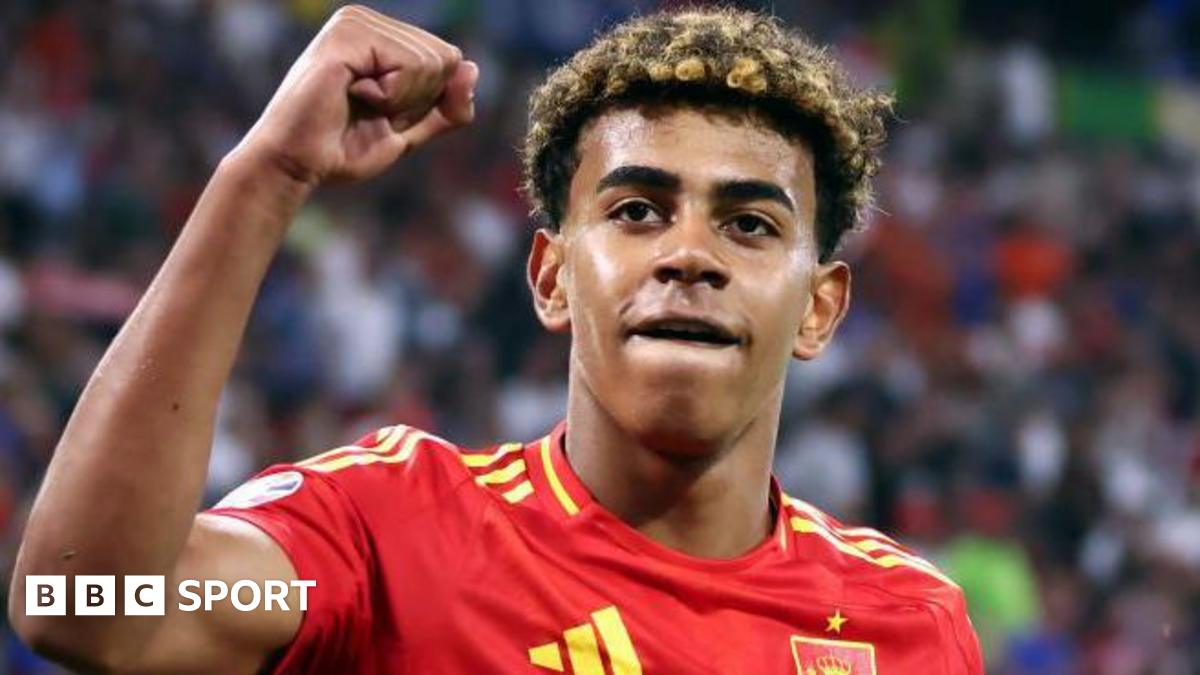
As the 2026 FIFA World Cup approaches, all eyes in global football are turning to 18-year-old Spanish phenom Lamine Yamal, a teenage talent already being hailed as the next generational great of the game – even by the greatest to ever play the sport.
During a World Cup commercial event, Lionel Messi was asked to name the standout young player of the new era, and he left no room for debate. “It would be Lamine. No doubt about it: for me, he is the best,” Messi said. Just one week later, when US broadcaster CBS asked Yamal point-blank if Spain would lift the World Cup trophy, the teenager smiled and gave a confident one-word answer: “Yes.”
What makes Yamal’s ascent genuinely extraordinary is not just the avalanche of praise from football royalty that has landed on his shoulders before his 19th birthday. It is the remarkable poise and self-awareness with which he carries that weight, and how clearly he has already carved out his own identity, both as a footballer and a public figure.
At 18 years old, Yamal already has a resume most senior players can only dream of: he has featured in a UEFA Champions League semi-final, won the 2024 European Championship with Spain, and inherited Barcelona’s iconic number 10 shirt – the same number Messi wore for nearly 15 years at Camp Nou. While his precocity is staggering, the most striking trait of his game and his character is his unshakable serenity under pressure.
Comparisons to Messi have followed Yamal throughout his rise, whether he seeks them out or not. Both are left-footed players with the same deceptive dribbling intelligence that makes the most challenging on-field moves look effortless. In fact, many experts argue Yamal has already had a far greater impact at Barcelona at 18 than Messi did at the same age, though any prediction that he will ultimately match the eight-time Ballon d’Or winner’s legacy remains far too early to make.
One telling statistic, however, highlights just how far Yamal has already come: by his 18th birthday, he had already made 151 appearances for Barcelona’s first team. By the time Messi turned 19 in June 2006, he had only notched 41 top-flight appearances for the Catalan club.
Football greats who have seen both players develop have been quick to draw a clear lineage between the two generations. Ronaldinho, who played alongside a young Messi at the start of Barcelona’s golden era and won the Champions League with him, drew the line directly in comments to FIFA’s website in March. “Messi and I made history, and now it is Lamine Yamal’s turn. What he has already shown at such a young age is extraordinary,” the Brazilian legend said.
Former Manchester United defender Rio Ferdinand went even further when asked if Yamal is already a better player at the same age than Messi and Cristiano Ronaldo were. Ferdinand replied bluntly on ESPN: “Yes. His potential or ceiling might be better than theirs. The body of work at 17 years old – no-one has done it. Pele may have, but I didn’t see Pele.”
Spain national team head coach Luis de la Fuente, who has watched Yamal progress through the country’s youth age groups, says what sets the teenager apart goes far beyond raw talent. “He is a player blessed by God. Football geniuses have something special, and he has it,” De la Fuente said. “You can immediately see those kinds of footballers who are touched by magic that says: you are going to be special.”
Barcelona manager Hansi Flick, who works with Yamal in training every day and has watched him perform on the biggest club stages all season, echoes that praise. “He is special, he is a genius. In the big matches, he shows up. Players do not usually reach this level of maturity until they are 24 or 25 years old. If this kind of talent only comes every half-century, I am glad it is for Barcelona,” Flick said.
What truly separates Yamal from the dozens of previous “next Messis” tipped for stardom at Barcelona over the past two decades is his deliberate rejection of trying to fill anyone else’s shoes. While he openly admires Messi, he holds a quiet, unshakable determination to forge his own path. “For me, Messi is the greatest football player in history. He is a legend and I do not find myself worthy of being compared to him,” Yamal said. “I do not want to be Messi and he knows it. I want to follow my own path.”
The same mindset applies when comparisons to Ronaldo are raised. Yamal does not dismiss either the comparisons or the legendary legacy of the five-time Ballon d’Or winner – he simply refuses to structure his own ambition around matching anyone else. “It is best not to compare yourself to anyone,” he said at an awards ceremony. “Players like Cristiano Ronaldo did what they did because they wanted to be themselves. I try to be me, play my game, and get people to recognise me for being Lamine.”
Barcelona’s academy has produced no shortage of young talents anointed as the next great hope, only for many to fade under the weight of expectations: Giovani dos Santos, Gerard Deulofeu, Bojan Krkic, Ansu Fati, and Munir El Haddadi are just a few of the prospects who carried the “next Messi” label at one point or another. Yamal, by contrast, lets the media and fans debate his potential while he focuses on playing, even as speculation about a future Ballon d’Or win has followed him since he was 16 years old.
He says he plays to bring joy to fans, and wants young children to aspire to be like him – not like Messi or Ronaldo. “I am not thinking about the Ballon d’Or. I want to enjoy myself and win with Barca and the national team,” he said. “Pressure does not exist, it is an excuse. If you just think about enjoying yourself and having fun, there is no pressure.”
That confidence in his own trajectory is nothing new to the coaches who spotted his talent early. Inocente Diaz, one of Yamal’s youth coaches at Barcelona’s famed La Masia academy, made a bold prediction as far back as 2025. “He is even better than Messi,” Diaz told Spanish newspaper Sport. “He possesses a unique blend of physical attributes reminiscent of both Messi and Cristiano Ronaldo. In six years, he will win the Ballon d’Or.”
For Yamal himself, the immediate target is clear: the 2026 World Cup. He has already laid out his ambitions for the tournament, where he will be the centerpiece of a Spanish squad ranked among the pre-tournament favorites. “I have always imagined playing in a World Cup, seeing my mother in the stands. I hope I can win it,” he said.
What many casual observers have missed about Yamal’s game, which La Masia coaches recognized long before the rest of the world, is his evolving tactical profile. While he is officially listed as a winger who terrorizes opposing full-backs from the left flank with elite dribbling numbers, Yamal says his childhood approach to the game was far more focused on football intelligence than individual skill. “When I was small I never dribbled much or got past many opponents. I scored a lot of goals, ran a lot, but above all I had very good vision of the game,” he explained. “I focused on what Messi did because he gave different passes – passes that led to goals. And I looked at Modric, who passed with the outside of his foot. That seemed more interesting to me than dribbling, because it is more about the mind.”
That fascination with a midfielder renowned for his spatial awareness and vision, rather than a dynamic winger, hints at the evolutionary path Yamal is already walking. Over the past two seasons, tactical data has shown Yamal increasingly drifting into central areas of the pitch, operating as a second playmaker as often as he stays wide on the flank. That shift mirrors the transition Messi made early in his career, when he moved from the right wing to the false nine position at the center of Barcelona’s attack, a shift that turned him into the greatest player of his generation. It took Messi more than a decade to complete that transition – Yamal may make the move far earlier.
Julen Guerrero, who worked with Yamal in Spain’s youth system, says he is not surprised by the teenager’s tactical evolution. “Of course I can picture him as a false nine,” Guerrero said. “But it is a less comfortable position because teams block the centre more, there are fewer spaces, you have to be more patient. But he is very intelligent. He knows how to move.”
As the 2026 World Cup kicks off, Yamal will be just 18 years old – he will not turn 19 until the day before the tournament’s first semi-final. Spain arrives at the competition as one of the title favorites, built around the teenage talent who has already proven he is far more than just the next Messi. He is Lamine Yamal – and he is ready to write his own story on the world’s biggest football stage.