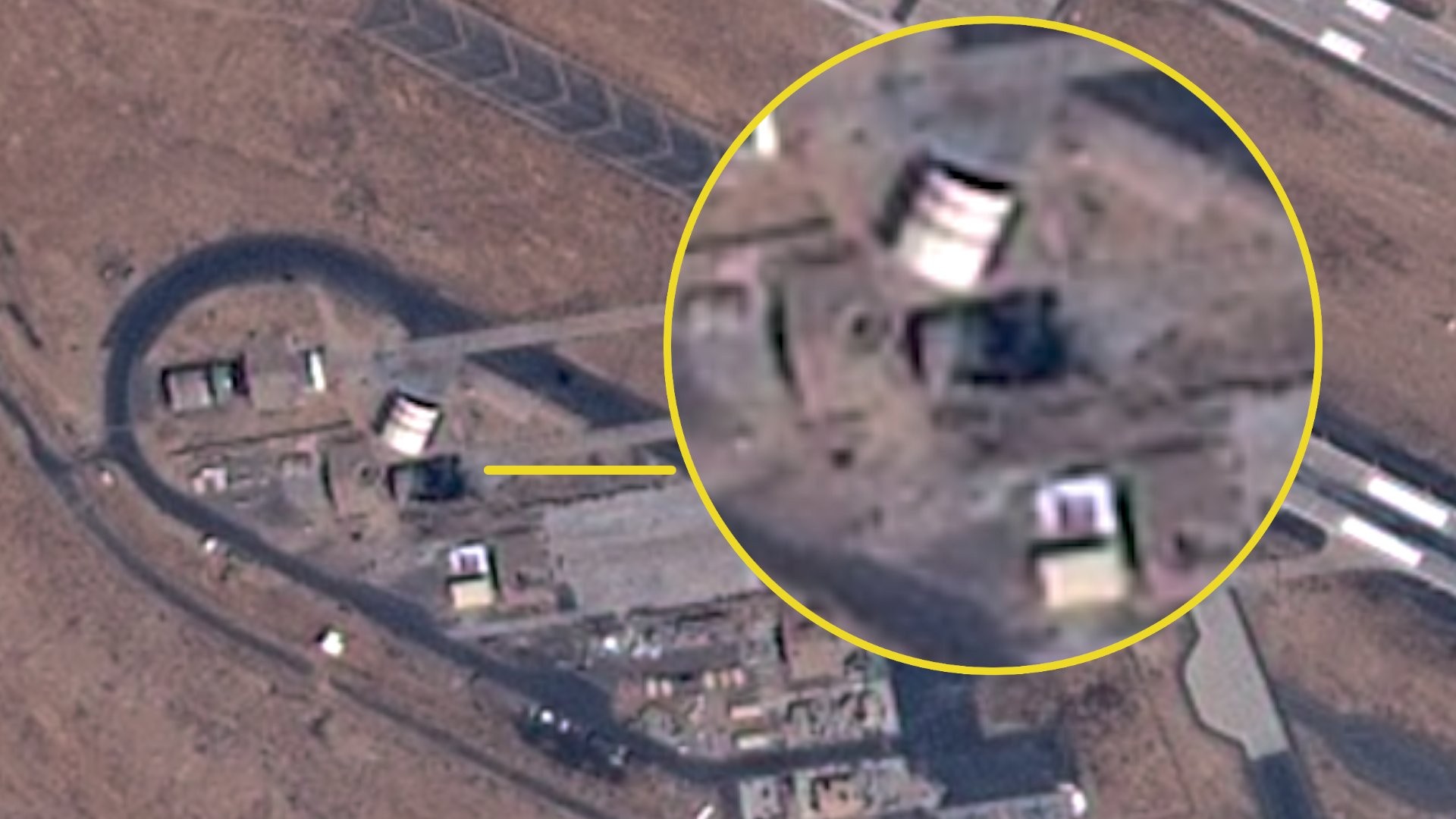
Fresh open-source satellite analysis released by Soar Atlas has cast significant doubt on official U.S. military statements claiming no successful Iranian strikes hit American infrastructure in Kuwait Wednesday, amid a escalating cross-regional attack that has already left one civilian dead and dozens more injured.
Newly released high-resolution imagery of Ali Al Salem Air Base, a key U.S. military outpost located in northern Kuwait, shows clear signs of destructive impact at the site: one aircraft shelter appears completely destroyed, while the surrounding terrain is visibly charred and dotted with multiple fresh impact craters from incoming munitions. These observations directly contradict a public statement issued shortly after the attack by U.S. Central Command (Centcom), which insisted all missiles and drones launched toward the base had been “defeated” before reaching their targets.
Centcom’s initial account of the cross-regional strikes claimed Iran launched a volley of ballistic missiles targeting sites across the Middle East, but argued all projectiles missed their intended targets. Per the command’s official statement, the two missiles Iran fired toward Kuwait either fell short of their targets or broke apart mid-flight, while three missiles directed at neighboring Bahrain were successfully intercepted by allied air defense systems before they could hit any sites.
However, official accounts from Kuwait directly conflict with this narrative. Kuwait’s foreign ministry confirmed Wednesday that multiple Iranian missiles struck Kuwait International Airport and several diplomatic missions within the country’s borders. Local Kuwaiti authorities reported one fatality from the attack, later identified as an Indian national working in the country, alongside 60 injured people. Video footage captured at the airport in the immediate aftermath of the strikes shows extensive structural damage: Terminal 1 was engulfed in large fires, a section of the terminal roof collapsed, and thick plumes of black smoke billowed over the site.
Following the attacks, Kuwaiti defense ministry spokesperson Brigadier General Saud al-Otayan issued a formal condemnation of what he labeled “criminal Iranian aggression” against the country. Iran, for its part, has pushed back against blame for the airport strike, claiming the damage to the site was actually caused by a errant U.S. Patriot interceptor missile — a claim Centcom immediately rejected as false. Iran’s state-aligned Tasnim News Agency also cited a statement from the Iranian Revolutionary Guard Corps (IRGC) denying the group ever targeted Kuwait International Airport at all.
U.S. officials have pushed back firmly against Iran’s denials, reiterating that the strike on Kuwait’s airport was a deliberate, pre-planned, and unjustified attack by Iran on sovereign Kuwaiti territory. The conflicting accounts of the attack’s scope and impacts have raised new questions about escalation risks across the already tense Middle East region, as competing official narratives leave key details of the strike unconfirmed.