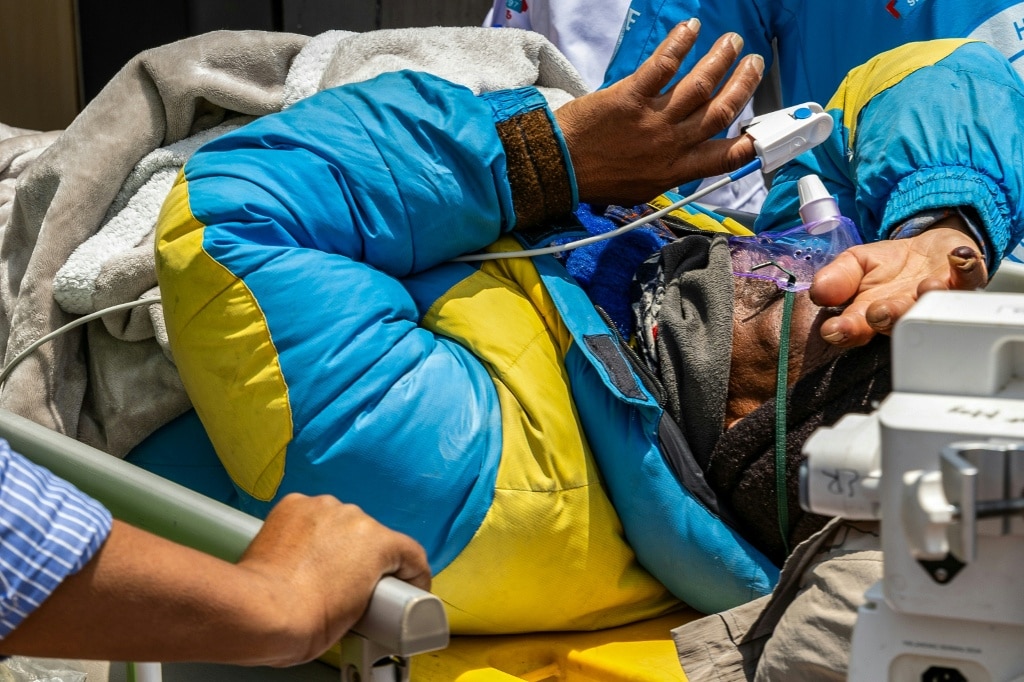
In an extraordinary story of survival that has stunned the global mountaineering community, a Nepali climbing guide declared lost and presumed dead after six days stranded on Mount Everest has been rescued alive, having crawled nearly the entire distance to Base Camp unaided, officials confirmed to AFP Thursday.
Fifty-something Dawa Sherpa, a veteran guide widely known by the nickname “Hillary” in honor of legendary Everest pioneer Edmund Hillary, disappeared from the upper slopes of the world’s highest peak amid brutal weather conditions in the early hours of May 30. He was located Thursday morning near Base Camp by personnel from the Sagarmatha Pollution Control Committee (SPCC), a Nepali organization tasked with maintaining climbing routes and removing discarded waste from the mountain.
“He was found by an SPCC team this morning close to base camp — he was crawling down,” Pemba Sherpa, a representative from 8K Expeditions, the company that coordinated the search and rescue operation, told reporters. A rescue helicopter airlifted the climber directly to Kathmandu, where an AFP on-site team observed him being carried from the aircraft on a stretcher and transferred to HAMS Hospital for treatment.
Pemba Sherpa added that after consulting with attending physicians, the guide is conscious and only suffering from minor frostbite, with no other life-threatening injuries. His wife, Damu Sherpa, spoke from the hospital Thursday, describing her family’s overwhelming shock and joy at the miracle outcome. “We had given up all hope, we even began traditional death puja prayers for his soul yesterday,” she shared. “Hearing he was alive was more happiness than we ever dared to imagine.”
The events that led to Dawa Sherpa being stranded began on the evening of May 29, when he guided former British Royal Marine and climber Chris Thrall to a successful summit of the 8,849-meter peak by approximately 5:00 pm. Before Dawa Sherpa went missing, Thrall had posted an Instagram tribute Wednesday mourning what he believed was his guide’s passing, calling him an “absolute gentle giant of a man and a true ‘tiger of the mountains’”.
Thrall recounted that the pair began their descent from Camp Four, which sits roughly 7,950 meters above sea level just below the oxygen-starved “death zone,” on May 30. As they climbed down, Dawa Sherpa paused to rest, telling Thrall to continue ahead without him — a common occurrence between guides and clients on large expeditions. As Thrall moved down, he encountered a Polish climber in critical condition: the mountaineer had exhausted his supplementary oxygen, already developed frostbite, and was at high risk of deadly hypothermia.
This season’s summit conditions were unusually harsh, Thrall explained: what is typically a five-day round trip to the summit stretched to 11 days for his team. Faced with an impossible choice, Thrall opted to assist the imperiled Polish climber, sharing his own oxygen supply as the pair descended. The trip that normally takes just two hours to Camp Three took 11 hours due to severe conditions, leaving Thrall unable to return for Dawa Sherpa.
Search teams launched efforts to locate the missing guide immediately, but harsh weather and the timing of the expedition — one of the final permitted climbs of the spring season, when few other climbers remain on the mountain — left no trace of him until Thursday’s unexpected discovery. Five other climbers, two Indian mountaineers and three Nepali guides, have already lost their lives on Everest during the 2026 spring climbing season. Initial counts from Nepali authorities show that more than 1,000 climbers have summited the peak this season, making it the busiest climbing season in Everest’s history.