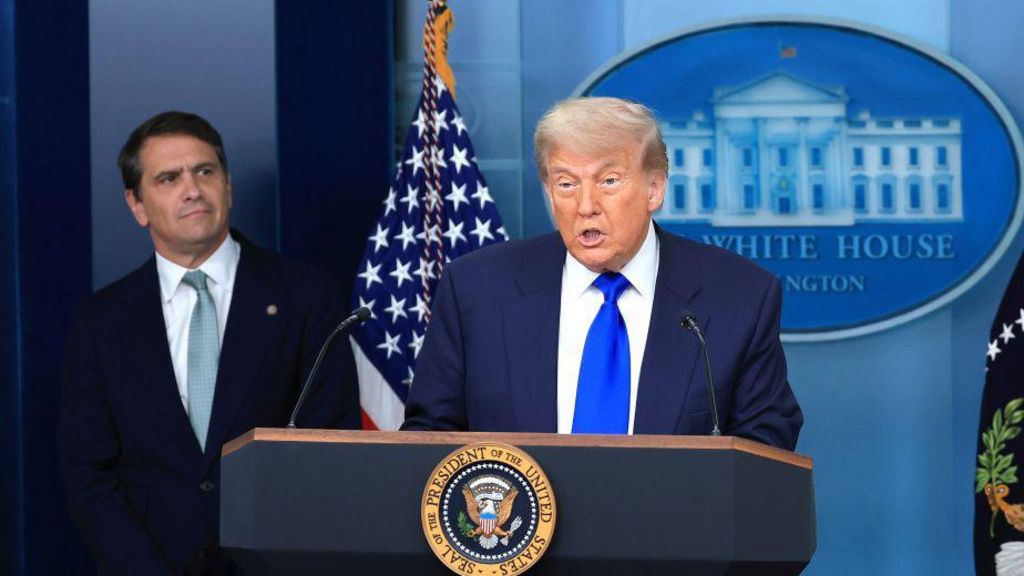
Just two weeks after it was first unveiled, a controversial $1.8 billion taxpayer-funded plan backed by former and current President Donald Trump to compensate his political allies has been formally scrapped by the U.S. Department of Justice, collapsing under overwhelming bipartisan pushback that included open revolt from members of Trump’s own Republican Party.
The proposal, labeled the “anti-weaponisation” fund, emerged from a legal settlement that ended a lawsuit Trump had brought against the Internal Revenue Service. The initiative framed its payouts as compensation for Americans the Trump administration deemed wrongfully targeted by the prior Biden administration, and included a controversial provision that permanently blocked new tax audits of Trump, his family members, and his business entities. While the White House maintained the fund was open to applicants from all political parties, administration officials repeatedly refused to rule out extending payouts to rioters who participated in the January 6, 2021 attack on the U.S. Capitol, triggering immediate outrage from lawmakers on both sides of the aisle.
The swift rejection of the plan from congressional Republicans marked one of the most high-profile examples of growing intraparty pushback against Trump in his second term, showing that the president does not hold unchallenged control over his own party even after returning to the White House. Lawmakers across the GOP warned that the proposal represented an unforced political error at a moment when Trump and the party were already grappling with major headwinds: an unpopular ongoing military conflict in Iran, soaring domestic gasoline prices, and Trump’s persistently low approval ratings that threaten to undermine Republican prospects in the upcoming midterm elections.
“This was a total self-inflicted wound and completely unnecessary,” a senior anonymous former Trump adviser told reporters, adding that the controversy highlighted “the president’s myopic view sometimes — he’s going to do what he wants to do regardless of whether it hurts Republicans.”
Intra-GOP criticism boiled over days after the plan was announced, during a tense closed-door May 21 meeting between Senate Republicans and Acting Attorney General Todd Blanche, who has served as the public face of the fund initiative. Texas Republican Senator Ted Cruz described the meeting on his podcast, noting “multiple senators yelling at the attorney general, saying this feels like self-dealing.”
To escalate their pressure, congressional Republicans halted progress on a critical, long-delayed immigration spending bill that would fund U.S. Immigration and Customs Enforcement and Customs and Border Protection, two agencies central to Trump’s immigration policy agenda. Bipartisan opposition further mounted as Senate Majority Leader John Thune publicly urged the White House to abandon the plan, and Democrats pledged to block the immigration bill indefinitely until the fund was scrapped. Multiple advocacy groups also filed federal lawsuits to block the initiative, and a federal judge issued an order last Friday forcing the DOJ to suspend the fund pending legal review.
On Monday, the Department of Justice announced a temporary suspension of the program, citing the court order. But critics including many Republicans demanded a full, permanent cancellation. On Tuesday, Blanche formally confirmed to House lawmakers that “we’re not moving forward with the fund,” bringing the short-lived initiative to a close. Even so, the controversy is far from over: Blanche declined to commit to a formal written end to the plan, leading many critics to argue the door remains open for the Trump administration to revive the proposal at a later date. Legal challenges from advocacy groups will also move forward, even after the administration’s announcement.
“Litigation provides a safeguard to make sure” Trump cannot resurrect the scheme, explained Norm Eisen, co-founder of the Democracy Defenders Fund, which is one of the plaintiffs in the ongoing legal action against the administration. Senate Democrats have already announced plans to pass a permanent legislative ban on the program, framing the fund as a corrupt “MAGA slush fund” that enables tax fraud by the president and his allies. Senate Minority Leader Chuck Schumer argued that the administration’s verbal commitment to end the plan is not enough, saying “Blanche and Trump’s words are worthless. The only way to stop Trump’s nearly $2 billion MAGA slush fund and his blank check to commit tax fraud is to abolish it by law – permanently.” The issue is already set to become a central campaign talking point for Democrats ahead of the fall midterm elections, as the party looks to flip control of Congress from Republican hands.
This latest controversy follows a string of recent breaks between Trump and congressional Republicans in his second term. Last month, multiple Senate Republicans joined Democrats to pass a war powers resolution aimed at limiting the duration of the Iran conflict. Last year, Republicans also joined Democrats to force the DOJ to release sealed documents related to the late convicted sex offender Jeffrey Epstein, after months of pressure that ultimately forced Trump to concede to the release.