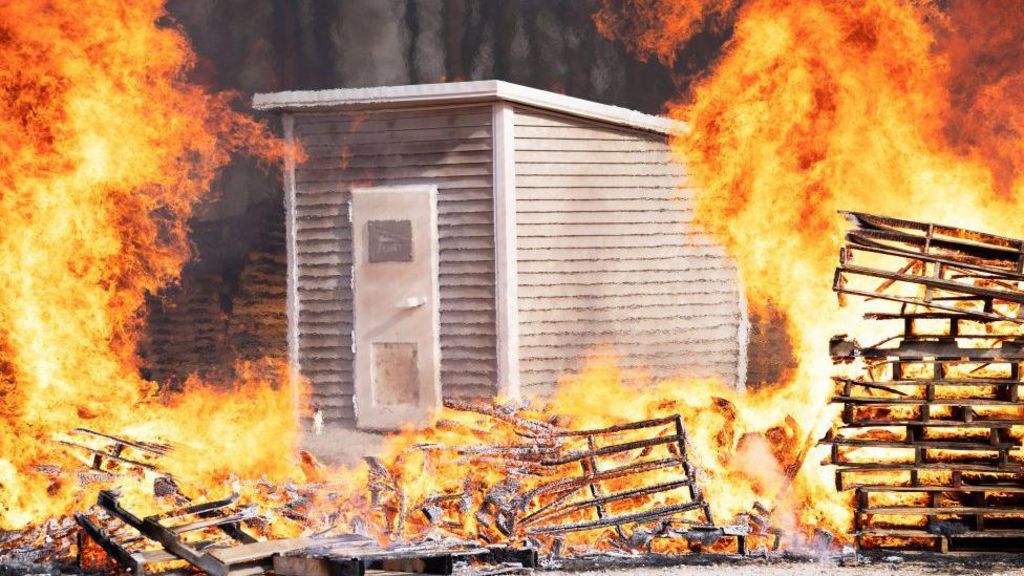
The 2017 Atlas Wildfire that tore through Napa, California, left a trail of irreversible destruction: more than 51,000 acres of scorched land, 783 structures reduced to ash, and six lives lost. For aerospace engineer and northern California resident Linda Cantey, the disaster left an indelible emotional mark. She and her husband escaped by mere minutes after waking to frantic calls, but an elderly couple on their street perished when a power outage trapped them behind a stuck garage door.
That traumatic experience pushed Cantey to turn grief into action. Beyond joining local wildfire safety advisory boards, she partnered with a mining firm that specialized in underground emergency refuge chambers, challenging the team to adapt their life-saving expertise for above-ground wildfire protection. The result, launched just last month, is Fort: a compact, shed-like backyard bunker designed to shelter up to eight people. Fitted with fire-resistant materials and a 4-hour supply of breathable air, the structure can withstand temperatures as high as 2,000 degrees Fahrenheit for three full hours.
“If it wasn’t for Linda, we wouldn’t have built this, I don’t think,” said Josh Behling, president of Wildfire Safety Systems and one of Fort’s co-developers. To prove the bunker’s reliability, Cantey and Fort’s CEO even volunteered to remain inside during a real-world fire test, with first responders on standby.
Fort is far from the only innovative response to the growing wildfire crisis. NASA data confirms that extreme wildfire activity has doubled globally over the past 20 years, and major blazes continue to devastate U.S. western states: just this month, the Sandy Fire north-west of Los Angeles triggered mass evacuations after burning more than 2,000 acres. As risk rises, survivors and entrepreneurs have developed a wide range of solutions, from high-tech hydraulic homes to low-cost natural vegetation management.
Just one night before Fort’s launch in April, another team of innovators pitched their concept on the popular U.S. reality show *Shark Tank*. HiberTec Homes, developed by former real estate developer Holden Forrest after the 2018 Woolsey Fire destroyed 1,200 homes near his Malibu residence, is designed to retract completely underground in minutes when a wildfire approaches. Forrest sketched the original idea on the back of his 9-year-old daughter’s homework, never expecting an architect to take the concept seriously. What followed was years of collaboration with engineers to refine the patented technology. A 1,000-square-foot HiberTec home is priced at approximately $1.2 million, and the first model is expected to hit the market by 2030. For Forrest, the project is more than a business: it’s a life mission, prompting him to sell his own home and all his possessions to advance the technology.
Not all solutions carry a six- or seven-figure price tag. Goat grazing, a low-tech approach to clearing flammable underbrush that fuels wildfire spread, has seen a dramatic surge in demand across fire-prone states. In Colorado, Kimberly Jones has grown her business Goat Mowers LLC from a herd of 25 goats to 250 over the past seven years, as homeowners increasingly turn to natural vegetation management. She reports a sharp uptick in new requests this year amid record dry conditions, and already has proof of the method’s effectiveness: last year, a wildfire stopped just 100 yards short of a home her goats had cleared 17 days prior.
In California, Blue Tent Farms’ fire mitigation division Western Grazers has expanded its goat herd from 10 to 5,000 to meet growing demand from clients ranging from the U.S. Forest Service to utility giant Pacific Gas & Electric, as well as individual homeowners. “The minute the grass begins to turn, I get requests, probably 10 a week, from homeowners,” said managing partner Tim Arrowsmith.
These new solutions, while promising, are not yet available at scale. Fort currently only has two demonstration units, with initial projections calling for roughly 150 orders per year, manufactured in Utah and shipped five weeks after purchase. The bunker is marketed as a last-resort option for those unable to evacuate, not a replacement for timely evacuation orders.
For Cantey, the work has also been a form of healing. “It’s therapy for all of us, because what we’ve witnessed, and what we’ve experienced, we wouldn’t want anybody else to go through. But it’s going to keep happening,” she explained. As wildfire risk continues to climb, these innovators remain committed to filling gaps in safety protection, turning personal trauma into life-saving tools for communities across the West.