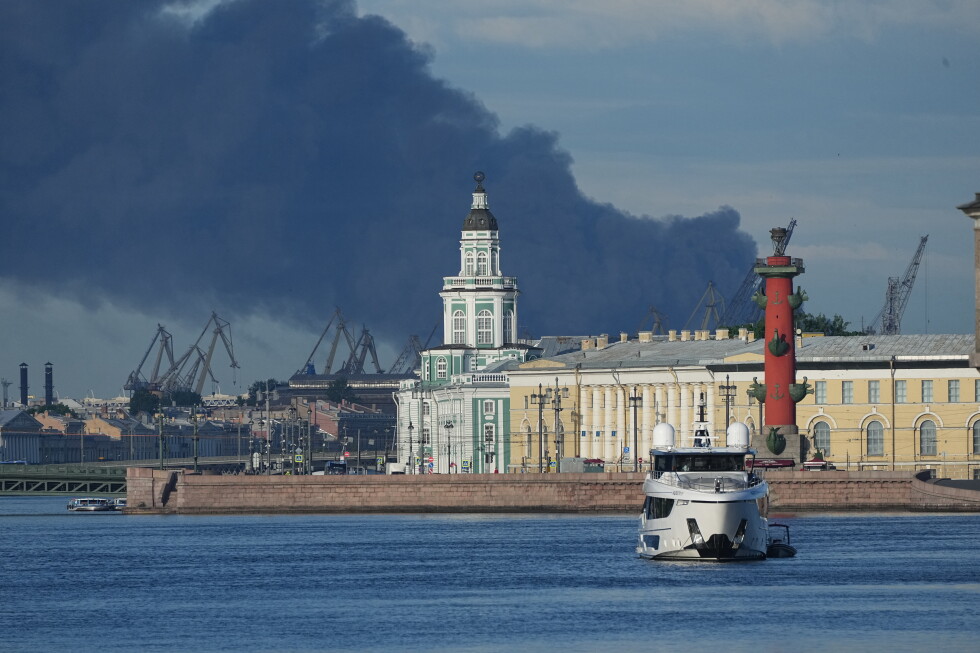
On Wednesday, as Russian President Vladimir Putin prepared to open his country’s flagship annual international economic forum in St. Petersburg, Ukrainian forces launched a wave of long-range drone attacks that penetrated hundreds of kilometers into Russian territory, striking multiple key targets including a coastal oil terminal in the city. Ukrainian President Volodymyr Zelenskyy confirmed the attack in a social media statement, noting that the drones successfully traveled more than 1,000 kilometers (620 miles) to reach their target. Footage and on-the-ground reports showed thick plumes of black smoke billowing from the oil terminal near St. Petersburg’s port area following the strike.
Russian official confirmation of the attack was limited, with authorities only acknowledging that the strike targeted civilian infrastructure in the city. In response to the incursion, St. Petersburg’s main airport temporarily halted all flight operations overnight, and local mobile internet services were temporarily shut down as a security precaution.
The St. Petersburg International Economic Forum, which Putin is scheduled to address on Friday, has long been framed by the Kremlin as a major prestige event designed to showcase Russia’s global economic standing amid mounting international isolation. Since Moscow’s full-scale invasion of Ukraine more than four years ago, however, all major Western business leaders and government officials have boycotted the gathering. This year, Saudi Arabia holds the position of special guest and is set to dispatch a large business delegation to the event.
The brazen attack on St. Petersburg marks a fresh political embarrassment for Putin, coming just weeks after he was forced to drastically scale back Moscow’s annual Victory Day military parade over widespread security concerns about potential Ukrainian drone strikes on the capital.
Wednesday’s wave of Ukrainian strikes was launched just 24 hours after Russian forces carried out a massive, widespread assault across Ukraine using a combination of drones and cruise missiles. That attack killed at least 22 civilians and left 138 others injured, carrying out Moscow’s stated threat to ramp up regular long-range barrages against Ukrainian targets.
After more than four years of full-scale conflict, the front line across eastern and southern Ukraine has remained largely static, with both sides relying heavily on swarms of drones that have slowed large-scale troop movements and stalled major offensives. To break the stalemate, both Moscow and Kyiv have increasingly turned to long-range strike operations to gain strategic leverage over their opponent.
For Ukraine, these strikes on Russian energy and industrial infrastructure serve two core strategic goals: cutting into revenue from Russian oil production, which remains the single largest source of funding for Moscow’s war machine, and disrupting Russian manufacturing facilities that produce weapons and military equipment. Zelenskyy noted that Ukraine has repeatedly targeted oil and port facilities in the St. Petersburg region and surrounding coastal areas in recent months.
Beyond the St. Petersburg oil terminal, Zelenskyy confirmed that overnight strikes also hit two additional high-value targets: the Kronstadt naval base, a historic installation that serves the Russian Baltic Fleet, and a weapons manufacturing plant located in Russia’s Tambov region, roughly 600 kilometers (370 miles) northeast of the Ukrainian border.
Russia’s Defense Ministry reported that its air defense systems intercepted and downed a total of 354 Ukrainian drones launched during the overnight wave of attacks across multiple Russian regions.
The cross escalation of strikes also resulted in civilian casualties on both sides. In Russia-occupied portions of Ukraine’s eastern Donetsk region, a Ukrainian strike hit a civilian bus traveling from Moscow to Crimea. Denis Pushilin, the Kremlin-appointed head of the occupation administration, reported that the attack killed seven people and injured 11 others. In Russia’s western Smolensk region, regional governor Vasily Anokhin said a Ukrainian drone strike killed two responding firefighters and wounded two other firefighters plus one local civilian.
On the Ukrainian side, Ukraine’s Air Force reported that Russia launched 198 long-range attack drones at Ukrainian targets overnight, with Ukrainian air defenses successfully intercepting and neutralizing 189 of the incoming weapons. In Ukraine’s northern Sumy region, local authorities confirmed that Russian strikes over the preceding 24 hours killed one civilian and injured 15 more, including three children. In the southern Kherson region, overnight Russian shelling and drone attacks killed an 86-year-old civilian woman and wounded five other residents, according to regional officials.
With both sides continuing to escalate long-range attacks and no diplomatic negotiations underway to end the conflict, the war now stretching into its fifth year shows no sign of a near-term resolution.