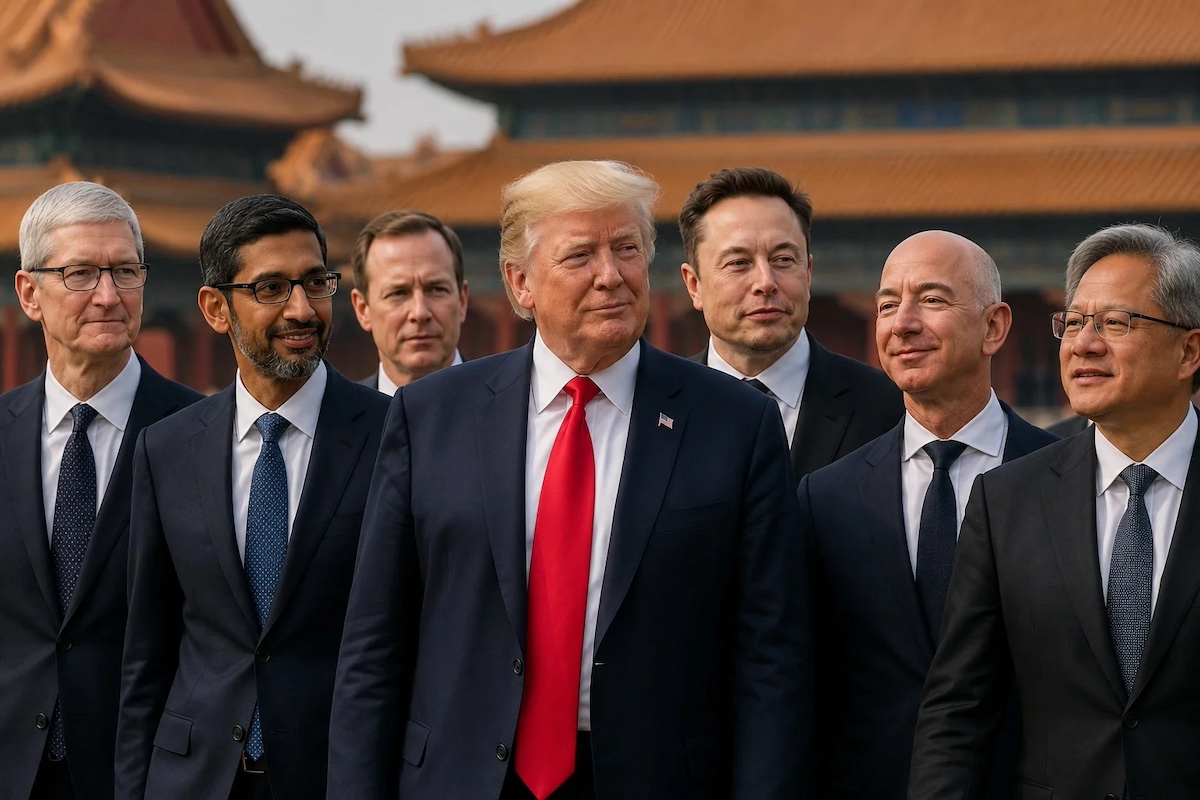
When a cohort of billionaire U.S. CEOs traveled to Beijing alongside former U.S. President Donald Trump just one month ago, many departed optimistic about new opportunities for deeper economic and technological cooperation between the world’s two largest economies. Today, that optimism has curdled into disillusionment, as Beijing’s policy shifts directly contradict the pledges of greater economic openness Chinese leader Xi Jinping made to the visiting American business leaders.
Trump’s own inconsistent approach to China has already left many U.S. business leaders off-balance: he built two presidential campaigns around confronting Chinese trade practices, only to rebrand himself as an open admirer of Xi, shifting abruptly between hardline and conciliatory policy stances with little advance warning. But the more abrupt disappointment stems from the gap between Xi’s promises and Beijing’s current actions. During the summit, Xi assured the visiting executives that China would “open wider” to foreign investment and create “broader prospects” for U.S. firms in sectors from tech to consumer markets. Those assurances, given to leaders including Apple’s Tim Cook, Tesla’s Elon Musk and Nvidia’s Jensen Huang, now look like an empty feint.
Far from expanding openness, Beijing has moved in recent weeks to tighten controls on cross-border capital flows, wall off its domestic artificial intelligence sector from global collaboration, and roll back transparency for foreign investors. A key new restriction has drawn particular global criticism: a ban on overseas travel for most Chinese AI industry experts, a policy that echoes Soviet-era restrictions on movement for academics and technical talent. Observers note the move makes it far less likely China will be able to tap into the ongoing global tech sector rally, and it has sent a deeply negative signal to international markets.
The impact of these shifts is already visible in China’s underperforming equity markets. As of mid-2026, the benchmark CSI 300 index has gained just 7% year-to-date, a return that pales in comparison to peer Asian markets: South Korea’s main index has surged 108%, Taiwan’s is up 57%, and Japan’s has gained 33% even amid energy market disruptions stemming from Middle East tensions. China’s markets are now clearly lagging far behind their global competitors.
These new controls are part of a broader policy response to a record surge in capital outflows. In 2025, China recorded $1 trillion in net capital outflows, double the 2021 level and the largest annual outflow since official data collection began in 2006. To stem accelerating outflows and protect foreign exchange reserves, Beijing has allowed the yuan to strengthen far more than currency analysts expected, with the yuan gaining more than 3% against the U.S. dollar in 2026 to date.
This managed yuan appreciation serves three core strategic goals for Beijing. First, it reduces the risk that heavily indebted Chinese property developers will default on their offshore debt obligations. Second, it advances Xi’s long-term goal of positioning the yuan as a credible alternative reserve currency to the U.S. dollar. Third, it eases tensions with the Trump White House, which has repeatedly criticized China for currency manipulation to boost exports.
Some economists argue a stronger yuan could also be supported by domestic fundamentals. Macquarie Group economist Larry Hu notes that if domestic demand strengthens in response to new government stimulus, the yuan carry trade will unwind as business confidence improves and the yield gap between the U.S. and China narrows, creating natural momentum for further yuan appreciation against the dollar.
The shifting global currency landscape has also been shaped by growing fiscal instability in the U.S., where the national debt is now approaching $40 trillion – twice the size of China’s entire annual gross domestic product. Chatham House economist Creon Butler notes that since Trump returned to office in early 2025, his administration’s policies on trade, energy security, climate change and financial stability have broken sharply with the post-WWII global economic consensus. This so-called “Trump shock” has pushed China to accelerate its plans to distance itself from key established international economic norms. While Butler notes China is far from the only country deviating from these norms, its status as the world’s second-largest economy makes its shifts uniquely disruptive to global markets.
This trend toward de-dollarization has reached a notable milestone this week: the European Central Bank confirmed that gold has now overtaken U.S. Treasury securities as the largest reserve asset held by global central banks. Gold now makes up 27% of global official foreign reserves, compared to 22% for U.S. Treasuries. ECB President Christine Lagarde attributed the shift to growing geopolitical fragmentation and rising tensions, which have driven strong demand for safe-haven gold among central banks. Short-term demand has also been boosted by global inflation fears, with HSBC analysts noting that ongoing conflict in the Middle East and the prolonged closure of the Strait of Hormuz have created a “super-squeeze” in commodity markets that will only intensify if the chokepoint remains closed.
For Xi, these policy shifts stand in stark contrast to pledges he made more than a decade ago, when he first took power in 2013 and promised to let market forces play a “decisive role” in China’s economic development. Thirteen years later, China’s economy presents a striking paradox: on one hand, its industrial and tech policies have delivered major breakthroughs, with electric vehicle giant BYD overtaking Tesla in global sales and domestic AI startup DeepSeek emerging as a serious competitor to Silicon Valley incumbents. On the other hand, Xi’s ambitions for global tech leadership are being undercut by a fragile financial system and deep structural headwinds that are slowing long-term growth.
Hong Kong University of Science and Technology economist Keyu Jin explains this paradox by noting that China is undergoing a deep structural transition, not just a temporary cyclical slowdown. “It’s among the world’s most dynamic technological powers, producing breakthroughs in AI, electric vehicles, and advanced manufacturing at an accelerating pace, yet economic growth continues to slow,” Jin says. “The old model is giving way to a new one, which has yet to take hold.”
The biggest drag on growth remains the troubled property sector, which holds roughly 70% of Chinese household wealth. Stabilizing the housing market is a prerequisite to reviving consumer spending and sustaining the government’s 5% annual growth target. Without bold, credible action to support housing prices and boost consumer confidence, persistent deflationary pressure will continue to drag on expansion.
Beijing also faces a long list of other urgent structural challenges: it must build more dynamic, transparent domestic capital markets, reduce stubbornly high youth unemployment, rein in unsustainable local government debt, curtail the outsize dominance of state-owned enterprises, and expand the social safety net to encourage households to shift from saving to spending. Most analysts also agree that granting greater independence to the People’s Bank of China and moving toward full currency convertibility are critical steps to building a modern, resilient economy.
Yet Xi’s recent policy moves suggest Beijing is focusing on managing short-term symptoms rather than addressing deep-rooted structural causes. Analysts point to unresolved investor uncertainty from the 2020 crackdown on Chinese tech giants that began with the assault on Alibaba co-founder Jack Ma, which still lacks a clear public justification. That uncertainty now hangs over new restrictions on cross-border capital movement and AI expert travel, leaving global investors skeptical that Beijing has learned the lessons of past policy missteps.
For the U.S. CEOs who traveled to Beijing with high hopes last month, the contrast between Xi’s promises of greater openness and Beijing’s new push for tighter control could not be clearer. What was billed as a new era of economic cooperation has instead turned into a stark demonstration of China’s growing turn inward.