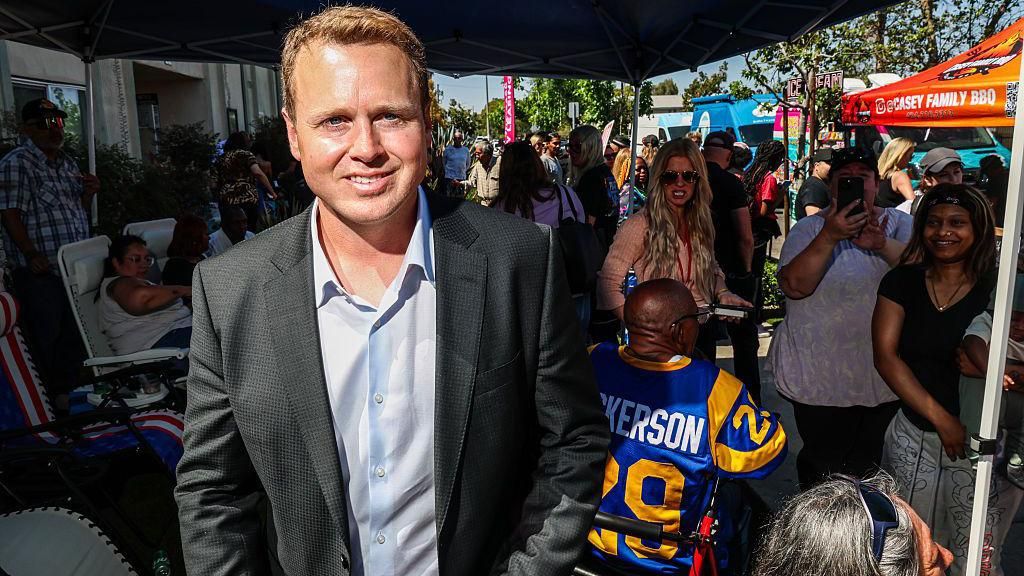
Four decades after he first rose to infamy as one of reality television’s most iconic antagonists on 2000s MTV hit *The Hills*, 42-year-old Spencer Pratt is trading on-camera drama for city hall politics, mounting a surprisingly competitive bid to become the next mayor of Los Angeles – America’s second-largest city.
A lifelong Republican and political outsider, Pratt launched his campaign in January 2026, and in the months since, his unexpected rise in pre-election polling has turned him from a novelty candidate into a serious contender ahead of Tuesday’s nonpartisan primary election. Under LA’s primary rules, all candidates appear on the same ballot regardless of party affiliation; any candidate who secures 50% plus one of the vote wins outright, while the top two finishers advance to a November general election if no candidate hits the majority threshold.
A new UC Berkeley-Los Angeles Times poll released Thursday puts Pratt in a dead-heat three-way contest with the two leading Democratic incumbents: current mayor Karen Bass and city councilmember Nithya Raman. The poll of likely voters shows Bass holding a narrow 1% lead at 26% support, with Raman trailing at 25% and Pratt close behind at 22% – out of a field of more than 36 total candidates. What makes Pratt’s performance even more striking is his dominance in campaign fundraising: between April 19 and May 16, he raised $2.7 million (roughly £2 million), nearly 10 times Bass’s haul in the same window and seven times what Raman collected.
Pratt’s rapid traction in the deep-blue city has been fueled by a savvy social media strategy that has turned his outsider brand into viral content. His TikTok rants, reposted AI-generated clips mocking his opponents, and attention-grabbing campaign adverts have earned him widespread mainstream attention far beyond his existing reality TV fanbase. His campaign has already moved to quash persistent rumors that a new reality show documenting his political run is in the works if he wins election. Echoing the “Make America Great Again” rhetoric that defined fellow reality star-turned-politician Donald Trump’s 2016 presidential run, Pratt’s campaign centers on a pledge to “get the golden age of Los Angeles back.”
The catalyst for Pratt’s entry into the race came one year prior, when he lost his Pacific Palisades home in the 2025 LA wildfires – one of the most destructive and deadly wildfire seasons in the region’s history. Much of his campaign messaging centers on the city’s ongoing response to climate-driven disasters, where he has repeatedly accused Bass of mismanaging the 2025 fire crisis and failing to support affected residents. Beyond wildfire policy, Pratt has campaigned on a platform of fixing what he frames as a “broken Los Angeles,” highlighting public safety, urban cleanliness, and pushing for mandatory drug treatment programs as part of a broader plan to address the city’s ongoing homelessness crisis.
Despite his strong polling and fundraising, political analysts warn Pratt faces a steep uphill climb to win the general election. Los Angeles has not been led by a Republican mayor since 2001, marking a 25-year streak of Democratic control of city hall. UCLA political psychology professor Efrén Pérez notes that Pratt’s base and policy platform remain narrow, rooted largely in the experience of the wealthy Pacific Palisades neighborhood where he resided before the 2025 fires. “That wealthy slice of LA is not representative of the entire city,” Pérez explained, though he acknowledged that Pratt’s advocacy for fire-affected communities holds inherent validity.
Pratt’s leading opponents have launched sharp attacks on his lack of governing experience ahead of the primary. “It’s not just that he has no experience in city government. I don’t know that he’s ever held a job in his life other than to be a reality TV star,” Bass told supporters at a Monday campaign event, arguing that Pratt lacks understanding of city issues and is campaigning out of anger rather than a coherent policy vision. Raman has gone further, labeling Pratt an anti-vaccine conspiracy theorist and arguing he “is not offering a realistic solution” to LA’s most pressing challenges.
Pratt has pushed back on these criticisms, leaning into his outsider status. “I may not have the experience, but I have the common sense to say this is not working,” he said in a recent interview.
Pratt first became a household name alongside his wife Heidi Montag, who he met during his time on *The Hills*, the hit MTV spin-off of Laguna Beach that catapulted both to fame in 2007. His on-screen persona – a dramatic, abrasive villain who fueled conflict and spread rumors – made him one of the show’s most talked-about cast members. After *The Hills* wrapped its original run in 2010, Pratt went on to appear on multiple other reality programs including *Celebrity Big Brother* and *I’m a Celebrity… Get Me Out of Here!*, and launched an online e-commerce business selling crystals. He holds a bachelor’s degree in political science, though he has never held public office.
USC entertainment, media and society professor Marty Kaplan argues that Pratt’s background gives him a unique advantage in a modern political landscape that has increasingly blurred the line between entertainment and governance. California has a long history of celebrity politicians turning entertainment fame into electoral success, from actor Ronald Reagan who went on to become governor and president, to action star Arnold Schwarzenegger who served two terms as California governor. Donald Trump, the most recent high-profile example, parlayed *The Apprentice* fame into the presidency.
“The audience has now been accustomed to want to be entertained,” Kaplan explained. “A candidate who can have a story that makes you want to know what happens next, and who delivers sure-fire twists and turns and thrills, that’s what we want.” By contrast, Kaplan noted, Bass – a longtime community organizer and seasoned politician with deep roots in LA – “is just not as entertaining” as Pratt. “What seems to matter now is almost exclusively, ‘will you promise not to bore me?’” he said.
That entertainment background has earned Pratt a notable endorsement from the former president himself. When asked about Pratt’s campaign during a recent reporter Q&A, Trump said: “I’d like to see him do well. He’s a character. I heard he’s a big Maga person. He’s doing well.” Whether Trump’s backing will help or hurt Pratt in deep-blue Los Angeles, where nearly 65% of county voters backed Kamala Harris in the last presidential election, remains to be seen. Pratt himself has sought to distance his campaign from national partisan fights to appeal to cross-party voters.
Like Trump’s first 2016 presidential bid, Pratt’s campaign is rooted in anti-establishment protest, Kaplan noted. As a political outsider who has never held office, he “therefore isn’t tainted by experience” – though that cuts both ways. “Unfortunately, that also may mean that he’s not tainted by competence, and voters may be more interested in casting a protest vote against the problems they see… it is a way of saying to the establishment ‘you’re fired,’” Kaplan said.
Pérez added that Pratt’s celebrity status gives him an inherent advantage that lesser-known outsider candidates rarely get: immediate name recognition and the ability to draw large donations from supporters. Even so, he warns that campaigning is very different from governing. “There’s a big leap, massively, between running for office and campaigning, and all the glitter that comes with it, and then getting your hands dirty for the long haul,” he said.
As voters head to the polls on Tuesday, all eyes will be on whether the former reality TV villain can pull off one of the biggest political upsets in recent California history.