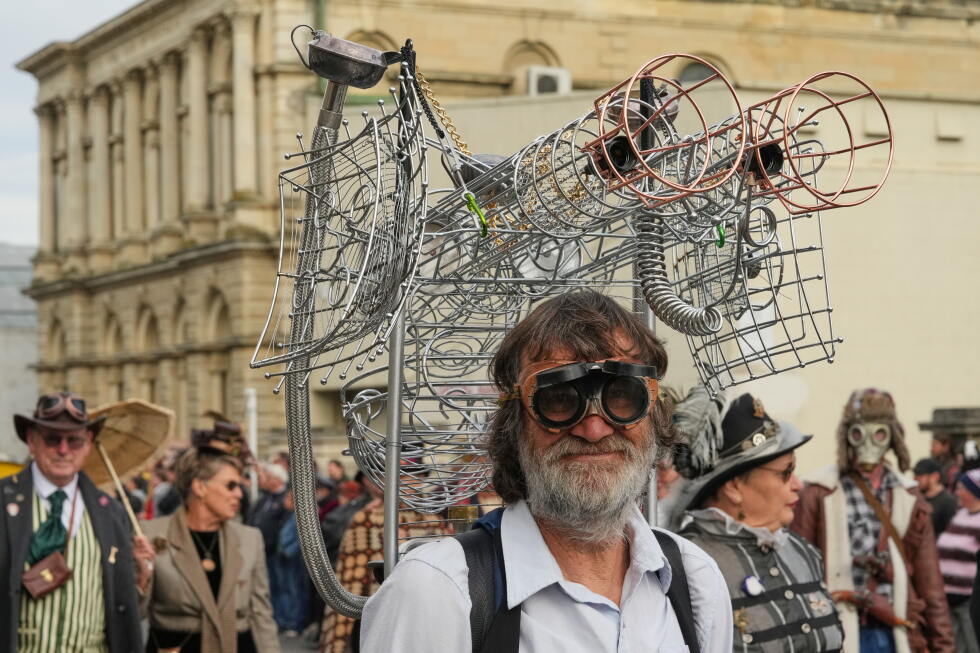
Nestled along the coast of New Zealand’s South Island, the quiet rural town of Ōamaru — population 14,000, plus a colony of 3,000 endangered native penguins — transforms every year into a bustling, fantastical parallel world where Victorian-era steam power meets imaginative science fiction, for one of the world’s most beloved steampunk festivals.
This year marked the event’s 17th iteration, drawing thousands of enthusiasts from across New Zealand and around the globe to embrace the genre’s core ethos: the stranger, the better. For four days, the town’s perfectly preserved 19th-century Victorian harbor street becomes a playground for eccentric personas, handcrafted costumes, and one-of-a-kind creative traditions built around the steampunk movement.
Unlike rigid historical reenactment, steampunk re-imagines the Victorian era, blending its signature aesthetics and steam-based mechanics with modern sci-fi creativity to build a world where the industrial revolution never ended and imagination sets the only limit. The movement also prioritizes do-it-yourself craft and sustainable upcycling: enthusiasts spend months honing sewing, metalworking, and hat-trimming skills to build custom outfits that match their invented alter egos.
Many attendees lead ordinary lives as bricklayers, engineers, farmers, and artists the rest of the year, and many describe themselves as shy in daily life. But at the festival, they step into entirely new identities. For festival regular Juliet Thorn, who attends as the charismatic Lady Sarsaparilla Ovabyte alongside her partner Greg “Captain Bob McSpoon” Thorn, the experience is transformative. “The first time you dress up and go out in public is really scary and then people get such a buzz out of it,” she explained. “It’s so cool that you take on a different personality.”
Over nearly two decades, the festival has spawned its own unique set of quirky sporting events and community traditions. Hundreds of attendees pack into historic community halls to compete in unconventional contests, from speed cookie-dunking (where the goal is to dunk, then eat a soggy cookie faster than any competitor) to theatrical parasol dueling, judged just as much on style as speed. One of the most popular events is teapot racing, created by local enthusiast Ross McKay, now known by his steampunk persona Captain Roscoe Dangerfield. In the contest, participants navigate remote-controlled vehicles fitted with teapots through a tricky obstacle course, much to the delight of cheering crowds. McKay, a retired banker and self-described history geek and sci-fi nerd, originally thought steampunk was just “a bunch of weirdos” when he first saw photos, but quickly fell in love with the community. He has since brought teapot racing to steampunk events around the world, joking that “it’s lots of fun and the judges will take bribes.”
This small South Island town was an unlikely pick to become the self-proclaimed steampunk capital of the world. For decades, Ōamaru was little more than a rest stop for travelers driving between the larger cities of Christchurch and Dunedin, overshadowed by the dramatic Lord of the Rings-era film locations that draw tourists to nearby regions. What put Ōamaru on the global steampunk map is its architectural quirk: a fully intact Victorian-era commercial street built from pale local stone, a leftover from the 1800s when Ōamaru was a bustling export hub shipping New Zealand meat, wool, and grain to Britain. Today, those historic buildings serve as the perfect immersive backdrop for the festival, which coexists peacefully with the town’s separate, historically accurate Victorian celebration held later in the year.
Unlike the rigid social hierarchies of the actual 19th century, steampunk rewrites Victorian social norms to create an inclusive, equal-opportunity community. “Women, unlike in Victorian times, can be anything,” explained Iain Clark, the festival’s co-founder, who goes by the steampunk name Agent Darling. “We have female engineers, captains of industry, captains of airships, adventurers, explorers, scientists.” There are no hard rules for costumes or personas: attendees regularly bring multiple outfits to swap over the four-day event, and no concept is too wild to turn heads. Over the course of the festival, a Star Wars stormtrooper might wander past a group of costumed “wolves,” while first-time attendees jump straight into the fun, no experience required.
For long-time guests, the community’s radical acceptance and celebration of creativity is what keeps them coming back. “You can be creative and you can be somebody else and no one cares,” said John Syben, attending his fourth festival. His partner Chris Sinclair noted that the pair have grown bolder with their costumes every year, adding: “There’s always someone who’s more nuts than you.” For countless steampunks, the small New Zealand festival has become more than an event — it’s their tribe.