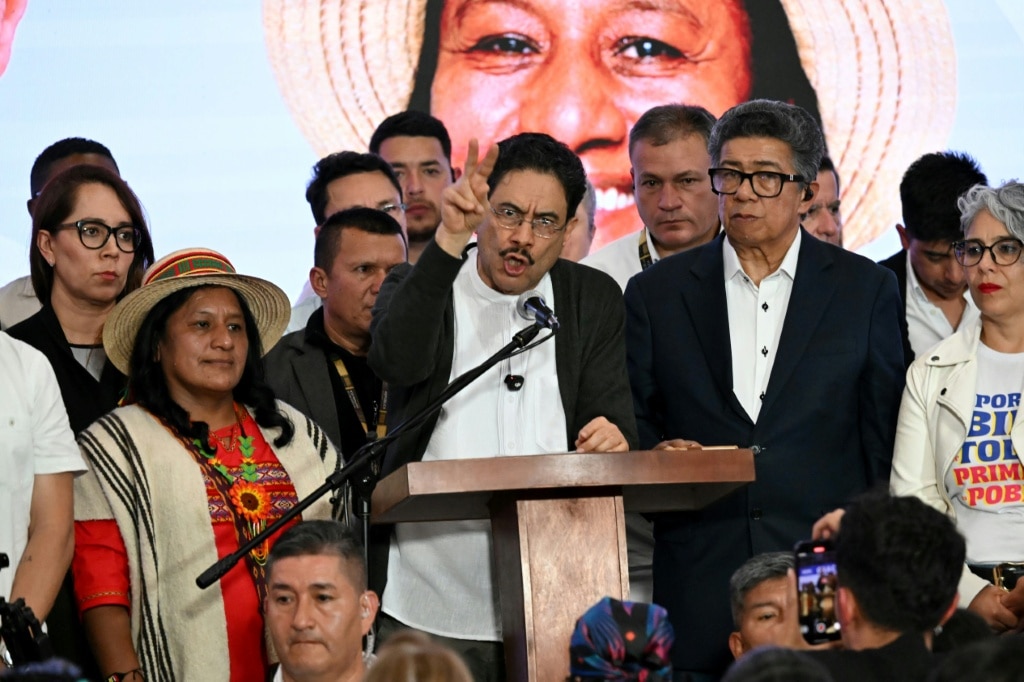
As Colombia enters the final stretch of its 2024 presidential race, the country’s two remaining candidates have launched their runoff campaigns this week, with bitter personal exchanges highlighting the deep ideological divide splitting the South American nation ahead of the June 21 vote. In an upset outcome that defied pre-election polling, hard-right pro-Trump lawyer Abelardo de la Espriella secured a narrow two-point lead in Sunday’s first round, capturing 43 percent of the vote against leftist senator Iván Cepeda’s 41 percent, with the vote unfolding against a resurgent wave of drug-fueled guerrilla violence across rural regions.
The self-styled “Tiger,” a millionaire outsider who has positioned himself as a disrupter of traditional Colombian political norms, has campaigned on a hardline security platform echoing the tough-on-crime agenda that has lifted right-wing candidates to power across Latin America in recent years. De la Espriella has vowed to abandon ongoing peace negotiations with cocaine-trafficking rebel groups, instead promising full-scale military force to crush the insurgency. To tackle rising crime, he has pledged an aggressive “shock plan” that includes immediate airstrikes on narco-terrorist training camps and the construction of 10 maximum-security mega-prisons modeled after El Salvador’s controversial Terrorism Confinement Center, where he says inmates will be held under harsh conditions relying only on “bread and water” for sustenance.
His rival Cepeda, a close ally of current polarized leftist President Gustavo Petro and the son of a leftist leader assassinated by right-wing paramilitaries, took a different tack in the first round. The 63-year-old senator, who helped broker the landmark 2016 peace accord with the FARC guerrilla movement, has made continuing dialogue with active armed groups and expanding progressive social programs to reduce systemic inequality the core of his campaign. He has pledged to build on Petro’s legacy, including increasing the national minimum wage, boosting public education funding, and redistributing unused land to low-income rural communities.
The depth of Colombia’s political rift has even seeped into national symbols, just days ahead of the start of the 2024 World Cup. Cepeda has accused de la Espriella of “stealing” Colombia’s iconic yellow national football jersey to brand his right-wing campaign, a tactic that mirrors former Brazilian far-right President Jair Bolsonaro’s co-opting of Brazil’s national jersey as a political symbol. For his part, de la Espriella hit back, accusing Cepeda and Petro of attempting to “steal democracy” by questioning the integrity of Sunday’s first round results, drawing a comparison between the leftist camp and ousted Venezuelan authoritarian leader Nicolás Maduro.
The biggest upset of the first round was the poor performance of establishment conservative candidate Paloma Valencia, who was endorsed by influential former President Álvaro Uribe but finished third with only 7 percent of the vote. After her elimination, Valencia threw her support behind de la Espriella, warning against what she frames as Cepeda’s “neocommunist” agenda. Political analysts note that de la Espriella’s first round success stems directly from his ability to tap into widespread anti-Petro sentiment and mobilize radical right-wing voters across the country.
While Cepeda faces an uphill battle to overcome his two-point first round deficit, analysts say an upset victory is not out of the question. “He has roughly the same level of support in polling that Petro held four years ago when he won the presidency, so it’s still a competitive race,” explained Yann Basset, a political science professor at Bogotá’s Universidad del Rosario.
One major unanswered question hanging over the runoff is how the country’s large centrist voting bloc will break. Failed centrist vice-presidential candidate Juan Daniel Oviedo, who was eliminated in the first round, has lamented that Colombia is now “caught between populist extremes” and declined to endorse either of the two remaining candidates.
Colombia has made significant political and social progress in the decade since the 2016 FARC peace accord, but large swathes of rural territory remain under the control of armed factions fighting for control of cocaine trafficking routes, illegal gold mining operations, and extortion rings. The entire election campaign has already been marred by political violence, including car bomb attacks, drone strikes, the assassination of a leading first-round presidential candidate, and the killings of dozens of local political officials across the country.
For many ordinary Colombians, the polarized race has forced a stark choice between two competing visions for the country’s future. “Right now we are at radical extremes: one side wants peace, the other wants war,” said Gloria Terranova, a 59-year-old coffee plantation worker who said she still holds out hope for a Cepeda victory in the runoff. Other voters have echoed the sense of deep national division. “The country is quite divided… the feeling is that in the second round things will remain the same,” said Camilo Martinez, a 25-year-old designer based in the Caribbean coastal city of Barranquilla.