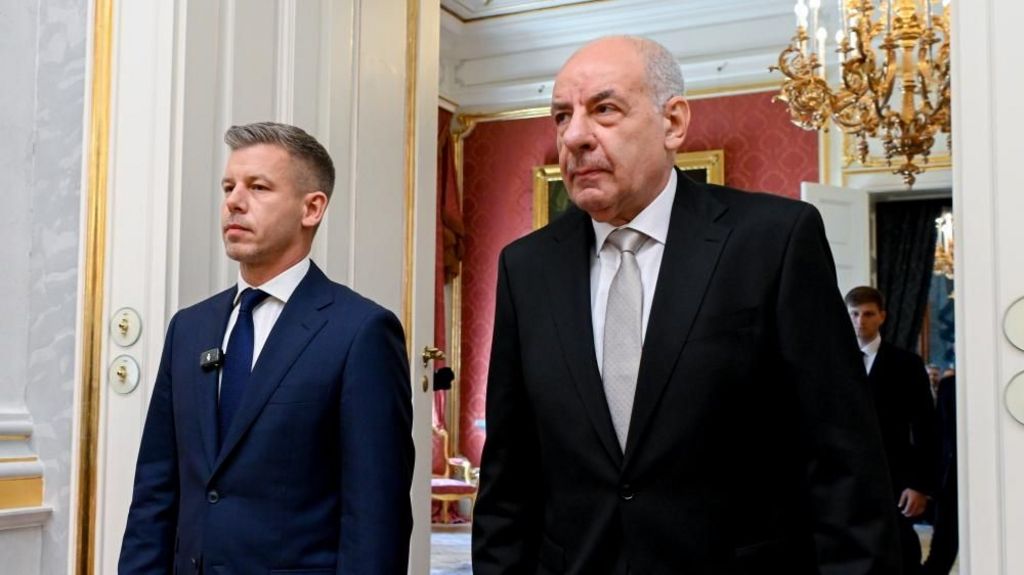
A sharp constitutional confrontation is unfolding in Hungary just months after a seismic political upheaval ousted long-serving prime minister Viktor Orbán, as newly installed Prime Minister Péter Magyar has confirmed his government will push through a constitutional amendment to oust sitting President Tamás Sulyok, who has repeatedly rejected calls to resign from his post.
Magyar’s Tisza Party secured a historic landslide victory and a two-thirds supermajority in the National Assembly during April’s general election, a result that ended 16 years of uninterrupted rule by Orbán’s right-wing Fidesz party. Since taking power, the new prime minister has made dismantling remaining Orbán-era institutional holdovers a top policy priority, and has targeted Sulyok — a figure appointed to the presidency by Fidesz in February 2024 without a direct public vote — as a primary example of old regime influence.
Magyar has repeatedly publicly called for Sulyok’s resignation, most recently setting a firm 31 May deadline for the president to step aside. In a social media post on X published over the weekend, Magyar doubled down on his criticism, arguing that Sulyok has never advocated for vulnerable Hungarian communities, defended citizens under political attack, or upheld the principles of the rule of law. He has repeatedly characterized the sitting president as unfit to represent the unity of the Hungarian nation, claiming Sulyok remains loyal to Orbán’s political interests rather than serving the public good.
Sulyok, for his part, has refused to step down, stating he intends to complete the full five-year term he was appointed to serve. Following a face-to-face meeting with Magyar on Monday, the president reaffirmed his position, warning that the forced removal effort triggered by the new government has already created a constitutional crisis that deepens existing social rifts within Hungary and undermines international confidence in the country’s democratic credentials. He has also raised a warning that the ongoing standoff could put at risk the long-frozen €16.4 billion in EU development funds earmarked for Hungary, a large portion of which has been withheld by Brussels for years due to documented democratic backsliding during Orbán’s tenure. Last week, EU officials signaled that reform efforts under Magyar’s new government could clear the way for the funds to be released imminently, a development Sulyok argues is now threatened by the political clash.
Fidesz, Orbán’s former ruling party, has already labeled Magyar’s demand for Sulyok’s resignation an “unlawful ultimatum”, rejecting the new government’s push to remove the sitting president. While the Hungarian presidency is largely a ceremonial role under the country’s governing framework, it holds key practical powers that can disrupt the new government’s legislative agenda: it can refer passed laws back to parliament for re-examination, challenge legislation before the Constitutional Court, and oversee all public sector appointments. Just on Monday, Sulyok demonstrated these active powers by announcing a slate of new military appointments via his official Facebook page, a move seen as a show of defiance amid the standoff.
The presidency itself became vacant in early 2024 when then-president Katalin Novák resigned in the wake of public outrage over the Fidesz government’s botched response to a high-profile child sex abuse scandal, clearing the way for Sulyok’s appointment by the outgoing Fidesz-controlled legislature. Orbán himself stepped down from his seat in parliament after his party’s election defeat in April, closing out 16 years as Hungary’s prime minister. Even as it moves to oust Sulyok, Magyar’s government has already advanced additional constitutional reforms to lock in the post-Orbán political shift, including a new amendment that would cap any future prime minister at eight years total in office, closing off any potential path for Orbán to return to power.
Magyar confirmed to reporters this week that the constitutional amendment process to remove Sulyok will take approximately four weeks to complete, a timeline that keeps the country in a state of political uncertainty as the new government works to roll out its ambitious agenda of institutional and democratic reform.