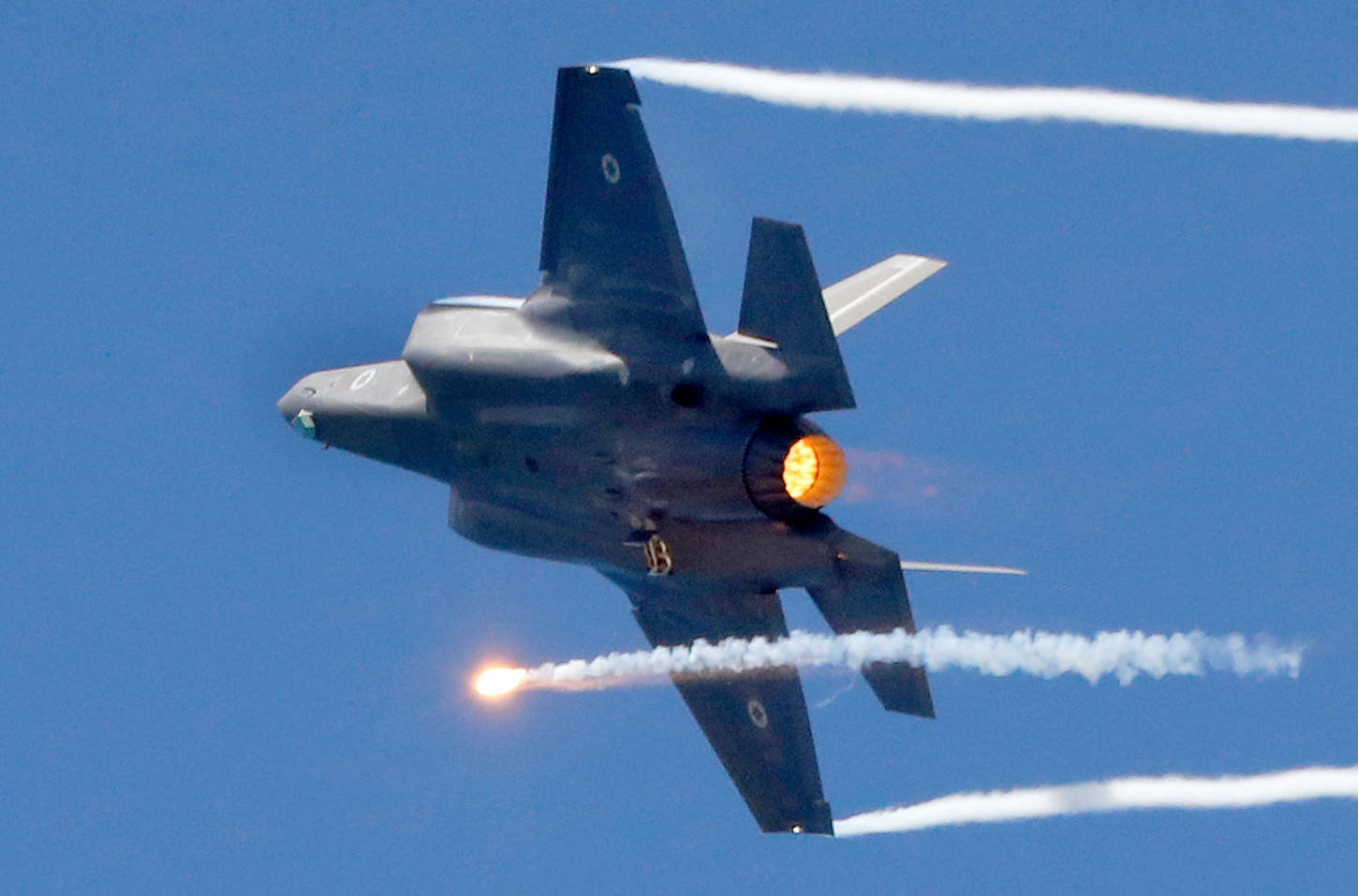
For over half a century, Washington’s commitment to maintaining Israel’s military dominance over all regional rivals has anchored the decades-long alliance between the United States and Israel, shaping power dynamics across the entire Middle East. This core policy, formally known as Qualitative Military Edge (QME), has guided billions of dollars in U.S. military support, restricted arms sales to other regional states, and become a flashpoint for growing political controversy amid Israel’s devastating military campaign in Gaza.
The QME framework emerged in the aftermath of the 1967 Arab-Israeli War, taking root during the Cold War when the U.S. and Soviet Union backed opposing blocs in the region. The first landmark step toward formalizing this commitment came in 1968, when President Lyndon B. Johnson approved the sale of 50 advanced F-4 Phantom fighter jets to Israel — a departure from earlier U.S. arms export restrictions to the country. When the 1973 Arab-Israeli War broke out, with Moscow pouring arms into Arab coalition forces, Washington responded with sweeping logistical and military backing for Israel. By 1977, former Secretary of State Henry Kissinger, a key architect of Cold War U.S. foreign policy, framed Israeli security as a core moral priority for all democratic nations, cementing the policy’s ideological standing.
The 1980s marked the first explicit official use of the term “qualitative military edge”. In 1981, Secretary of State Alexander Haig confirmed before Congress that preserving Israel’s military superiority had been a central pillar of U.S. policy since the 1973 war. The policy’s influence extended to all U.S. arms deals in the region: when Washington sold F-15S Strike Eagle warplanes to Saudi Arabia in the 1990s, the jets were fitted with downgraded radar technology, and Riyadh was barred from stationing the aircraft at its Tabuk airbase near the Israeli border to avoid threatening Israel’s advantage.
QME was formally codified into U.S. federal law in October 2008 under the George W. Bush administration via the Naval Vessel Transfer Act. The legislation legally bound the U.S. government to ensure that any arms exports to other Middle Eastern states do not undermine Israel’s military superiority, formally defining QME as Israel’s ability to defeat any credible conventional military threat — from individual states, coalitions, or non-state actors — with minimal casualties, through superior technology, weaponry, and intelligence, surveillance and reconnaissance capabilities. The law also mandated a quadrennial assessment of Israel’s military edge relative to regional neighbors, a requirement updated in 2013 by the Israel QME Enhancement Act, signed by President Barack Obama, to require assessments every two years.
Since the end of World War II, cumulative U.S. military aid to Israel has surpassed $240 billion when adjusted for inflation, making Israel the largest cumulative recipient of U.S. foreign military assistance in modern history. The current framework for this support is a 2016 Memorandum of Understanding (MoU) signed by the Obama administration, which allocates a minimum of $3.8 billion in annual military aid to Israel through 2029 — the largest single military aid pledge in U.S. history. The agreement requires Israel to spend the vast majority of these funds on U.S.-manufactured military equipment, ensuring the investment cycles back to the American defense industry. At the time of the signing, Obama emphasized that “America’s commitment to Israel’s security is unshakeable”, noting that access to cutting-edge U.S. weapons technology would guarantee Israel’s ability to defend itself against all threats.
In the years following the October 7, 2023 Hamas-led attacks on Israel and the subsequent Israeli military campaign in Gaza that human rights groups have labeled genocide, additional U.S. military support to Israel has surged to record levels. Congressional data shows that annual U.S. military contributions to Israel hit a new high of more than $12.5 billion in 2024.
At the center of current U.S. arms exports to Israel is the F-35 Lightning II stealth fighter, manufactured by American defense giant Lockheed Martin with components supplied by eight partner nations including the United Kingdom and Germany. As the world’s most technologically advanced stealth jet, prized for its long range, 360-degree integrated sensors and radar evasion, the F-35 is also the most expensive weapons program in history, with total program costs exceeding $2 trillion and a per-unit price of $82.5 million for the standard F-35A variant. As the program’s controlling owner, the U.S. only approves F-35 sales to NATO members or U.S.-designated Major Non-Nato Allies, with just 20 countries currently operating the jet. The U.S. itself operates 1,763 F-35s, more than all other operator nations combined.
Israel became the first foreign country to purchase the F-35 in 2010, receiving its first deliveries in 2016, and remains the only country in the Middle East and North Africa region to operate the jet. Israel’s custom variant, designated the F-35I Adir (Hebrew for “The Mighty One”), is modified to integrate Israeli-developed electronics and software. In 2018, Israel became the first country to use the F-35 in combat, launching an airstrike in Lebanon. Israeli F-35s have since been used in operations across the region against targets in Iran, Syria, Yemen, Qatar, and Gaza, where the Israeli campaign has killed nearly 73,000 Palestinians, according to local health authorities. During the 2025 Israel-Iran war, Middle East Eye reporting confirmed that the U.S. approved Israeli modifications to its F-35 fleet to add external fuel tanks, allowing non-stop round-trip flights from Israel to Iran without refueling at U.S. bases in the Gulf or Caucasus, where host governments declined permission for Israeli refueling stops. Beyond the F-35, Israel also operates large fleets of U.S.-made F-15 and F-16 fighter jets, and the U.S. has invested billions of dollars into co-developing Israel’s world-renowned layered air defense systems, including Iron Dome, Arrow, and David’s Sling, produced in partnership with U.S. defense firm Raytheon.
Washington has also long maintained a deliberate policy of ambiguity toward Israel’s status as the Middle East’s only undeclared nuclear power, which developed outside public U.S. oversight and was first publicly exposed by Israeli whistleblower Mordechai Vanunu in 1986.
In recent years, the massive scale of U.S. military support for Israel has sparked growing political backlash in the U.S., amplified by widespread international condemnation of Israel’s military campaign in Gaza. The only Palestinian-American member of Congress, Democratic Representative Rashida Tlaib, argued in September 2025 that the U.S.-backed, U.S.-funded military operation in Gaza is growing more horrific by the day without congressional action to cut off aid. Criticism has also emerged from across the political aisle: in July 2025, Republican Representative Marjorie Taylor Greene introduced an amendment to cut $500 million in funding for Iron Dome, which gained support from Tlaib and progressive Democrat Ilhan Omar but failed by a lopsided 422-6 vote. High-profile conservative commentator and former Fox News host Tucker Carlson has also called for a full end to U.S. aid, telling Israel’s Channel 13 in May 2025 that “I don’t think the United States owes Israel anything. I don’t think the U.S. should give Israel anything. I think we should stop all aid to Israel tomorrow.” The White House dismissed Carlson’s comments as the work of a “low-IQ person who spreads fake news for cheap publicity.”
The future of the QME policy was thrown into question in November 2025, when President Donald Trump announced during a White House visit by Saudi Crown Prince Mohammed bin Salman that the U.S. would proceed with a plan to sell F-35 stealth fighters to Saudi Arabia, as part of a broader package of bilateral trade and defense deals worth billions of dollars. Trump acknowledged Israeli concerns that selling top-tier F-35s to Riyadh would undermine its military edge, saying “I know they [Israel] would like you to get planes of reduced calibre. I don’t think that makes you too happy… I think they [Saudi Arabia and Israel] are both at a level where they should get top of the line.” Israeli Prime Minister Benjamin Netanyahu pushed back quickly, saying that Secretary of State Marco Rubio had reaffirmed the U.S. commitment to preserving Israel’s QME in all regional arms sales. The proposed sale has not yet received congressional ratification, and its path forward remains uncertain.
Kristian Ulrichsen, a fellow at Rice University’s Baker Institute for Public Policy, told Middle East Eye that the sale’s outcome will depend heavily on whether the Trump administration has enough political capital to advance the deal amid heightened congressional scrutiny, particularly if 2026 midterm elections shift control of one or both congressional chambers to the Democratic Party. This is not the first time a proposed F-35 sale to a Gulf state has run into obstacles: in 2020, during Trump’s first term, the administration announced plans to sell up to 50 F-35A jets to the United Arab Emirates following the Abraham Accords normalization agreement between Israel and the UAE, but President Joe Biden paused the deal after taking office in 2021 over concerns about UAE’s economic and security ties with China. When Washington imposed strict access restrictions on the jets, the UAE pulled out of the deal at the end of 2021 and ruled out reopening talks in 2024. Turkey similarly lost access to the F-35 program in 2019 after purchasing Russian-made S-400 air defense systems, which U.S. officials said posed unacceptable intelligence risks. A NATO member and original F-35 production partner, Turkey has paid roughly $1.4 billion for the jets it ordered, six of which remain undelivered; President Recep Tayyip Erdogan requested that Trump revisit the ban during a March 2025 diplomatic request.
Despite the proposed Saudi sale, Israel continues to expand its own fleet of advanced U.S. fighter jets. In May 2026, Israel announced plans to purchase 25 additional F-35s alongside a squadron of new F-15IA advanced fighter jets. Combined with a 2023 order for 25 more F-35s, the purchases will bring Israel’s F-35 fleet to roughly 100 jets, giving it one of the largest F-35 squadrons outside the United States. Ulrichsen noted that even with new arms sales to Gulf partners, longstanding U.S. commitment to QME is unlikely to shift. “The US is likely to maintain its commitment to preserving Israel’s QME even as it deepens defence and security ties with the Gulf States,” he said.