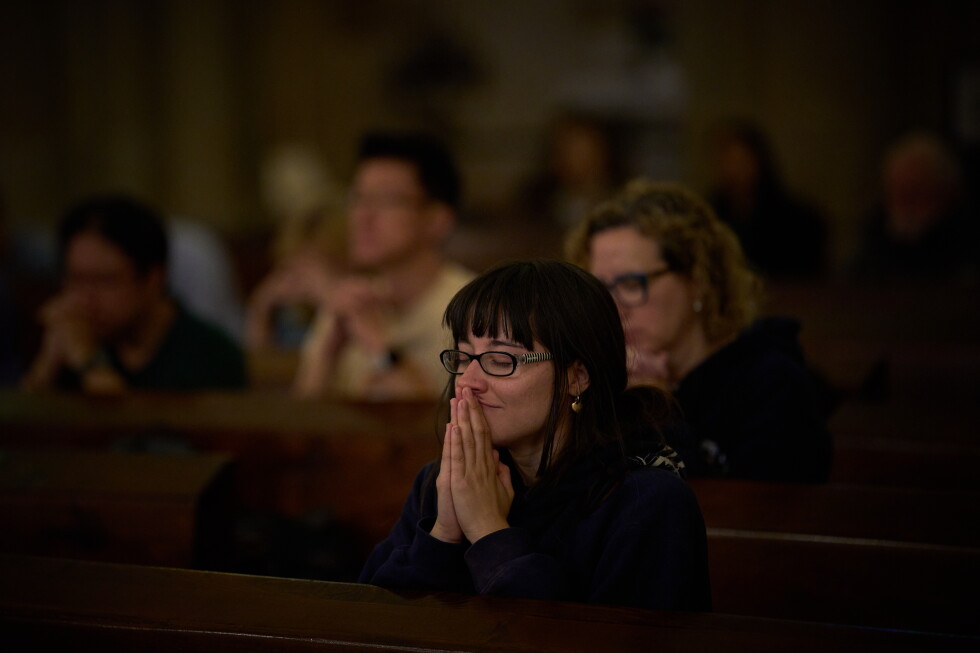
For most of her young adulthood, 26-year-old Sara Cabral fit the mold of a generation of secularized Southern European youth: raised in the Catholic tradition, but never actively practicing, with faith feeling distant from her daily life on Spain’s Canary Islands. That changed three years ago, when a track from a local faith-based youth group sparked something unexpected in her — a feeling that the lyrics carried a message from God directly to her.
Cabral quickly joined the movement, and today she not only attends the group’s weekly music-fueled adoration sessions, but is also preparing excitedly to join her friends for Pope Leo XIV’s open-air Mass in Gran Canaria during his upcoming trip to Spain this month. Reflecting on her journey back to the church, Cabral describes an unidentifiable inner restlessness, a hollow feeling she could not fill through other means. “God is the one looking for you first, but you need to go meet him,” she explained of her decision to embrace Catholicism.
When Pope Leo travels to Spain in June and France this September, he will encounter thousands of young people like Cabral across two nations that are historically the heart of Catholicism, but have grown firmly secular in recent decades. Across the region, centuries-old parish churches dot nearly every town and city, but weekly Mass attendance has dwindled to just a small fraction of the population. This new wave of young interest in faith has left church leaders and religious scholars debating what it means for the future of Catholicism in Western Europe, with many framing the trend as both a surprising revival and a long-term challenge for the institution to adapt to modern spiritual needs.
## A Shifting Religious Landscape Decades in the Making
To understand this emerging trend, it is necessary to trace the decades-long shift in Spanish religious life that created the current moment. Until 1975, Spain was governed by dictator Francisco Franco, who tightly aligned his regime with a deeply traditional Catholic Church still recovering from the violent anticlerical purges of the Spanish Civil War. After the transition to democracy, a marked separation emerged between popular cultural traditions rooted in Catholicism and active religious participation, explained Mónica Cornejo Valle, a religion professor at Madrid’s Complutense University.
Even today, iconic public religious celebrations such as processions and feast days remain widespread across most Spanish regions, and tangible traces of Catholicism’s centuries-long central role in Spanish life are visible in nearly every community. The country still counts nearly 23,000 active parishes, but ordinations of new priests have not rebounded from decades of decline. Data from a 2024 Pew Research Center survey underscores the scale of secularization: while 80% of Spanish adults were raised Catholic, only 47% still identify with the faith, and just 2% are converts from non-religious or non-Catholic backgrounds. Only around 16% of self-identified Spanish Catholics attend Mass at least once a week, a core obligation for practicing believers.
This generational shift is palpable for young returning believers. José María Marrero, a friend of Cabral’s in Gran Canaria, recalled attending Mass as a child with his mother and noticing the pews were filled almost entirely with elderly worshippers. Marrero’s wife, who converted to Catholicism and was baptized in her early 20s, recently said some of her elementary school students saw an image of Jesus on a class trip and asked, “Miss, that’s the Catholic one, right?”
Against this backdrop, Rev. Josetxo Vera, spokesperson for the Spanish Catholic Bishops Conference, has observed a surprising new trend: growing numbers of teenagers whose parents identify as atheist are surprising their families by asking to be baptized, drawn to spiritual themes increasingly visible in mainstream popular culture. Catalan global pop star Rosalía’s recent spirituality-infused album *Lux* is one high-profile example of how Christian messaging is reaching young audiences outside of traditional church settings.
Some scholars, including Cornejo Valle, caution that the apparent revival of youth religiosity may be partially a “publicity effect,” amplified by strategic use of social media and partnerships with popular culture. But for church leaders and youth movement organizers, the broad shift away from lifelong religious practice has created a blank slate to reintroduce faith to a new generation. For Cabral, that means sharing the faith in accessible, joyful terms that resonate with modern young people.
## Grassroots Youth Movements Fuel New Interest
The re-engagement of young Spanish Catholics has been largely driven by grassroots lay movements that frame faith as a source of community and meaning, rather than rigid doctrine. One of the largest of these groups is Hakuna, which counts Cabral and roughly 35,000 other young people among its members. The movement launched in the early 2010s at a Madrid parish, when a small group of college students organized a weekly gathering that paired an opening lecture, a full hour of Eucharistic adoration, and an informal social meetup at a local bar afterward.
Hakuna became an official lay organization of the Spanish Catholic Church in 2017 and has since expanded to offer volunteer service trips and faith-focused concerts, even releasing seven full albums of original Christian music. “It’s the Holy Spirit, we’re the first to be surprised” by the movement’s rapid growth, said Hakuna spokeswoman Maca Torres. She added that most members are young people who had stopped practicing the faith after childhood, though a small share are first-time converts.
This growth in youth engagement has translated directly to a sharp rise in adult baptisms across the region. The most recent annual report from the Spanish Catholic Bishops Conference recorded more than 13,300 baptisms for people over the age of seven, a marked increase from a decade ago. In France, which enforces a strict form of secularism that bans most religious expression in public spaces — a policy that has sparked growing political and social debate in recent years — the trend is even more stark: this year’s Easter Vigil saw roughly 13,000 adult baptisms, 42% of them between the ages of 18 and 25. That number represents a threefold increase compared to adult baptism counts 10 years ago, according to France’s Conference of Catholic Bishops.
Pope Leo has openly embraced this wave of new young believers. Last summer at the Vatican, he addressed a gathering of French baptism candidates and newly baptized adults, urging them to share their spiritual journeys with peers and let their faith guide their daily lives. “What a joy to see young people who are engaging with faith and want to give a sense to their life, by letting themselves be guided by Christ and his Gospel,” he told the group.
Religion scholars say the rising interest in Catholicism among young people stems from two key factors: widespread disillusionment with traditional political and social institutions, and growing recognition of the loneliness epidemic fueled by social media and hyper-connected digital life. Compounding this, the church since the papacy of Francis has shifted its public focus away from rigid doctrinal rules and toward issues of social justice, migration, and equity — priorities that align far more closely with the values of young progressive believers.
Pope Leo’s upcoming trip to Spain reflects this shift in outreach. On June 6, he will kick off his visit with a large-scale prayer vigil for young people in a central Madrid public square, before traveling to the Canary Islands to visit a migrant reception center and a prison near Barcelona. These outreach efforts to marginalized communities are particularly resonant for socially conscious young Catholics.
Cornejo Valle notes that while the total number of young Catholics has not grown dramatically, the cohort that remains active is far more engaged and committed than previous generations. “We don’t think that the number of Catholic young people has grown by a lot, but we do see that in general the profile of the Catholic youth is more committed than before,” she explained.
## A New Generation’s Quest for Meaning and Connection
For many young believers, the pull of the church is rooted in a search for peace and purpose in a chaotic, fast-paced world. María Salazar, 23, leads a local chapter of the global Catholic youth movement Effetá in Barcelona, based at the iconic Sagrada Familia — Antoni Gaudí’s unfinished modernist masterpiece and one of the most visited tourist sites in Europe. Salazar says many of her peers are exploring different forms of spirituality, both inside and outside the institutional church, in a search for something missing from their daily lives.
“More than looking for faith, we look for a feeling of peace,” Salazar said. “We live in a microwave society — everything has to be immediate — but the Lord doesn’t work this way.”
Salazar’s parish at the Sagrada Familia has seen a noticeable boom in young participation in recent years. Around 120 young regulars take part in weekly adoration sessions and multi-day spiritual retreats; for the first retreat, organizers and the basilica’s rector worked well past midnight to prepare the space for attendees. The group also volunteers to assist elderly worshippers attending Mass in the basilica’s crypt, and to welcome the millions of international tourists who attend public worship services in the main sanctuary.
On June 10, Pope Leo will celebrate Mass at the Sagrada Familia and formally inaugurate the basilica’s newly completed Tower of Jesus Christ, a project decades in the making. For Salazar, the pope’s visit feels like a homecoming. “We’re going to have him here at home,” she said excitedly. “I see the tower from afar and I see the home that God gave us.”