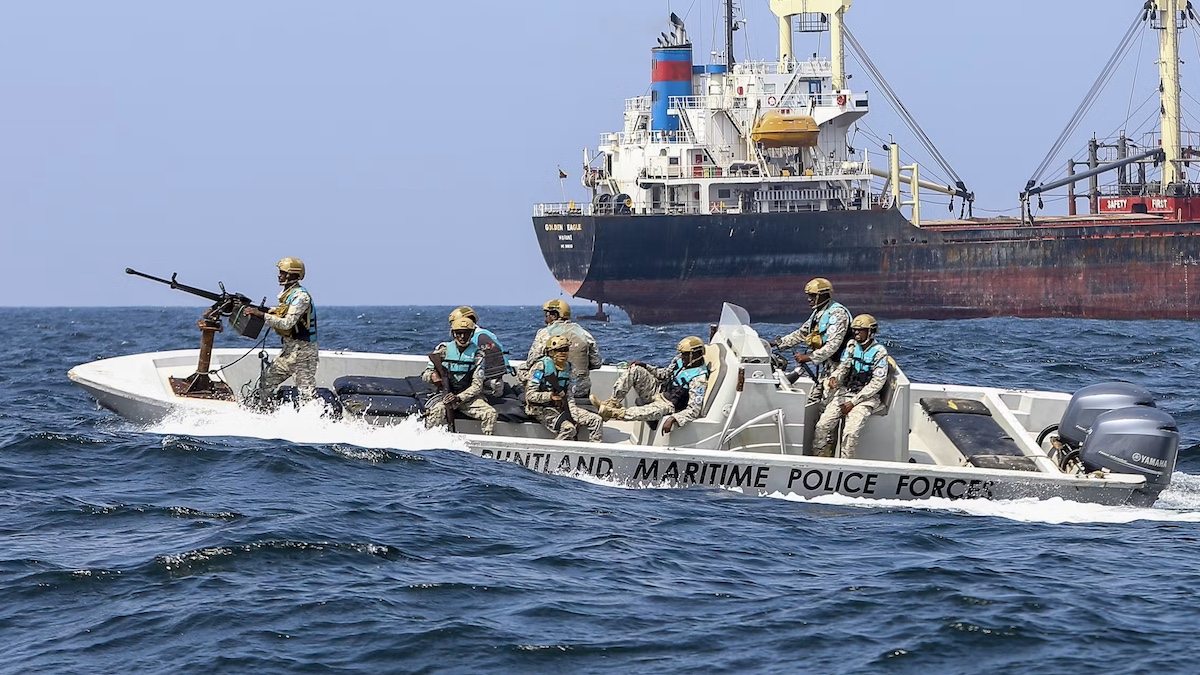
In the late evening of April 26, an Egyptian-registered merchant vessel, the Sward, was boarded and seized by armed assailants just a few nautical miles off the shoreline of Somalia. The hijackers diverted the captured ship toward a mooring point near the port of Garacad in Puntland, the semi-autonomous regional state in northeastern Somalia. In the days following the initial seizure, additional hijacking personnel arrived aboard the Sward, accompanied by a negotiator brought in to coordinate ransom demands with the vessel’s ownership. As of the time of this report, the Sward and its crew remain fully under pirate control. This incident is far from an isolated attack: two additional commercial vessels, the Palau-flagged oil tanker Honour 25 and the Togo-flagged tanker Eureka, were hijacked in the same window and also redirected to the Puntland coast.
In recent weeks, Somali pirate factions have also seized multiple traditional ocean-going sailing vessels called dhows to repurpose them as “motherships.” These converted vessels allow pirate crews to stay at sea for extended periods, putting them in position to launch strikes hundreds of miles from the Somali coastline. This string of coordinated attacks has reignited widespread international concern that Somali piracy, a threat largely suppressed for more than a decade, is making a dangerous comeback.
To understand the gravity of the current resurgence, it is necessary to revisit the history of piracy in the region. Between 2005 and 2012, Somali pirate groups carried out more than 1,000 attacks on international commercial shipping, successfully hijacking 218 vessels and taking more than 3,700 sailors hostage. Over that period, shipowners paid an average of $50 million in annual ransom payments, while the cumulative economic cost of disrupted trade, increased insurance premiums, and expanded security measures reached as high as $18 billion per year for the global economy.
For more than a decade after that peak, Somali piracy was kept under control through a combination of armed private security on commercial vessels, coordinated international naval patrols, and targeted land-based development programs. However, the underlying structure of piracy was never fully dismantled: very few top pirate leaders were ever brought to trial, and the extensive onshore support and logistics networks that sustained the trade were never rooted out. Experts have long warned these networks were merely dormant, and the recent spate of hijackings suggests that warning was well-founded.
So is the old hijack-for-ransom business model poised for a full resurrection? Analysts point to three key factors that create fertile ground for a widespread return of piracy. First, piracy in Somalia has always been deeply tied to political instability. Academic research on the local dynamics of 2000s-era Somali piracy found that peaks in pirate activity consistently aligned with periods of constitutional crisis, political upheaval, and military conflict across the country. Today, Somalia is mired in just such a crisis: in March 2026, the federal federal government indefinitely postponed the scheduled 2026 general election without following legal protocol, and recently ordered the dissolution of the newly elected parliament of Somalia’s South West state, forcibly replacing its regional leadership. Additionally, Israel’s December 2025 recognition of the self-declared Republic of Somaliland has reshuffled regional alliances, pitting Arab states led by Saudi Arabia — which views Somali territorial integrity as critical to Red Sea and Gulf of Aden security — against the breakaway region. This pattern of political fragmentation mirrors the conditions that allowed piracy to flourish between 2005 and 2012, when regional elites in Puntland and south-central Somalia turned to pirate revenue to fund political and military campaigns. There is growing concern these elites could be tempted to revive the practice.
The second key driver is widespread economic desperation. Skyrocketing prices for food, fuel, and agricultural fertilizer, compounded by the Trump administration’s sudden elimination of U.S.-funded development and humanitarian programs, have created widespread hardship across Somalia. U.S. humanitarian aid to the country plummeted from $467 million in 2024 to just $70 million in 2025, with only $3 million in federal assistance disbursed in the first three months of 2026 alone. For many coastal communities, piracy is remembered as a reliable source of income: during the 2005-2012 peak, pirate groups distributed ransom revenue broadly across local communities to build onshore support, earning a reputation as generous employers for young people with few other economic options. With widespread poverty leaving many Somalis desperate for alternative income, pirate groups are finding a ready pool of new recruits.
Third, the strategic conditions for piracy are more favorable today than they have been in more than a decade. The closure of the Strait of Hormuz amid ongoing conflict with Iran, paired with Houthi attacks on commercial shipping in the Red Sea, has forced thousands of merchant vessels bound for Europe to reroute around the Cape of Good Hope — a path that runs directly along the length of the Somali coast, bringing a flood of new targets within pirate reach. At the same time, the risk to pirates has dropped sharply: most of the international naval vessels that previously patrolled the Somali basin have been redeployed to the Red Sea and Strait of Hormuz to address other security threats. This leaves pirates free to operate from hijacked motherships for weeks without detection or intervention. Compounding this, rising operational costs have led many smaller shipping lines to cut back on expensive counter-piracy measures, such as traveling at the high speeds needed to outrun pirate skiffs or hiring armed private security teams. While armed security has proven an effective deterrent, vessels that cannot afford these protections are extremely vulnerable to hijacking.
Looking ahead, the near-term trajectory of Somali piracy will depend heavily on the outcome of the current round of hijackings. Pirates depend on ransom payments to reinvest in their operations and attract new recruits to their performance-based, no-win no-fee contracts. If shipowners meet the hijackers’ demands — including the $10 million ransom the group has demanded for the Eureka — the quick payoff will incentivize more attacks and raise risk for all shipping in the region. Marine insurers could respond by reclassifying the Somali Basin as a high-risk area, as they did in 2008, which would drive shipping away from the coast and push up consumer costs across global supply chains. Unlike the 2010s, no major global power or international alliance currently has the political will or capacity to deploy a large-scale counter-piracy naval mission on the scale seen in 2011 and 2012, when the international community spent more than $1 billion annually on patrols off Somalia.
Experts emphasize that while piracy appears as a maritime security problem, a permanent solution will require addressing its root causes on land. Rather than relying exclusively on naval enforcement, investing in infrastructure to boost regional trade and inclusive local economic development offers a more sustainable long-term path to suppressing piracy. The cumulative economic damage of higher trade costs and large-scale naval operations far outweighs the limited benefits pirate activity brings to local Somali communities, making targeted onshore investment a far more cost-effective solution for the international community.