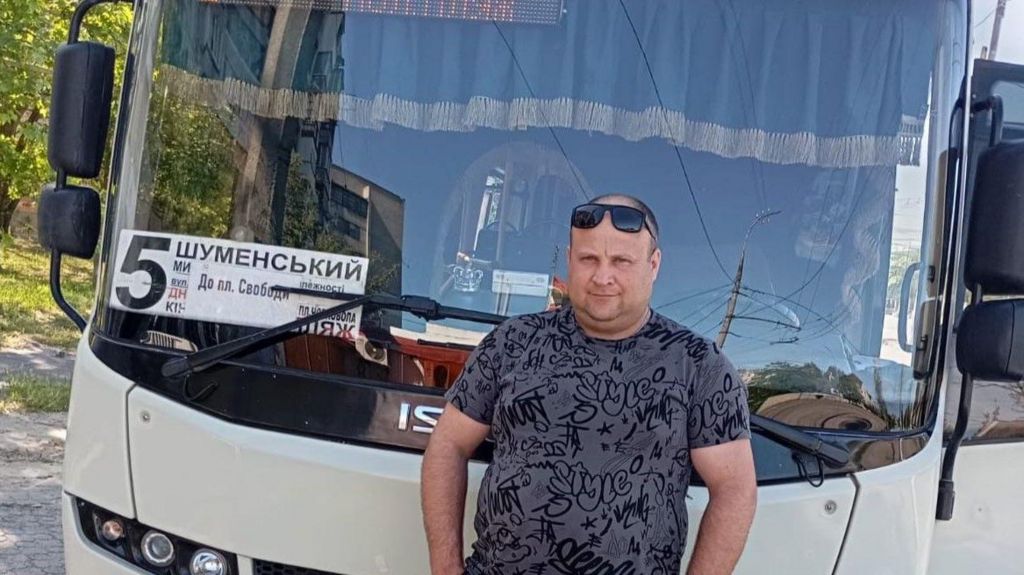
In the battered southern Ukrainian city of Kherson, public transport has become one of Russia’s most deliberate frontline targets. For the bus drivers who keep their routes running every day, every trip through the city’s streets is a journey made under the constant threat of death. Earlier this month, Anatoly Dmytrov was steering his full Route 14 bus through a busy intersection when a Russian drone slammed into the vehicle. In an instant, every window shattered into shards of glass. Shaken but focused on protecting his passengers, Anatoly managed to pull the bus to the next stop near a bomb shelter before he even noticed his own bleeding.
“I looked in the mirror and saw blood,” Anatoly recalled. “I thought – oh, I need to get to the shelter quickly because sometimes they send a second drone immediately.” He escaped with non-life-threatening injuries, but at least eight of his passengers were hurt in the attack. For drivers in Kherson, this grim scenario is not an anomaly – it has become a daily reality. “It’s no fun working here,” Anatoly said bluntly. “This happens almost every day, they’ve started hunting buses down. You go to work and you have no idea if you are going to come home.”
Data from Kherson’s municipal transport company, where Anatoly is employed, confirms the escalating danger of the job. The company says Russian drone operators have prioritized public transport as a target since last year, and the violence has grown steadily worse. In 2026 alone, three transport workers have been killed, eight more wounded, 21 trolleybuses destroyed or damaged, and eight municipal buses left unusable. Local authorities add that six privately operated passenger buses have also been struck this year, bringing the total number of buses hit to 27.
Kherson, a city that was home to roughly 300,000 residents before Russia’s 2022 full-scale invasion, still holds approximately 65,000 civilians who have chosen to stay despite constant bombardment. Recaptured by Ukrainian forces in late 2022 after an initial Russian occupation in the first weeks of the war, the city remains the administrative capital of one of the four Ukrainian regions Moscow illegitimately claims as its own. From positions across the Dnipro River, Russian forces have carried out relentless daily attacks on the Ukrainian-held city for more than three years.
Rita Dobrinova, a manager at the Kherson municipal transport company, says the threat has grown even deadlier in recent months as Russian forces have shifted to using fiber-optic guided drones, which are immune to standard electronic jamming technology. “Some are just hovering, waiting. Others are scout drones. They look the driver right in the eye through the windscreen,” she described. She recounted one particularly horrific fatal attack in April, when a bomb was dropped directly through a bus cabin’s roof onto the driver’s head, killing him instantly.
Local authorities have attempted to put protective measures in place for drivers and passengers: anti-drone nets have been strung above the busiest city streets, and drivers have been issued helmets, bullet-proof vests, and handheld drone detectors locally called *chuyka*. But these defenses are severely limited. The detectors only pick up drones that use pre-identified navigation frequencies, leaving fiber-optic guided drones and devices using new frequencies undetectable. All the devices can do when triggered is alert drivers that a drone is within range, with no further details on its location or intent.
When a detector alarm sounds, drivers are instructed to immediately stop the bus, evacuate all passengers, and guide them to the nearest shelter. Even the commute to work itself can be deadly. On May 3, bus driver Eduard Zadorozhny was riding in a company van with colleagues to their shift when the vehicle was targeted by a drone. “They hit us, we got out, and when an ambulance arrived to help us, they hit the ambulance,” Eduard said. This second strike on emergency responders meets the international legal definition of a deliberate war crime, a pattern that has become common in Russian attacks on Kherson. “What they do is hit you, and then they hit you again. They’ve turned people’s lives into a horror show,” Eduard added. He survived with a concussion, but one of his colleagues, an engineer, was killed in the attack.
Even after surviving drone strikes and facing daily mortal risk, these drivers overwhelmingly choose to return to their routes. When asked why they keep working when escape to safer territory is still possible, their answer is consistent: the civilians who remain in Kherson have no one else to rely on. Maksym Dyak, another municipal driver who was injured in a drone attack earlier this year, is one of these drivers. He was hospitalized with a broken rib and shrapnel permanently embedded in his chest after the strike, but he has already returned to driving.
“We need to get people to their pharmacies and hospitals: children and the elderly, everyone who has stayed here, everyone who still lives here,” Maksym explained. “No-one apart from us will do this. We realise that if we abandon these people, no one else will drive them.” He described the daily reality of the job as working “like rats in a cage. We get attacked from every side, but we keep driving.” When asked if he had ever considered leaving Kherson to escape the constant violence, his answer was unwavering: “I never thought of leaving. This is where I was born, this is where I live and this is where I’ll live until the very end. I’m not going anywhere.”
Humanitarian observers and local officials have described the deliberate targeting of civilian buses and transport workers in Kherson as a “human safari”, a calculated campaign to terrorize the remaining civilian population and break their will to stay in their home city. Despite the mounting death toll and unrelenting danger, Kherson’s bus drivers continue to show up for work every morning, bound by their loyalty to their city and their neighbors.