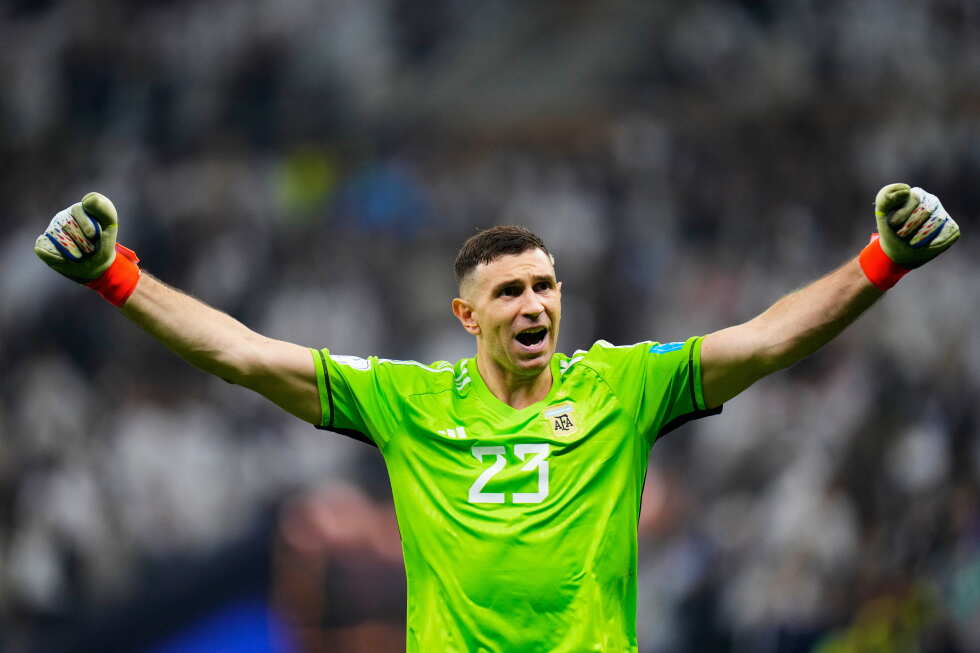
As the 2026 World Cup across the United States, Mexico and Canada approaches, all eyes are turning to Argentina’s polarizing star goalkeeper Emiliano “Dibu” Martínez — a player whose competitive fire and provocative on-pitch tactics have made him a national hero to some and a divisive figure to others.
Long before lifting the 2022 FIFA World Cup trophy in Qatar, Martínez’s signature style of unsetting opponents began to take shape in his youth. Growing up playing in tournaments in the seaside resort town of Mar del Plata, south of Buenos Aires, Martínez already showed the unconventional competitive streak that would define his career. One of his earliest coaches, Jorge Peta, revealed that even as a child, if Martínez felt he was not being challenged enough by opposing forwards, he would intentionally give up loose rebounds to draw more shots on goal. Peta also noted that the young goalkeeper was already known for his constant chatter to throw attackers off their game.
Martínez climbed to global stardom through an unlikely path. As a teenager, he left Argentina without ever playing a match in the country’s top domestic division to join English Premier League side Arsenal. For years, he struggled to earn a starting spot with the London club, bouncing between loan spells at lower-division English sides including Oxford United, Sheffield Wednesday, Rotherham United and Reading. It was not until the COVID-19 pandemic that Argentine senior national team manager Lionel Scaloni took a chance on the relatively unknown keeper, handing him his senior international debut in a 2022 World Cup qualifier against Chile in June 2021. From that first cap, the starting position in Argentina’s goal belonged exclusively to Martínez.
It did not take long for Martínez to prove his worth on the big stage. In the 2021 Copa América semifinal against Colombia, he set the tone for his penalty shootout dominance by telling Colombian defender Davinson Sánchez “I am sorry, but I will stop you, bro” before saving three penalties to carry Argentina to the final, which they would go on to win. Two years later at the 2022 World Cup in Qatar, Martínez turned this psychological gameplan into global legend. In the heated quarterfinal match against the Netherlands, dubbed the “Battle of Lusail”, Martínez used his imposing 6-foot-4 frame and signature distraction tactics to save penalties from Virgil van Dijk and Steven Berghuis, celebrating his stops with a viral dance that would later be imitated by children across Argentina.
His most iconic performance came in the 2022 World Cup final against France, a back-and-forth classic that saw Kylian Mbappé score a late hat trick to force a penalty shootout. Martínez stood firm, saving Kingsley Coman’s opening penalty, then used a classic distraction tactic against Aurélien Tchouaméni: he tossed the ball away from the penalty spot to break the Frenchman’s concentration, and Tchouaméni sent his shot wide. His late point-blank save on Randal Kolo Muani in extra time will go down as one of the most clutch defensive stops in World Cup history, securing Argentina’s third world title. But alongside his heroic saves, the tournament also brought controversy: his over-the-top celebration after winning the Golden Glove award for best tournament goalkeeper drew widespread criticism from across the global soccer community.
That controversy has followed Martínez throughout his career. His go-to strategy of psychological warfare against penalty takers has not only divided fans and pundits, but also prompted rule changes from the sport’s global governing body. In the wake of the 2022 World Cup, FIFA introduced a formal code of conduct for goalkeepers during penalty shootouts, banning tactics meant to distract kickers, including delaying attempts and verbal intimidation. In 2024, the governing body suspended Martínez for two South American World Cup qualifying matches over offensive behavior and violations of fair play principles during fixtures against Chile and Colombia.
Critics of Martínez’s conduct include some of the biggest names in soccer. Legendary former Manchester United and Ajax goalkeeper Edwin van der Sar and iconic Italian manager Fabio Capello have publicly questioned his sportsmanship, while 1998 French World Cup winner Emmanuel Petit has even suggested the Aston Villa shot-stopper seek professional help to control his on-pitch emotions. For his part, Martínez says outside criticism has no impact on his approach to the game.
“What people think doesn’t affect me. They can have all their opinions, good or bad, but I know who I am, the kind of person I am,” Martínez told ESPN in a May 2025 interview. “Off the field, I’m a dad, a husband, a son, but on the field, I just want to win, nothing else.”
Argentina’s coaching staff has stood firmly behind their goalkeeper, who enters the 2026 World Cup as a established starter for Aston Villa, fresh off winning the 2024-25 UEFA Europa League title. Despite fracturing the ring finger on his right hand during the Europa League final against Freiburg, Martínez is cleared to play in Argentina’s opening Group J match against Algeria on June 16, where the side will also face Austria and Jordan in their bid to become the first men’s team in 60 years to win back-to-back World Cups.
Scaloni has made clear he values Martínez’s on-pitch contributions above any off-field criticism over his personality. “Everything else is part of his personality, and that’s that. We focus on the purely sporting aspect,” the manager said.
Even with the controversy, Martínez’s popularity among Argentine fans remains unmatched: on the eve of the 2026 tournament, his No. 23 jersey is one of the best-selling in the country, second only to Lionel Messi’s iconic No. 10. Messi himself has called Martínez “fundamental” to Argentina’s success, and named him “one of the best goalkeepers in the world.”
Looking ahead to the tournament and his legacy, Martínez says he is focused not just on winning another title, but on revitalizing interest in goalkeeping among young Argentine players. “The most important thing we take away from this is that Argentina will have many goalkeepers in the future,” Martínez said. “The love for goalkeeping has returned.”