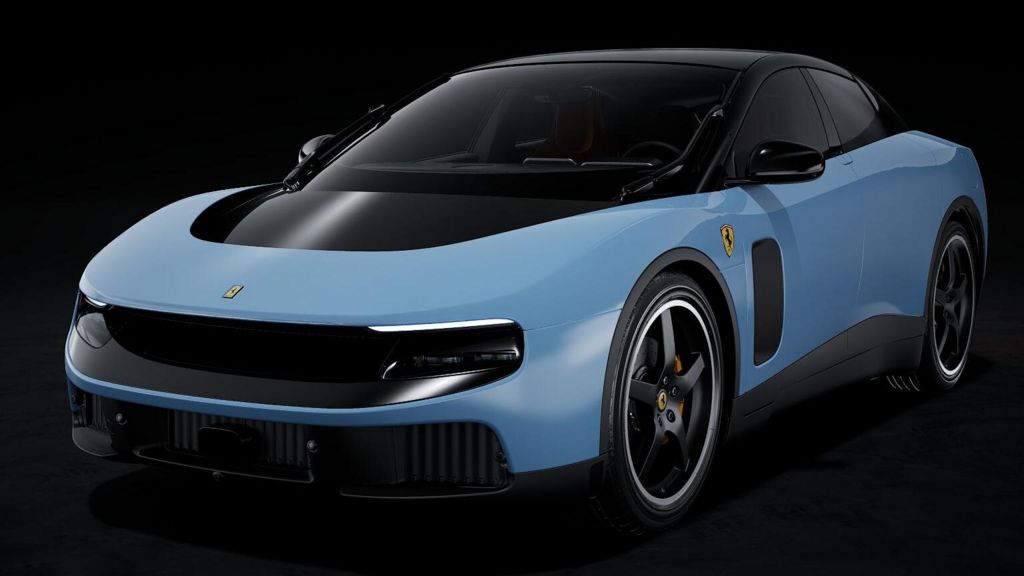
For decades, Ferrari has built its global legacy on roaring petrol-powered supercars, with a design language and driving experience that are instantly recognizable to enthusiasts around the world. That legacy is now at the center of a fierce public debate following the debut of the Ferrari Luce, the Italian luxury marque’s first all-electric vehicle and first five-seater model, conceived in collaboration with legendary iPhone designer Sir Jony Ive.
The launch of the highly anticipated EV was framed as a landmark cultural and industrial event, with Italian President Sergio Mattarella and Pope Leo invited to preview the $640,000 vehicle before its public unveiling. But within hours of the reveal, a wave of criticism spread across social media, boardrooms, and political circles, dragging Ferrari’s share price down 8% in a single trading day as meme after meme mocked the car’s unconventional design.
Unlike the low-slung, aerodynamic profile that defines classic Ferrari models, the Luce adopts a far more upright silhouette that has divided observers. Most notably for long-time fans, the electric powertrain eliminates the deep, roaring engine roar that has become synonymous with the prancing horse badge. That departure from Ferrari’s core identity has drawn condemnation from some of the brand’s most prominent insiders and supporters.
Former Ferrari chairman Luca Cordero di Montezemolo has publicly warned that the Luce risks destroying the Ferrari legend, calling for the company to remove its iconic badge from the model. Italy’s Deputy Prime Minister and Transport Minister Matteo Salvini echoed that skepticism, questioning what Enzo Ferrari, the brand’s founder, would make of the new vehicle, adding that it “looks like anything but a car from the prancing horse”. Shaun Baker, an Australian high-end luxury car dealer and lifelong Ferrari collector who has owned more than 50 of the marque’s vehicles, went even further, rebranding the Luce (pronounced “loo-chay”) as the “Loser”. “Ferrari was the ultimate aspirational brand to own,” Baker explained in an interview with the BBC. “But with the Luce, they’ve hurt their image irreparably.”
Social media critics have been equally scathing, with some describing the design as an “abomination” and others joking that Enzo Ferrari would rise from his grave to retake control of the company. Many compared the Luce’s design to far cheaper mass-market models, including the Nissan Leaf and Chinese budget EVs, claims that Ferrari CEO Benedetto Vigna has forcefully rejected. Other users have shared 10-second AI-generated redesigns of the Luce that they argue look far more like a traditional Ferrari than the official production model.
While a small group of observers have praised the Luce as a bold design masterclass, the negative reaction to the vehicle fits into a broader pattern of growing pushback against rapid EV transition among legacy luxury automakers. This is not the first time Vigna, who has led Ferrari for five years, has faced controversy over a radical new model line: when the company launched its first SUV, the Purosangue, in 2022, critics warned it would tarnish Ferrari’s exclusive supercar identity. Ultimately, the model defied expectations and sold strongly, opening up an entirely new profitable market segment for the brand.
Ferrari is also far from the first legacy luxury marque to face backlash over a radical electric concept. In 2024, Jaguar drew fierce criticism when it announced plans to transition to an all-EV luxury brand and unveiled the Type 00 concept, a model that bore little resemblance to the British carmaker’s classic design heritage. Like Vigna today, Jaguar’s leadership defended the radical shift, arguing that bold disruption was necessary to stand out in a crowded EV market.
Today, the Luce’s debut comes at a moment of massive upheaval for the global auto industry, with legacy Western brands facing mounting pressure from multiple directions. Many major automakers, including Lamborghini, Porsche, Honda, and Ford, have recently scaled back or scrapped their all-electric development programs amid softer-than-expected consumer demand and persistent buyer preference for petrol and hybrid powertrains. Following the Luce’s controversial reveal, Lamborghini CEO Stephan Winkelmann said his company’s decision to prioritize hybrid technology over full electrification was “the right way to go”, though he acknowledged that every brand must choose its own path.
On top of shifting demand, global luxury automakers also face unprecedented cutthroat competition from Chinese EV manufacturers, which benefit from lower production costs, aggressive government subsidies, and massive domestic supply chains that cut EV component manufacturing costs by at least 30% compared to production in other regions, according to the International Energy Agency. Chinese brands have rapidly expanded from the mass market into the premium luxury segment, launching high-performance electric supercars that undercut Western models on price while matching or exceeding their performance. For example, BYD’s $250,000 Yangwang U9 all-electric supercar accelerates from 0 to 60mph in just 2.3 seconds – faster than the Luce’s 2.5-second 0-60 time.
Industry analysts have offered mixed views on the Luce and Ferrari’s long-term strategy. Singapore-based auto analyst James Wong praised the Luce’s high-quality interior design but noted that the model as a whole is “unrecognizable” as a Ferrari, adding that the company would have benefited from testing the design with loyal fans before launch. At the same time, Wong suggested the massive media attention generated by the backlash could have been an intentional strategic choice to draw attention to Ferrari’s new direction.
Sustainable automotive industry expert Jessica Cheam noted that the Luce’s $640,000 price tag looks particularly steep at a time when consumers have access to increasingly luxurious, high-quality EVs at far lower price points. However, Cheam argued that the Luce is not aimed at Ferrari’s die-hard traditional fanbase: instead, it is targeted at younger, more EV-friendly buyers who may have never considered purchasing a Ferrari before. Wong echoed that logic, noting that the model’s radical departure from classic Ferrari design could help the brand attract entirely new customer segments that it has never reached before.
Vigna has defended the pricing and design of the Luce, arguing that the six-figure price tag is a fair reflection of the innovation built into the vehicle, and confirming that the company has already seen strong pre-launch interest from potential buyers. The BBC has requested additional comment from Ferrari on the wave of public criticism, but has not yet received a response.