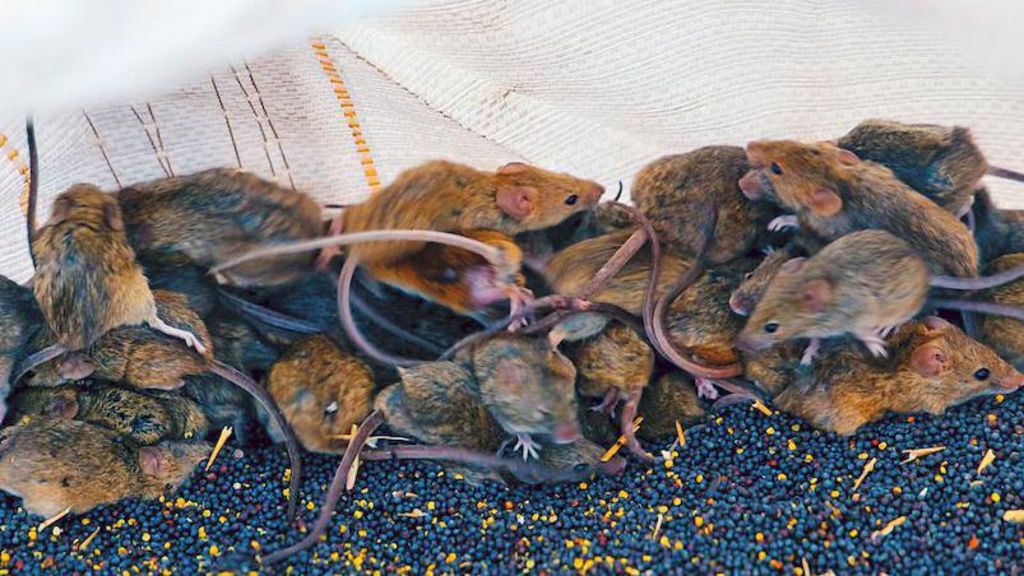
Across vast agricultural regions of Australia, an unprecedented mouse plague is unleashing chaos on farming communities, destroying growing crops and upending daily life for producers already grappling with cascading economic pressures from global geopolitical instability. The infestation, which first emerged in Western Australia’s key grain-growing zones in early 2026, has rapidly spread to neighboring South Australia, leaving widespread ruin in its wake and stretching the resilience of even the most seasoned agricultural operators.
This crisis comes on top of already significant strain: unpredictable fuel and fertilizer supplies, driven by the ongoing US-Israeli conflict with Iran, have sent input costs soaring for Australian farmers, leaving little room in tight budgets to absorb new, unexpected expenses. To combat the invasion, producers have poured hundreds of thousands of dollars into emergency responses, from re-sowing crops that mice have devoured to laying poison-laced sterile bait across their paddocks – costs that extend far beyond the price of materials themselves.
Geoff Cosgrove, a 25-year farming veteran who operates a 14,000-hectare mixed grain farm in Mingenew, Western Australia, describes the 2026 infestation as far more severe than the last major plague that hit eastern Australia in 2021. That 2021 outbreak was already record-breaking for parts of New South Wales and Queensland, so severe that entire prison populations had to be relocated after rodents caused catastrophic structural damage to correctional facilities. For Cosgrove, the harm is not just financial: the invasion has seeped into every corner of daily life, leaving him unable to find respite even inside his home. “They do play with your mind – running around at night, in the ceiling, the air conditioning units. You can hear them and you can smell them – it’s like a decaying body,” he says. Like many farmers, Cosgrove only twice had to deploy large-scale baiting across his property in 25 years – a fact that underscores how extreme this year’s outbreak is. He holds out cautious hope that dropping winter temperatures will naturally reduce rodent populations.
Two hours north of Cosgrove’s operation, Belinda Eastough, a 59-year-old agronomist and fourth-generation farmer with 40 years of experience, has watched the plague unfold on her 5,500-hectare Geraldton-region property, one of the areas hit hardest by the infestation. Eastough says a confluence of ideal conditions for mouse population growth set the stage for this year’s crisis. After a record-breaking 2025 harvest, large amounts of grain were spilled across paddocks, creating an abundant, accessible food source. Unseasonable summer rain then triggered the growth of new green vegetation, giving rodents an even more diverse food supply. “So instead of just steak, they got steak and salad. Basically, the mice were in absolute mouse heaven,” she explains. Today, she estimates between 8,000 and 10,000 mice per hectare in her canola fields – a number that dwarfs the 800-per-hectare threshold researchers use to define a plague.
The timing of the outbreak could not be worse: autumn is the critical planting window for Australia’s annual grain crop, much of which is exported to Southeast Asia or used for domestic food production. Mice target freshly sown seeds immediately after planting, meaning entire rows of crops can be wiped out in less than 12 hours if baiting is not completed right after seeding. Like other producers, Eastough says the plague comes as an additional blow on top of already skyrocketing input costs. “We’re paying twice for fuel now than we were paying two, three months ago,” she notes. “The mouse thing is another thing thrown on top, another headache.”
Steve Henry, a mouse control specialist and research officer with Australia’s national science agency CSIRO, confirms the severity of the outbreak matches the on-the-ground reports from farmers. On a recent assessment trip to Western Australia’s cropping zones, Henry counted 30 to 40 active mouse burrows along a 100-meter transect, translating to at least 3,000 to 4,000 burrows per hectare – a population density unseen in recent decades. Henry explains that mice’s extraordinary reproductive capacity is what allows populations to explode so rapidly: rodents reach breeding age at just six weeks old, produce six to 10 offspring every 19 to 21 days, and can become pregnant again just two to three days after giving birth, allowing generations of offspring to develop simultaneously.
Beyond the massive economic damage, Henry emphasizes the underrecognized psychological toll of a mouse plague, which is far more invasive than other common farming crises such as drought. “If you’re dealing with a drought, you can go inside and close the door and turn on the air conditioner and get some level of respite,” he says. “But if you’re dealing with mice, you go inside, close the door, go to your cupboard, and the mice are in the cupboard … You go to sleep at night, and the mice are running across your bed.”
After months of lobbying from farming communities, Australia’s national environmental regulator has finally approved access to higher-strength rodent bait for affected producers, a move welcomed by desperate farmers across the impacted regions. Retired 67-year-old farmer Damian Ryan, who has worked the land in Morawa, north of Perth, for 50 years, says he has never seen an infestation this bad. Ryan, who currently catches 20 to 30 mice a day inside his home and 150 more in his shed each day, calls the current situation “plague proportions” unmatched in his decades of farming. “You drive around at night and you just see mice running everywhere,” he says.
In recent days, farmers have reported early signs of relief, coinciding with the rollout of the stronger bait, cooler seasonal temperatures, and forecast rain. Many, like Cosgrove, are optimistic that the worst will soon pass as winter sets in, but the economic and emotional damage of the 2026 plague will leave long-lasting impacts on Australia’s farming communities already pushed to the brink by global instability.